Question 7
Find the area (in square metres) occupied by your school playground.
- A school playground is typically rectangular in shape.
- To find the area occupied by a rectangle, measure or assume its length and breadth (width) in metres, then multiply them together:
- The resulting area is expressed in square metres ().
Step 1 · Assume the Dimensions of the Playground
Let the rectangular playground have:
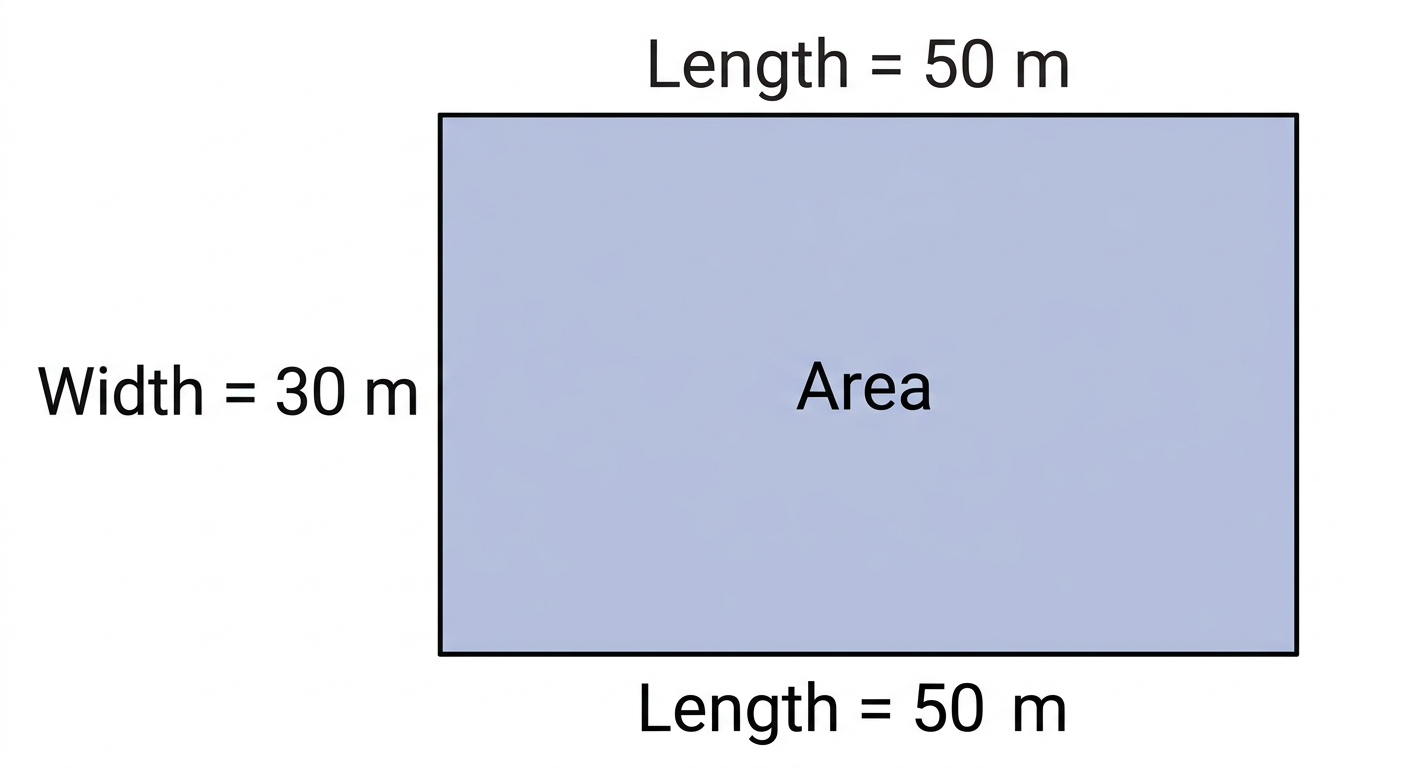
Step 2 · Calculate the Area
Using the area formula for a rectangle
Substitute the dimensions
- Unit Errors: Writing the unit of area as metres () instead of square metres ().
- Confusing Perimeter and Area: Calculating the perimeter () instead of the area ().
More questions in A
Deep Dive: In races, usually there is a common finish line for all the runners. Here are two square running tracks with the inner track of each side and outer track of each side. The common finishing line for both runners is shown by the flags in the figure which are in the center of one of the sides of the tracks.
If the total race is of , then we have to find out where the starting positions of the two runners should be on these two tracks so that they both have a common finishing line after they run for . Mark the starting points of the runner on the inner track as 'A' and the runner on the outer track as 'B'.
Estimate and Verify
Take a rough sheet of paper or a sheet of newspaper. Make a few random shapes by cutting the paper in different ways. Estimate the total length of the boundaries of each shape then use a scale or measuring tape to measure and verify the perimeter for each shape.
Find various objects from your surroundings that have regular shapes and find their perimeters. Also, generalise your understanding for the perimeter of other regular polygons.
Draw a circle on a graph sheet with diameter (breadth) of length 3. Count the squares and use them to estimate the area of the circular region.
Try using different shapes (triangle and rectangle) to fill the given space (without overlaps and gaps) and find out the merits associated with using a square shape to find the area rather than another shape. List out the points that make a square the best shape to use to measure area.
Find the area (in square metres) of the floor outside of the corridor.
Find the area (in square metres) occupied by your school playground.
On a squared grid paper (1 square = 1 square unit), make as many rectangles as you can whose lengths and widths are a whole number of units such that the area of the rectangle is 24 square units.
a. Which rectangle has the greatest perimeter?
b. Which rectangle has the least perimeter?
c. If you take a rectangle of area 32 sq cm, what will your answers be? Given any area, is it possible to predict the shape of the rectangle with the greatest perimeter as well as the least perimeter? Give examples and reasons for your answer.
Draw a rectangle on a piece of paper and draw one of its diagonals. Cut the rectangle along that diagonal and get two triangles.
- Check! whether the two triangles overlap each other exactly. Do they have the same area?
Try this with more rectangles having different dimensions. You can check this for a square as well.
- Can you draw any inferences from this exercise? Please write it here.
Draw suitable triangles on grid paper to verify your inferences and relationships observed in the above exercises.