Question 1
Why does this happen? Do you think it will happen forever?
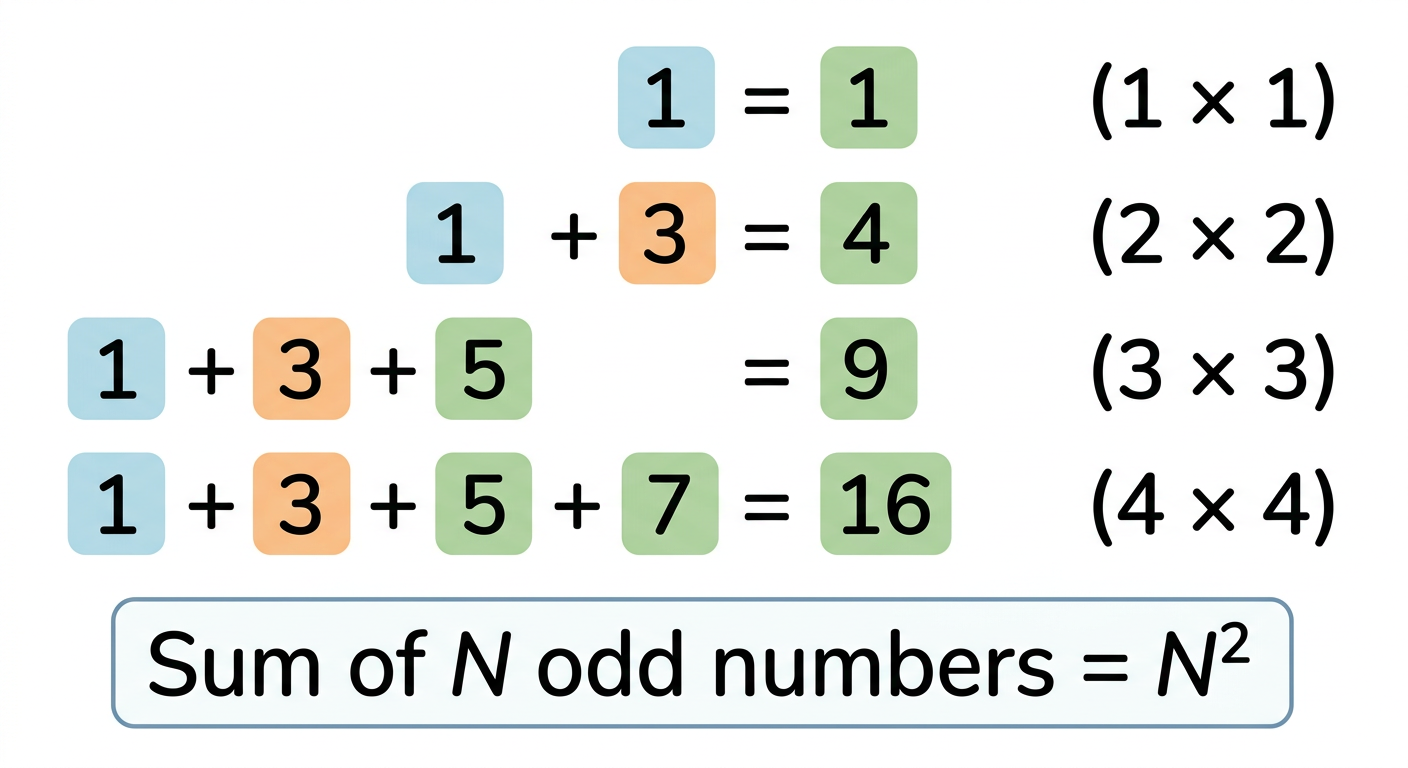
- Adding consecutive odd numbers starting from always results in a perfect square:
- Visually, adding the next odd number to an existing square of blocks wraps around two adjacent sides plus one corner block to form the next square.
- Since every positive integer has a unique next odd number , this geometric and algebraic pattern continues forever.
Step 1 · Identify the Pattern of Consecutive Odd Numbers
Observing the sum of consecutive odd numbers:
In general, the sum of the first odd numbers is:
Step 2 · Geometric Reason for the Square Pattern
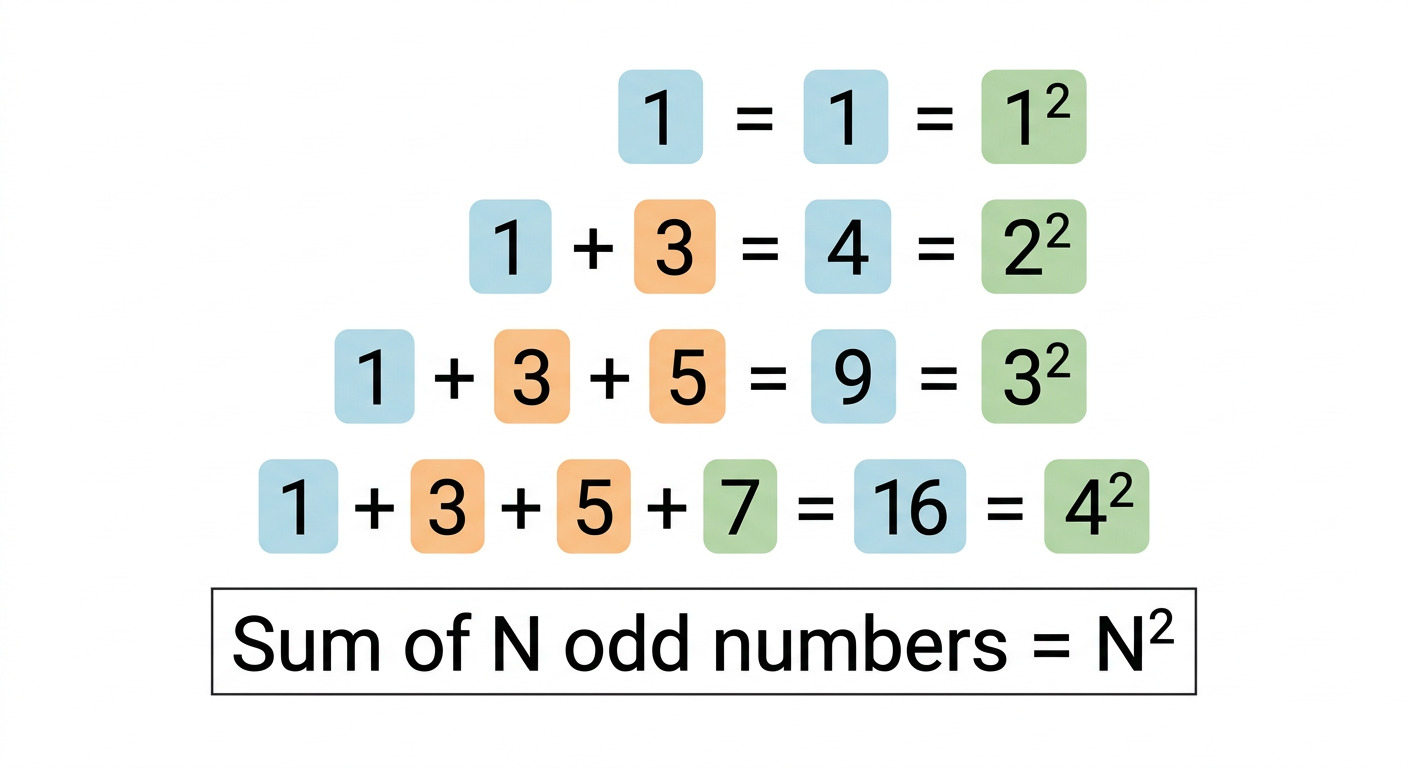
Representing squares using unit blocks:
- First odd number (): Forms a square ( block).
- Second odd number (): Adding blocks around the square forms a square ( blocks).
- Third odd number (): Adding blocks around the square forms a square ( blocks).
- Fourth odd number (): Adding blocks around the square forms a square ( blocks).
To expand an square to an square, we add blocks along the top, blocks along the side, and block at the corner. The total number of blocks added is always an odd number ().
Step 3 · Verify That the Pattern Continues Forever
For any square of size , adding the next odd number gives:
Since this algebraic identity holds for every positive integer , the pattern never ends and will continue forever.
(i) It happens because adding the next odd number creates an L-shaped layer that perfectly completes an square. (ii) Yes, this will happen forever because holds for all positive integers .
- Starting from an Even Number or Skipping: The pattern only holds when adding consecutive odd numbers starting strictly from (e.g., , which is not a square number).
- Missing the Corner Block: Forgetting that expanding an grid requires blocks on each of the two sides plus corner block, totaling blocks.
More questions in IT
Why does this happen? Do you think it will happen forever?
How can we partition the dots in a square grid into odd numbers of dots: ?
By drawing a similar picture, can you say what is the sum of the first 10 odd numbers?
Now by imagining a similar picture, or by drawing it partially, as needed, can you say what is the sum of the first 100 odd numbers?
Can you find a similar pictorial explanation?