Question 4
Now by imagining a similar picture, or by drawing it partially, as needed, can you say what is the sum of the first 100 odd numbers?
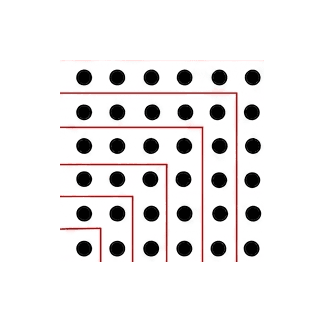
- Adding consecutive odd numbers starting from forms square numbers of increasing sizes.
- The sum of the first odd numbers is always equal to .
- To find the sum of the first odd numbers, we apply this rule with .
Step 1 · Observe the Geometric Pattern
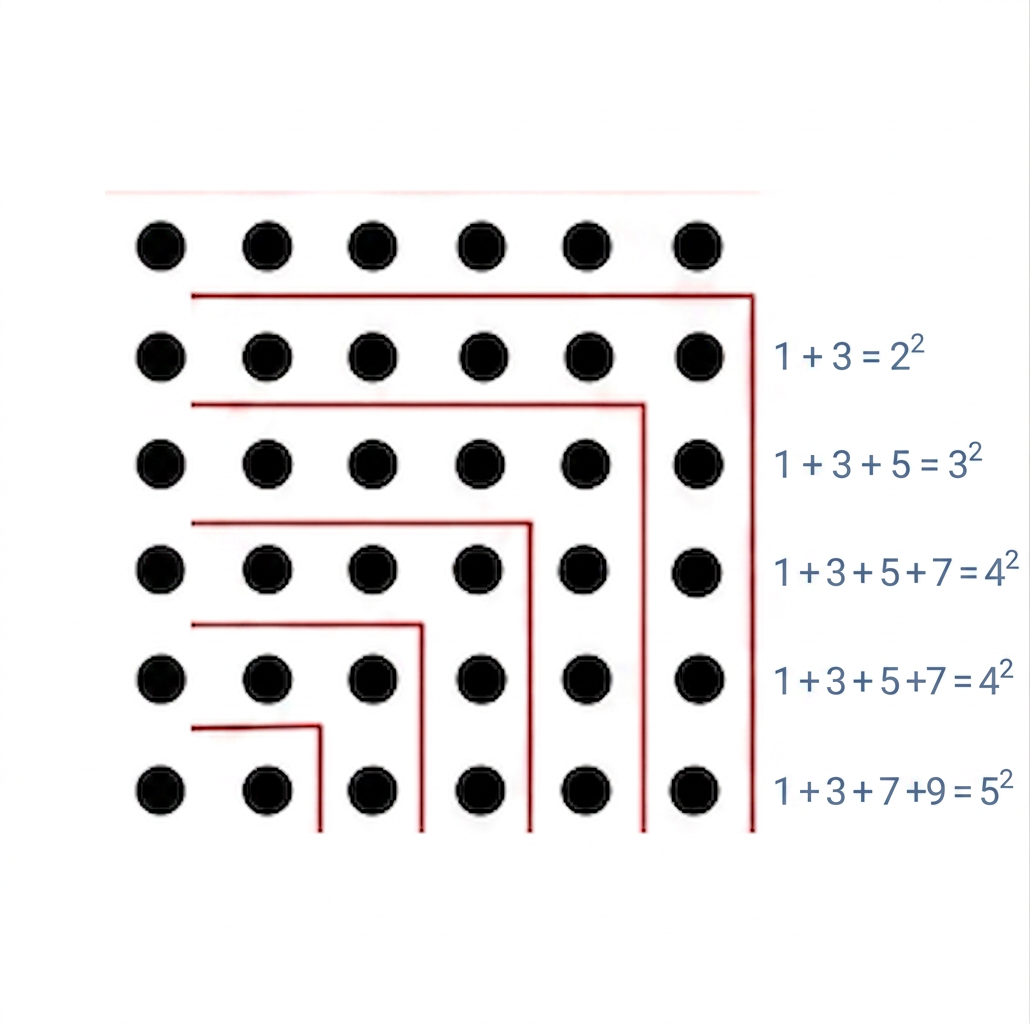
Observing the sum of the first few odd numbers:
Step 2 · Establish the General Rule
From the pattern, the sum of the first odd numbers is:
Step 3 · Calculate the Sum of First 100 Odd Numbers
For the first odd numbers, substitute :
- Adding Manually: Attempting to manually add all numbers instead of using the formula .
- Confusing the -th Term with the Sum: The odd number is , while the sum of the first odd numbers is .
More questions in IT
Why does this happen? Do you think it will happen forever?
How can we partition the dots in a square grid into odd numbers of dots: ?
By drawing a similar picture, can you say what is the sum of the first 10 odd numbers?
Now by imagining a similar picture, or by drawing it partially, as needed, can you say what is the sum of the first 100 odd numbers?
Can you find a similar pictorial explanation?