Question 5
Can you find a similar pictorial explanation?

- A symmetric sum of consecutive numbers counting up from to a peak number and back down to (such as ) always equals .
- Geometrically, this can be represented as an square array of dots, where each term in the sum represents the number of dots along successive diagonal lines in the square.
- The largest number in the sequence gives the side length of the square array.
Step 1 · Visualising Number Patterns as Dot Squares
Arranging dots into square arrays shows how symmetric sums form perfect squares: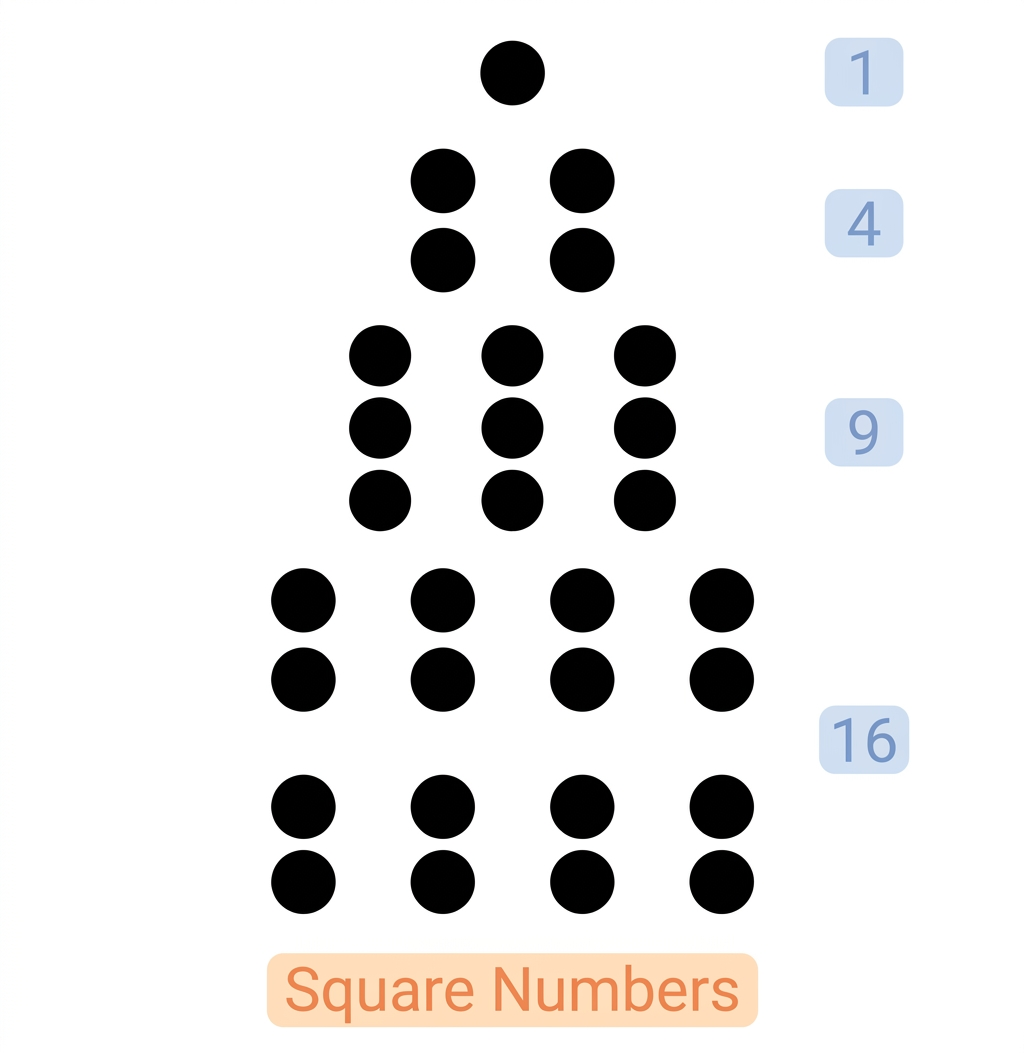
The largest number in the sum gives the side length of the square.
Step 2 · Representing the Square Pattern
A square grid with dots in each row and dots in each column has:
This corresponds to the symmetric sum:
The largest number in the sum is , which matches the side length of the square.
Yes, a symmetric sum counting up to and back to forms an square of dots with total dots:
- Double-counting the peak number: The peak number in the sequence appears only once in the sum (e.g., in , the number appears once).
- Confusing the sum with consecutive sum: This pattern only works for symmetric "pyramid" sums (), not a simple sum of first numbers ().
- Misidentifying the side length: The side length of the square is the maximum (central) number in the sequence, not the number of terms.
More questions in IT
Why does this happen? Do you think it will happen forever?
How can we partition the dots in a square grid into odd numbers of dots: ?
By drawing a similar picture, can you say what is the sum of the first 10 odd numbers?
Now by imagining a similar picture, or by drawing it partially, as needed, can you say what is the sum of the first 100 odd numbers?
Can you find a similar pictorial explanation?