Question 17
What happens when you start to add up hexagonal numbers, i.e., take 1, 1 + 7, 1 + 7 + 19, 1 + 7 + 19 + 37, ... ? Which sequence do you get? Can you explain it using a picture of a cube?
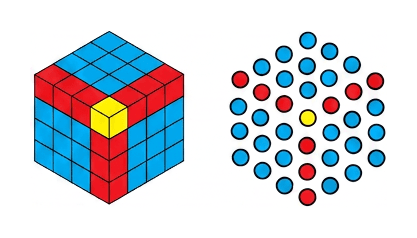
Adding up hexagonal numbers gives a sequence of cubic numbers.
Step 1 — Calculate the sums
Let us add the given hexagonal numbers one by one.
The first hexagonal number is 1.
Next, we add the first two hexagonal numbers.
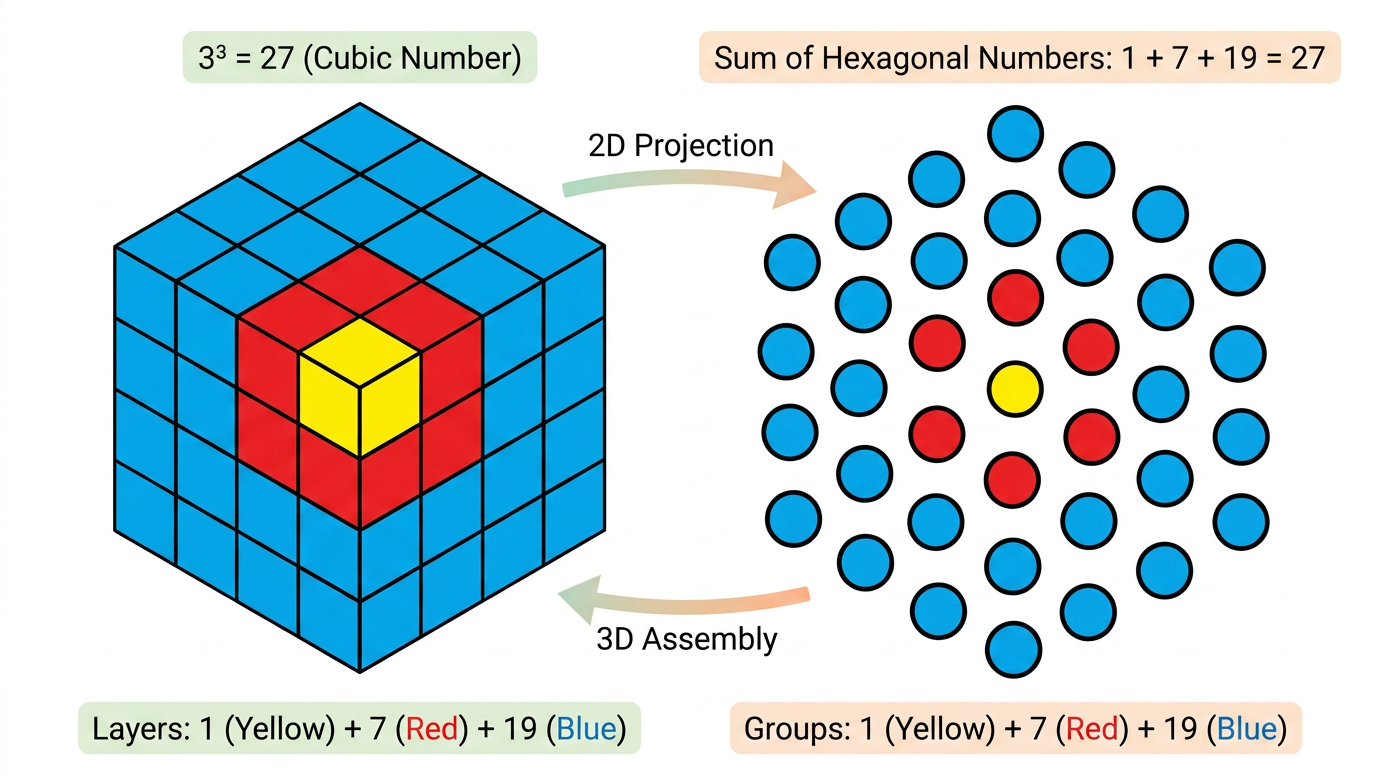
Then, we add the first three hexagonal numbers.
Finally, we add the first four hexagonal numbers.
Step 2 — Identify the sequence
The sums we found are 1, 8, 27, 64. This sequence is , , , . These are cubic numbers ().
Step 3 — Explain with the cube picture
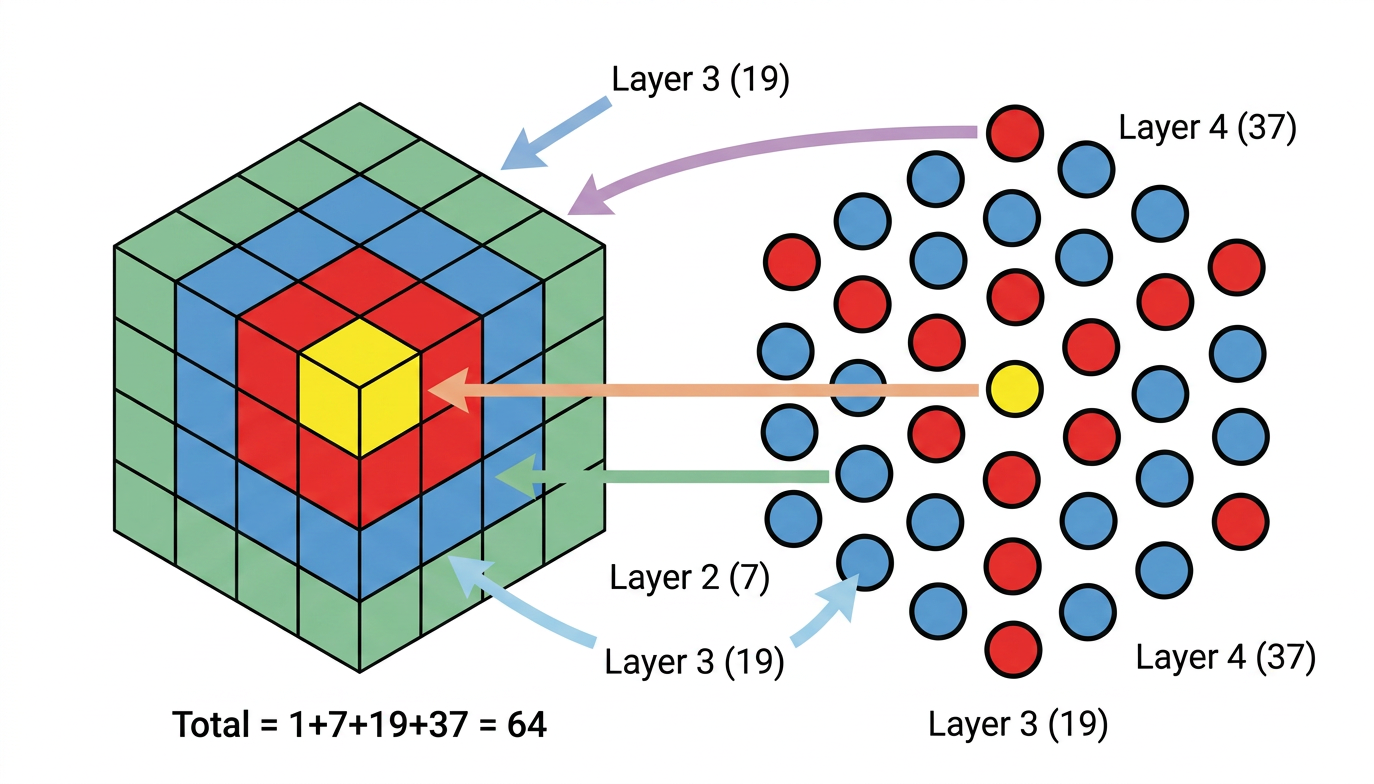
Look at the cube picture. It shows a large cube. This large cube is made of many small unit cubes. The cube in the picture is a cube. It has small cubes in total.
We can think of building this large cube layer by layer. First, we start with a tiny cube. This has 1 small cube. This is the first hexagonal number.
Next, we add cubes around the cube. We make a cube. We added new cubes. This is the second hexagonal number.
Then, we add more cubes around the cube. We make a cube. We added new cubes. This is the third hexagonal number.
Finally, we add even more cubes around the cube. We make a cube. We added new cubes. This is the fourth hexagonal number.
The total number of cubes in the cube is 64. This total is exactly the sum of the hexagonal numbers we added: . Each hexagonal number represents a "shell" of cubes. When we add these shells, they build up a complete cube.
Answer
When you start to add up hexagonal numbers, you obtain a sequence of cubic numbers.
(i) The sums are 1, 8, 27, 64. (ii) This sequence is the cubic numbers (). (iii) Each hexagonal number represents a layer of cubes. Adding these layers builds a larger cube. For example, , which is a cube.
More questions in FIO
Can you think of other examples where mathematics helps us in our everyday lives?
How has mathematics helped propel humanity forward? (You might think of examples involving: carrying out scientific experiments; running our economy and democracy; building bridges, houses or other complex structures; making TVs, mobile phones, computers, bicycles, trains, cars, planes, calendars, clocks, etc.)
Can you recognise the pattern in each of the sequences in Table 1?
Rewrite each sequence of Table 1 in your notebook, along with the next three numbers in each sequence! After each sequence, write in your own words what is the rule for forming the numbers in the sequence.
Copy the pictorial representations of the number sequences in Table 2 in your notebook, and draw the next picture for each sequence!
Why are 1, 3, 6, 10, 15, ... called triangular numbers? Why are 1, 4, 9, 16, 25, ... called square numbers or squares? Why are 1, 8, 27, 64, 125, ... called cubes?
You will have noticed that 36 is both a triangular number and a square number! That is, 36 dots can be arranged perfectly both in a triangle and in a square. Make pictures in your notebook illustrating this!
This shows that the same number can be represented differently, and play different roles, depending on the context. Try representing some other numbers pictorially in different ways!
What would you call the following sequence of numbers?
That's right, they are called hexagonal numbers! Draw these in your notebook. What is the next number in the sequence?
Can you think of pictorial ways to visualise the sequence of Powers of 2? Powers of 3?
Can you find a similar pictorial explanation for why adding counting numbers up and down, i.e., 1, 1 + 2 + 1, 1 + 2 + 3 + 2 + 1, ..., gives square numbers?
By imagining a large version of your picture, or drawing it partially, as needed, can you see what will be the value of 1 + 2 + 3 + ... + 99 + 100 + 99 + ... + 3 + 2 + 1?
Which sequence do you get when you start to add the All 1's sequence up? What sequence do you get when you add the All 1's sequence up and down?
Which sequence do you get when you start to add the counting numbers up? Can you give a smaller pictorial explanation?
What happens when you add up pairs of consecutive triangular numbers? That is, take 1 + 3, 3 + 6, 6 + 10, 10 + 15, ... Which sequence do you get? Why? Can you explain it with a picture?
What happens when you start to add up powers of 2 starting with 1, i.e., take 1, 1 + 2, 1 + 2 + 4, 1 + 2 + 4 + 8, ... ? Now add 1 to each of these numbers—what numbers do you get? Why does this happen?
What happens when you multiply the triangular numbers by 6 and add 1? Which sequence do you get? Can you explain it with a picture?
What happens when you start to add up hexagonal numbers, i.e., take 1, 1 + 7, 1 + 7 + 19, 1 + 7 + 19 + 37, ... ? Which sequence do you get? Can you explain it using a picture of a cube?
Find your own patterns or relations in and among the sequences in Table 1. Can you explain why they happen with a picture or otherwise?
Can you recognise the pattern in each of the sequences in Table 3?
Try and redraw each sequence in Table 3 in your notebook. Can you draw the next shape in each sequence? Why or why not? After each sequence, describe in your own words what is the rule or pattern for forming the shapes in the sequence.
Count the number of sides in each shape in the sequence of Regular Polygons. Which number sequence do you get? What about the number of corners in each shape in the sequence of Regular Polygons? Do you get the same number sequence? Can you explain why this happens?
Count the number of lines in each shape in the sequence of Complete Graphs. Which number sequence do you get? Can you explain why?
How many little squares are there in each shape of the sequence of Stacked Squares? Which number sequence does this give? Can you explain why?
How many little triangles are there in each shape of the sequence of Stacked Triangles? Which number sequence does this give? Can you explain why? (Hint: In each shape in the sequence, how many triangles are there in each row?)
To get from one shape to the next shape in the Koch Snowflake sequence, one replaces each line segment '—' by a 'speed bump' _/_ . As one does this more and more times, the changes become tinier and tinier with very very small line segments. How many total line segments are there in each shape of the Koch Snowflake? What is the corresponding number sequence? (The answer is 3, 12, 48, ..., i.e., 3 times Powers of 4; this sequence is not shown in Table 1.)