Question 11
In Fig. 6.40, is a point on side produced of an isosceles triangle with . If and , prove that .
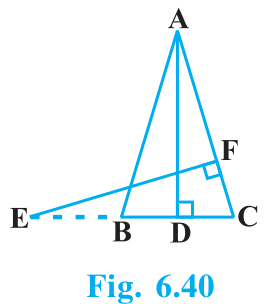
- In , since , the angles opposite to the equal sides are equal: .
- Both and contain a right angle () formed by the perpendiculars and .
- By showing two pairs of corresponding angles are equal, we establish similarity using the AA (Angle-Angle) criterion.
Step 1 · Equate Base Angles of the Isosceles Triangle
Given an isosceles triangle with .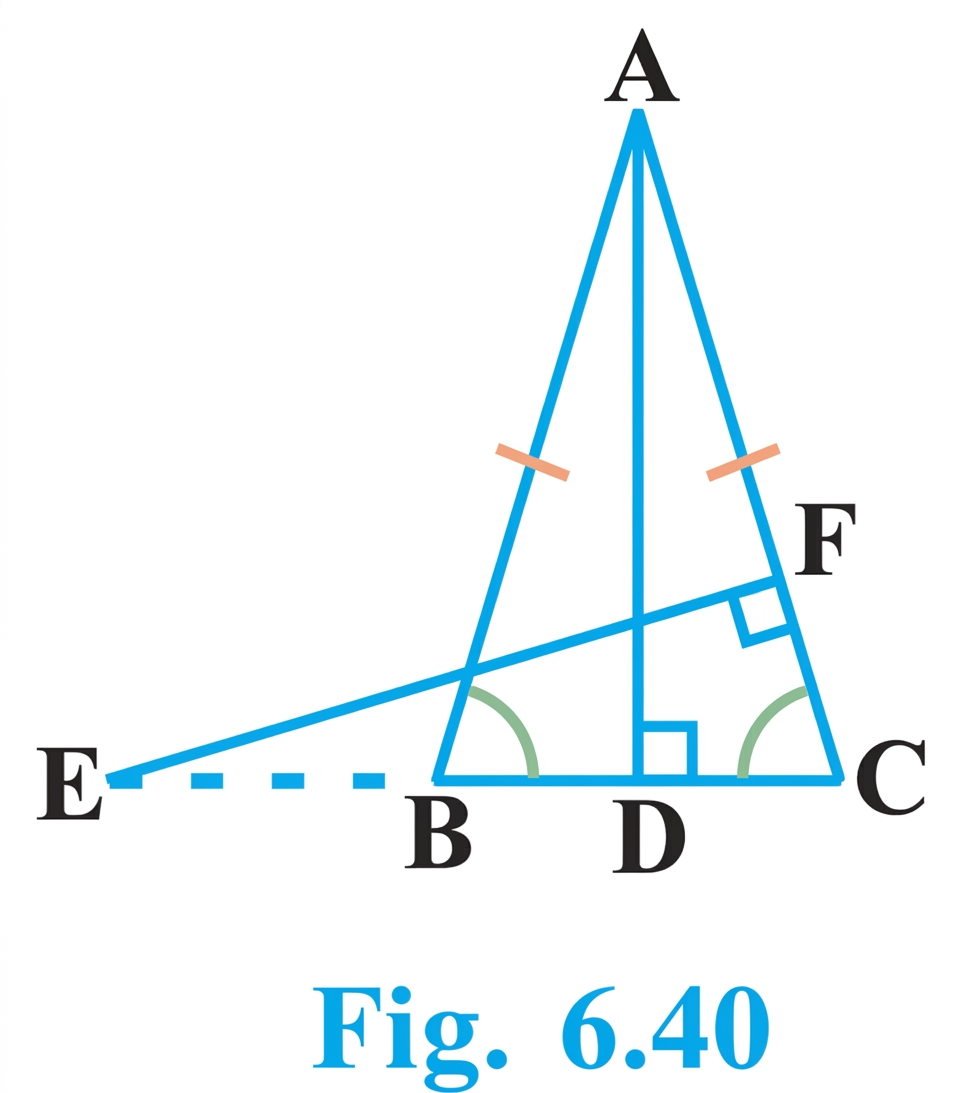
Since angles opposite to equal sides in a triangle are equal:
Since lies on , and lie on the same line with on , this can be written as:
Step 2 · Apply AA Similarity Criterion
In and :
Therefore, by AA similarity criterion:
- Vertex Correspondence Error: Not maintaining correct vertex order in the similarity statement. is correct because and .
- Isosceles Property Confusion: Incorrectly assuming instead of . Angles opposite to equal sides and are and respectively.
More questions in Exercise 6.3
- State which pairs of triangles in Fig. 6.34 are similar. Write the similarity criterion used by you for answering the question and also write the pairs of similar triangles in the symbolic form :
- In Fig. 6.35, , and . Find , and .
- Diagonals and of a trapezium with intersect each other at the point . Using a similarity criterion for two triangles, show that .
- In Fig. 6.36, and . Show that .
S and T are points on sides and of such that . Show that .
- In Fig. 6.37, if , show that .
- In Fig. 6.38, altitudes and of intersect each other at the point . Show that:
(i)
(ii)
(iii)
(iv)
- E is a point on the side AD produced of a parallelogram ABCD and BE intersects CD at F. Show that .
- In Fig. 6.39, ABC and AMP are two right triangles, right angled at B and M respectively. Prove that:
(i)
(ii)
- CD and GH are respectively the bisectors of and such that D and H lie on sides AB and FE of and respectively. If , show that:
(i)
(ii)
(iii)
In Fig. 6.40, is a point on side produced of an isosceles triangle with . If and , prove that .
Sides AB and BC and median AD of a triangle ABC are respectively proportional to sides PQ and QR and median PM of (see Fig. 6.41). Show that .
D is a point on the side of a triangle such that . Show that .
Sides and and median of a triangle are respectively proportional to sides and and median of another triangle . Show that .
A vertical pole of length casts a shadow long on the ground and at the same time a tower casts a shadow long. Find the height of the tower.
If and are medians of triangles and , respectively where , prove that