Question 13
D is a point on the side BC of a triangle ABC such that ADC = BAC. Show that .
We will use the following similarity criterion:
- AA (Angle-Angle): If two angles of one triangle are equal to two corresponding angles of another triangle, the triangles are similar.
We will use the AA similarity criterion to prove that two triangles are similar.
Step 1 — Identify similar triangles
Let's look at the two triangles. We consider ADC and BAC. We are given that ADC is equal to BAC. Both triangles share a common angle. The angle ACD is the same as BCA. So, two angles of ADC are equal to two angles of BAC. This means the triangles are similar by AA similarity.
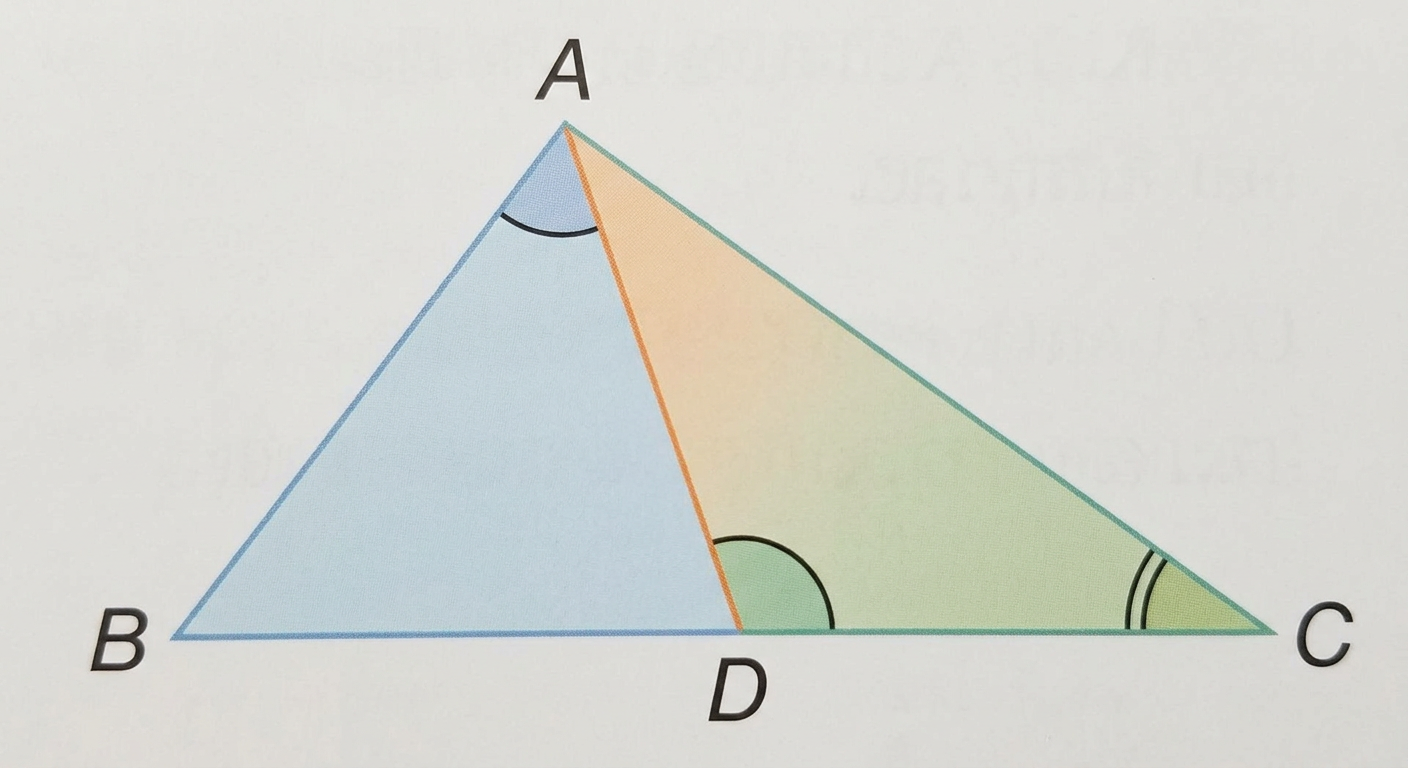
Step 2 — Use side proportionality
We know that corresponding sides of similar triangles are proportional. Let's write down the ratios of the sides. From ADC BAC, we have:
We need to prove . Let's take the second and third parts of the proportion.
Now, we can cross-multiply these terms.
Answer
The statement is proven.
More questions in Exercise 6.3
- State which pairs of triangles in Fig. 6.34 are similar. Write the similarity criterion used by you for answering the question and also write the pairs of similar triangles in the symbolic form :
- In Fig. 6.35, , and . Find , and .
- Diagonals AC and BD of a trapezium ABCD with intersect each other at the point O. Using a similarity criterion for two triangles, show that .
- In Fig. 6.36, and . Show that .
- S and T are points on sides PR and QR of such that . Show that .
- In Fig. 6.37, if , show that .
- In Fig. 6.38, altitudes AD and CE of intersect each other at the point P. Show that:
(i) (ii) (iii) (iv)
- E is a point on the side AD produced of a parallelogram ABCD and BE intersects CD at F. Show that .
- In Fig. 6.39, ABC and AMP are two right triangles, right angled at B and M respectively. Prove that:
(i) (ii)
- CD and GH are respectively the bisectors of and such that D and H lie on sides AB and FE of and respectively. If , show that:
(i) (ii) (iii)
In Fig. 6.40, E is a point on side CB produced of an isosceles triangle ABC with AB = AC. If AD BC and EF AC, prove that ABD ECF.
Sides AB and BC and median AD of a triangle ABC are respectively proportional to sides PQ and QR and median PM of PQR (see Fig. 6.41). Show that ABC PQR.
D is a point on the side BC of a triangle ABC such that ADC = BAC. Show that .
Sides AB and AC and median AD of a triangle ABC are respectively proportional to sides PQ and PR and median PM of another triangle PQR. Show that ABC PQR.
A vertical pole of length 6 m casts a shadow 4 m long on the ground and at the same time a tower casts a shadow 28 m long. Find the height of the tower.
If AD and PM are medians of triangles ABC and PQR, respectively where ABC PQR, prove that