Question 5
In a classroom, 4 friends are seated at the points , , and as shown in Fig. 7.8. Champa and Chameli walk into the class and after observing for a few minutes Champa asks Chameli, “Don’t you think is a square?” Chameli disagrees. Using distance formula, find which of them is correct.
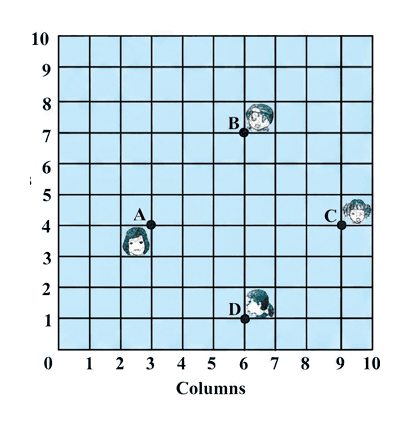
- The seating coordinates of the four friends from the classroom grid are , , , and .
- To determine if quadrilateral is a square, we use the distance formula:
- A quadrilateral is a square if:
- All four sides are equal:
- Both diagonals are equal:
Step 1 · Identify the Coordinates
From the given classroom grid, the coordinates of the four points are:
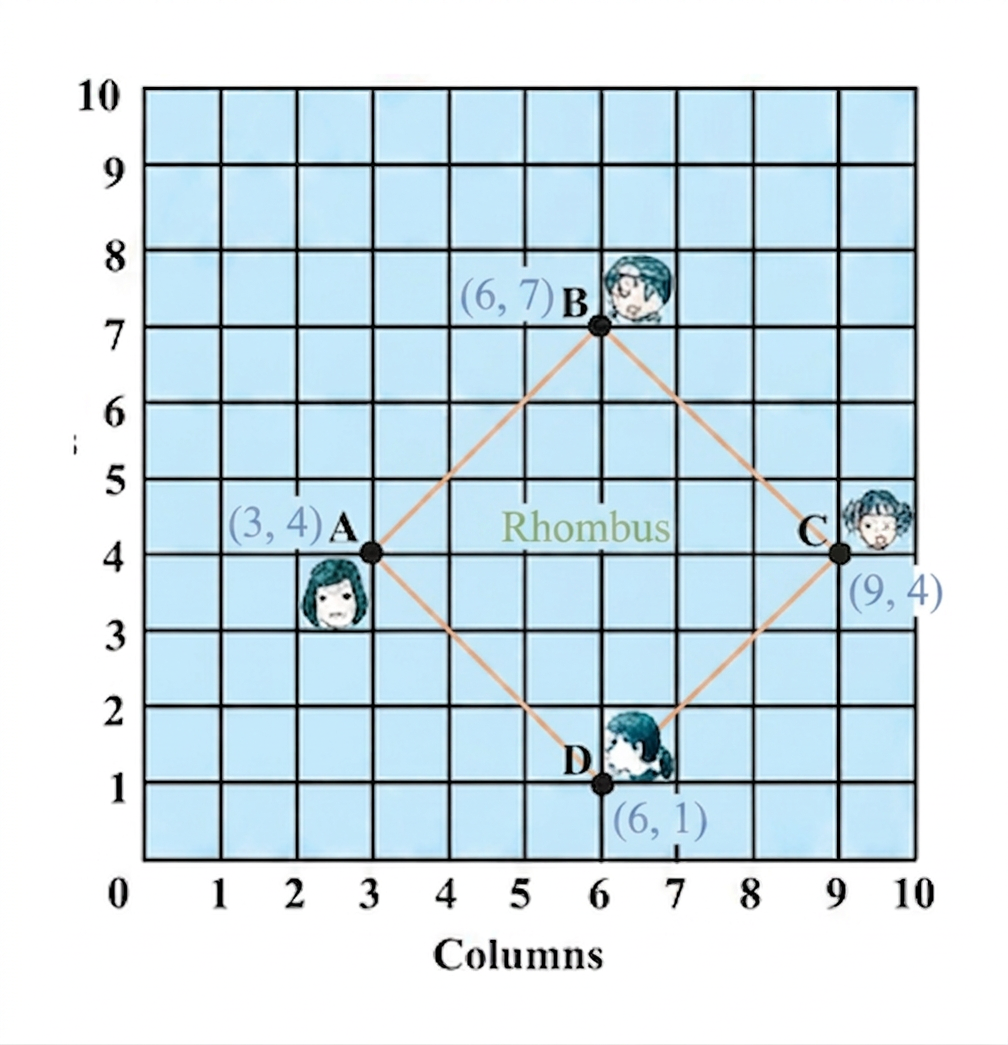
Step 2 · Calculate the Lengths of the Four Sides
Using the distance formula :
Since , all four sides are equal.
Step 3 · Calculate Diagonal Lengths and Conclude
Calculate the diagonals and :
Since all four sides are equal () and both diagonals are equal (), is a square.
Champa is correct ( is a square).
- Checking Only Sides: Showing that all four sides are equal proves is a rhombus, but it could still fail to be a square. You must also check that the diagonals are equal ().
- Swapping and Coordinates: Reading the grid row first instead of column first (e.g., writing instead of ).
- Sign Error When Squaring: Forgetting that negative numbers squared are positive, e.g. , not .
More questions in Exercise 7.1
Find the distance between the following pairs of points :
(i)
(ii)
(iii)
Find the distance between the points and . Can you now find the distance between the two towns and discussed in Section 7.2.
Determine if the points and are collinear.
Check whether , and are the vertices of an isosceles triangle.
In a classroom, 4 friends are seated at the points , , and as shown in Fig. 7.8. Champa and Chameli walk into the class and after observing for a few minutes Champa asks Chameli, “Don’t you think is a square?” Chameli disagrees. Using distance formula, find which of them is correct.
Name the type of quadrilateral formed, if any, by the following points, and give reasons for your answer:
(i)
(ii)
(iii)
Find the point on the -axis which is equidistant from and .
Find the values of for which the distance between the points and is 10 units.
If is equidistant from and , find the values of . Also find the distances and .
Find a relation between and such that the point is equidistant from the point and .