Question 4
Check whether , and are the vertices of an isosceles triangle.
- An isosceles triangle is a triangle that has at least two sides of equal length.
- Let the given points be , , and .
- To determine if is isosceles, we calculate the lengths of all three sides (, , and ) using the distance formula:
Step 1 · Calculate the length of side AB
Let the points be , , and .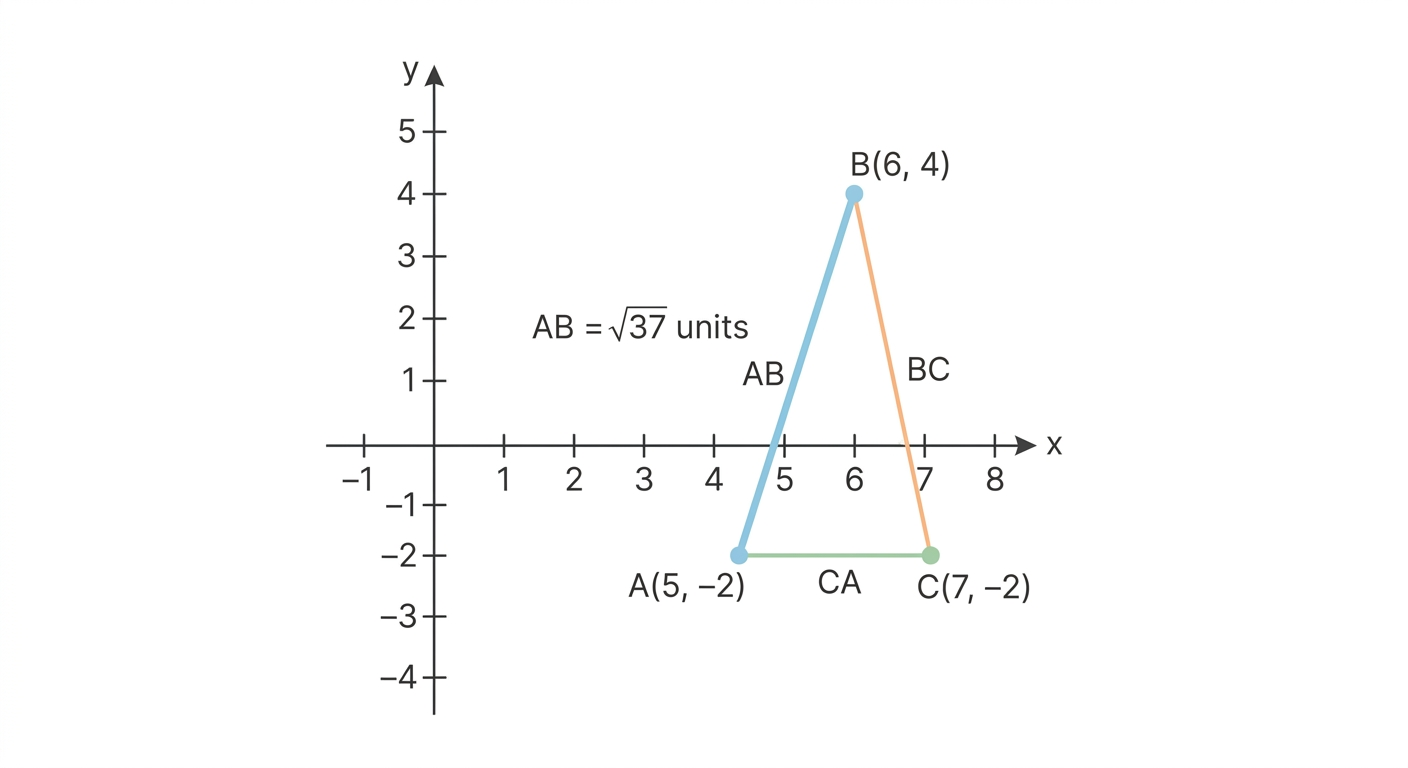
Using the distance formula for and
Step 2 · Calculate the length of side BC
Using the distance formula for and
Step 3 · Calculate the length of side CA
Using the distance formula for and
Step 4 · Compare side lengths
Comparing the lengths of the three sides
Since , two sides are equal in length. Therefore, is an isosceles triangle.
Yes, , , and are the vertices of an isosceles triangle.
- Negative Sign Errors: Mishandling double negatives when subtracting coordinates, e.g., writing as instead of .
- Squaring Negative Numbers: Incorrectly evaluating as instead of .
- Early Stopping: Calculating only two sides without verifying the third side (to confirm it is not equilateral, though equilateral triangles are technically also isosceles).
More questions in Exercise 7.1
Find the distance between the following pairs of points :
(i)
(ii)
(iii)
Find the distance between the points and . Can you now find the distance between the two towns and discussed in Section 7.2.
Determine if the points and are collinear.
Check whether , and are the vertices of an isosceles triangle.
In a classroom, 4 friends are seated at the points , , and as shown in Fig. 7.8. Champa and Chameli walk into the class and after observing for a few minutes Champa asks Chameli, “Don’t you think is a square?” Chameli disagrees. Using distance formula, find which of them is correct.
Name the type of quadrilateral formed, if any, by the following points, and give reasons for your answer:
(i)
(ii)
(iii)
Find the point on the -axis which is equidistant from and .
Find the values of for which the distance between the points and is 10 units.
If is equidistant from and , find the values of . Also find the distances and .
Find a relation between and such that the point is equidistant from the point and .