Coordinate Geometry | Exercise 7.1

Question 1

Find the distance between the following pairs of points :

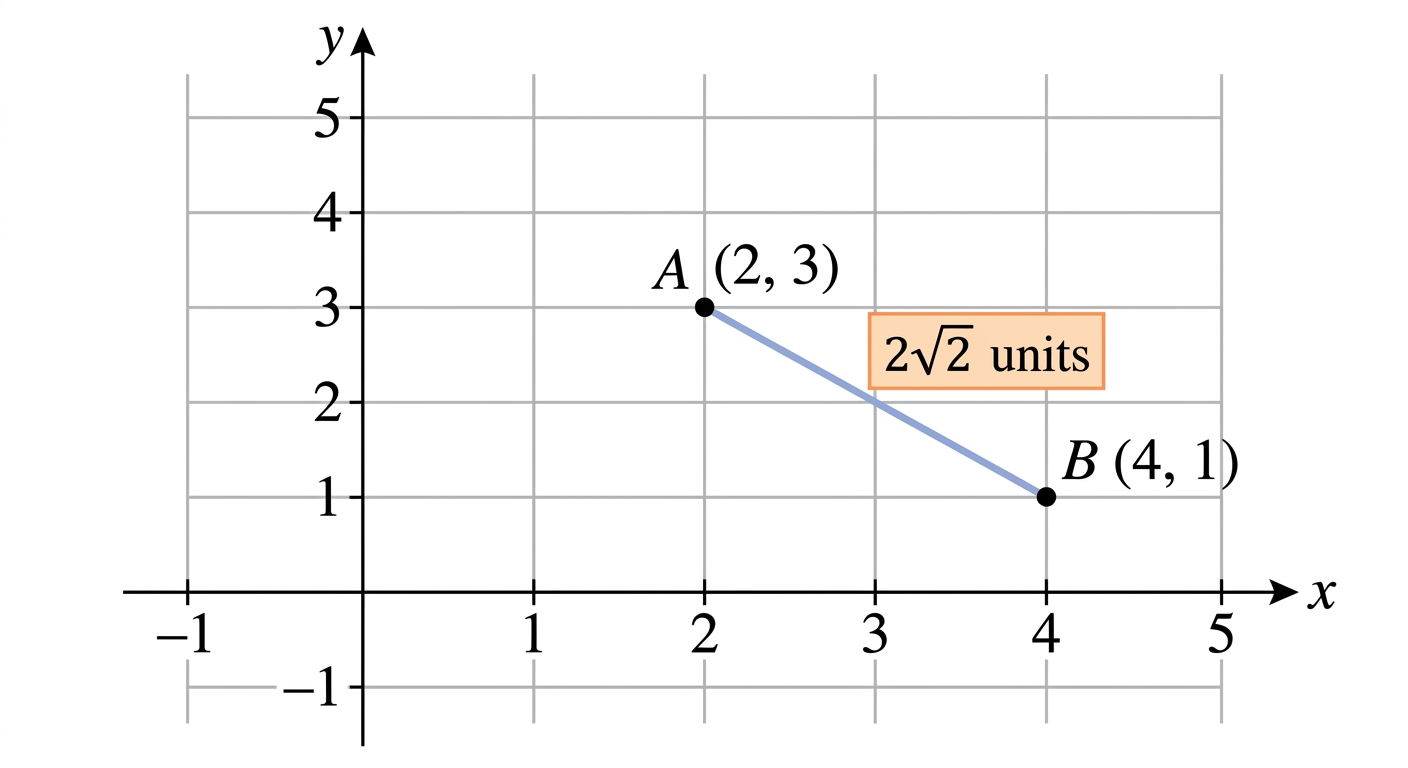
(i) (2,3),(4,1)(2, 3), (4, 1)

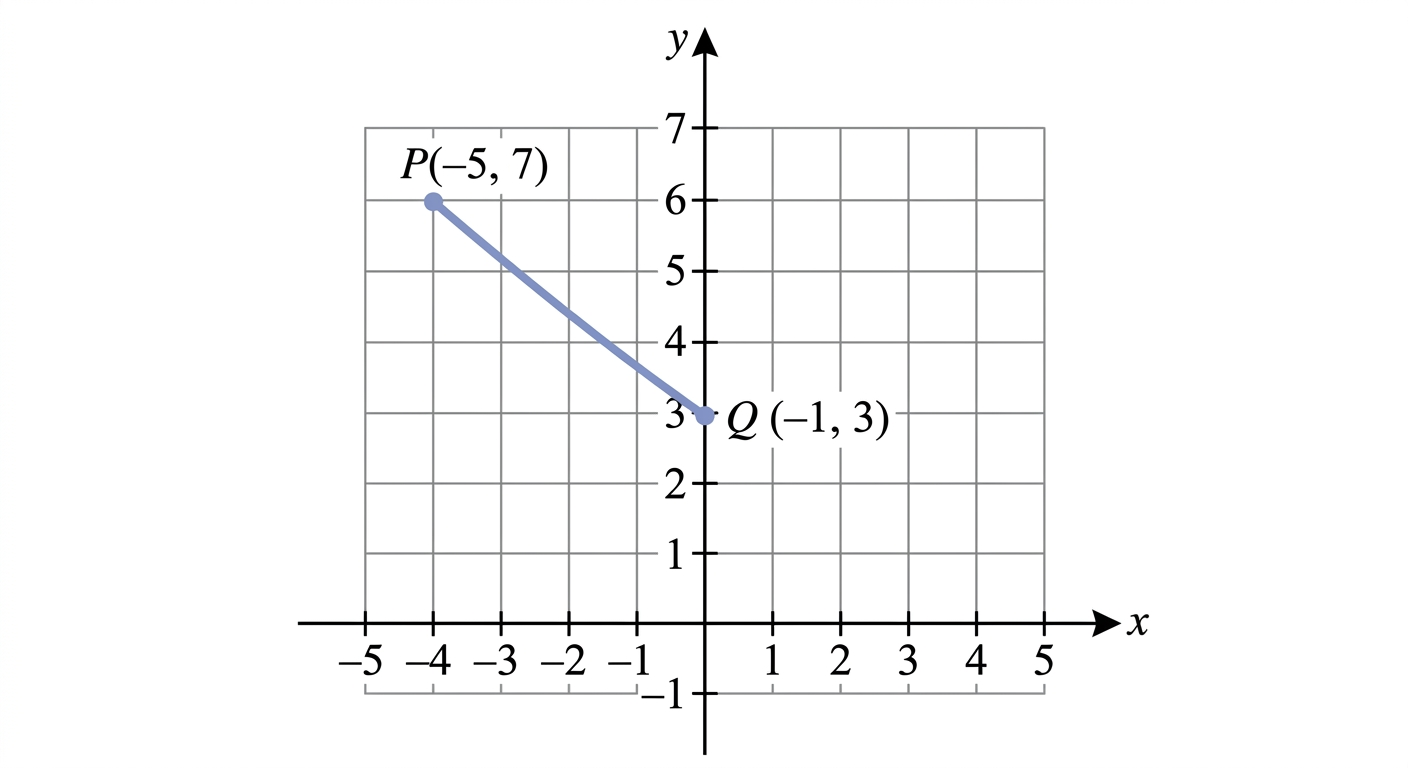
(ii) (5,7),(1,3)(-5, 7), (-1, 3)

(iii) (a,b),(a,b)(a, b), (-a, -b)

Check your answer with HomiSolve it yourself, then let Homi check your steps and spot mistakes.
Solution
Understand the Question
  • The distance dd between two points A(x1,y1)A(x_1, y_1) and B(x2,y2)B(x_2, y_2) is given by the Distance Formula: d=(x2x1)2+(y2y1)2d = \sqrt{(x_2 - x_1)^2 + (y_2 - y_1)^2}
  • This formula is derived directly from the Pythagoras theorem, where the distance is the hypotenuse of the right triangle formed by the horizontal difference (x2x1)(x_2 - x_1) and vertical difference (y2y1)(y_2 - y_1).

(i) (2,3),(4,1)(2, 3), (4, 1)

Step 1 · Calculate Distance between (2,3)(2, 3) and (4,1)(4, 1)

Let the points be A(2,3)A(2, 3) and B(4,1)B(4, 1).Diagram 1

Using the distance formula

Distance AB=(42)2+(13)2=22+(2)2=4+4=8=22 units\begin{aligned} \text{Distance } AB &= \sqrt{(4 - 2)^2 + (1 - 3)^2} \\ &= \sqrt{2^2 + (-2)^2} \\ &= \sqrt{4 + 4} \\ &= \sqrt{8} \\ &= 2\sqrt{2} \text{ units} \end{aligned}
Answer

(i) 22 units2\sqrt{2} \text{ units}

(ii) (5,7),(1,3)(-5, 7), (-1, 3)

Step 1 · Calculate Distance between (5,7)(-5, 7) and (1,3)(-1, 3)

Let the points be P(5,7)P(-5, 7) and Q(1,3)Q(-1, 3).Using the distance formula

Distance PQ=(1(5))2+(37)2=(1+5)2+(4)2=42+(4)2=16+16=32=42 units\begin{aligned} \text{Distance } PQ &= \sqrt{(-1 - (-5))^2 + (3 - 7)^2} \\ &= \sqrt{(-1 + 5)^2 + (-4)^2} \\ &= \sqrt{4^2 + (-4)^2} \\ &= \sqrt{16 + 16} \\ &= \sqrt{32} \\ &= 4\sqrt{2} \text{ units} \end{aligned}
Answer

(ii) 42 units4\sqrt{2} \text{ units}

(iii) (a,b),(a,b)(a, b), (-a, -b)

Step 1 · Calculate Distance between (a,b)(a, b) and (a,b)(-a, -b)

Let the points be M(a,b)M(a, b) and N(a,b)N(-a, -b).Diagram 3

Using the distance formula

Distance MN=(aa)2+(bb)2=(2a)2+(2b)2=4a2+4b2=4(a2+b2)=2a2+b2 units\begin{aligned} \text{Distance } MN &= \sqrt{(-a - a)^2 + (-b - b)^2} \\ &= \sqrt{(-2a)^2 + (-2b)^2} \\ &= \sqrt{4a^2 + 4b^2} \\ &= \sqrt{4(a^2 + b^2)} \\ &= 2\sqrt{a^2 + b^2} \text{ units} \end{aligned}
Answer

(iii) 2a2+b2 units2\sqrt{a^2 + b^2} \text{ units}

Common Mistakes
  • Sign Errors with Negatives: When substituting negative coordinates, remember that x2x1x_2 - x_1 with a negative value becomes addition, e.g., 1(5)=1+5=4-1 - (-5) = -1 + 5 = 4, not 6-6.
  • Squaring Negatives: The square of any real number is always positive, e.g., (2)2=+4(-2)^2 = +4 and (2a)2=+4a2(-2a)^2 = +4a^2, not 4-4 or 4a2-4a^2.
  • Incorrect Square Root Simplification: Note that 4(a2+b2)=2a2+b22(a+b)\sqrt{4(a^2 + b^2)} = 2\sqrt{a^2 + b^2} \neq 2(a + b). The square root does not distribute across addition.

More questions in Exercise 7.1

Q1

Find the distance between the following pairs of points :

(i) (2,3),(4,1)(2, 3), (4, 1)

(ii) (5,7),(1,3)(-5, 7), (-1, 3)

(iii) (a,b),(a,b)(a, b), (-a, -b)

Q2

Find the distance between the points (0,0)(0, 0) and (36,15)(36, 15). Can you now find the distance between the two towns AA and BB discussed in Section 7.2.

Q3

Determine if the points (1,5),(2,3)(1, 5), (2, 3) and (2,11)(-2, -11) are collinear.

Q4

Check whether (5,2)(5, -2), (6,4)(6, 4) and (7,2)(7, -2) are the vertices of an isosceles triangle.

Q5

In a classroom, 4 friends are seated at the points AA, BB, CC and DD as shown in Fig. 7.8. Champa and Chameli walk into the class and after observing for a few minutes Champa asks Chameli, “Don’t you think ABCDABCD is a square?” Chameli disagrees. Using distance formula, find which of them is correct.

Q6

Name the type of quadrilateral formed, if any, by the following points, and give reasons for your answer:

(i) (1,2),(1,0),(1,2),(3,0)(-1, -2), (1, 0), (-1, 2), (-3, 0)

(ii) (3,5),(3,1),(0,3),(1,4)(-3, 5), (3, 1), (0, 3), (-1, -4)

(iii) (4,5),(7,6),(4,3),(1,2)(4, 5), (7, 6), (4, 3), (1, 2)

Q7

Find the point on the xx-axis which is equidistant from (2,5)(2, -5) and (2,9)(-2, 9).

Q8

Find the values of yy for which the distance between the points P(2,3)P(2, -3) and Q(10,y)Q(10, y) is 10 units.

Q9

If Q(0,1)Q(0, 1) is equidistant from P(5,3)P(5, -3) and R(x,6)R(x, 6), find the values of xx. Also find the distances QRQR and PRPR.

Q10

Find a relation between xx and yy such that the point (x,y)(x, y) is equidistant from the point (3,6)(3, 6) and (3,4)(-3, 4).

← Back to Coordinate Geometry