Question 10
Find a relation between and such that the point is equidistant from the point and .
- A point is equidistant from two points and if the distance equals the distance ().
- The distance formula between two points and is:
- Equating eliminates the square roots, which allows us to expand the terms, cancel the quadratic terms (), and simplify to find a linear relation between and .
Step 1 · Set Up the Distance Equation
Let the given points be , , and .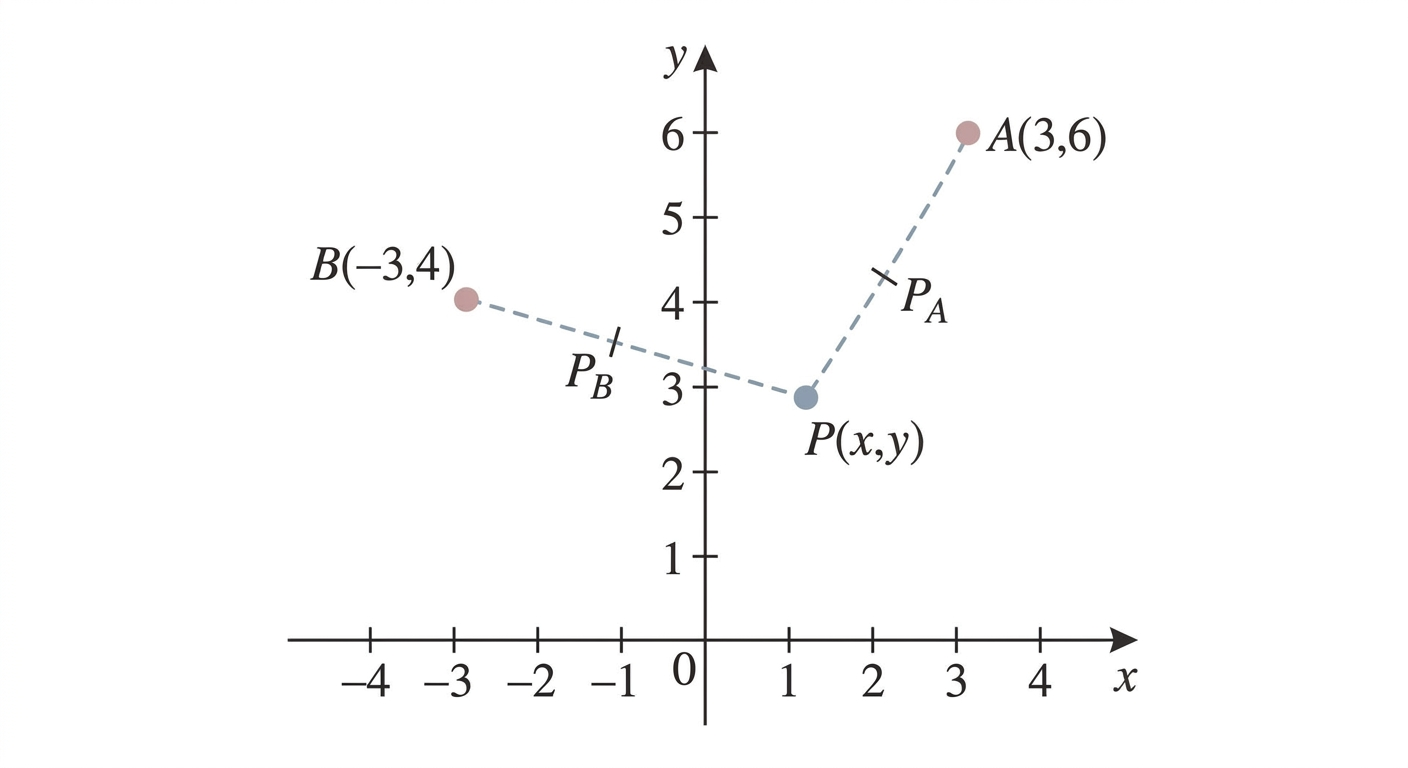
Since point is equidistant from and , .
Using the distance formula :
Equating both distances:
Step 2 · Square Both Sides and Expand
Squaring both sides:
Expanding each term using algebraic identities:
Step 3 · Simplify and Find the Relation
Combine constant terms on both sides:
Cancelling and from both sides:
Rearranging terms:
Dividing the entire equation by :
- Sign Errors in Expansion: Incorrectly expanding as . Since , the correct expansion is .
- Forgetting to Square Both Sides: Trying to simplify without eliminating the radical signs, leading to algebraic errors.
More questions in Exercise 7.1
Find the distance between the following pairs of points :
(i)
(ii)
(iii)
Find the distance between the points and . Can you now find the distance between the two towns and discussed in Section 7.2.
Determine if the points and are collinear.
Check whether , and are the vertices of an isosceles triangle.
In a classroom, 4 friends are seated at the points , , and as shown in Fig. 7.8. Champa and Chameli walk into the class and after observing for a few minutes Champa asks Chameli, “Don’t you think is a square?” Chameli disagrees. Using distance formula, find which of them is correct.
Name the type of quadrilateral formed, if any, by the following points, and give reasons for your answer:
(i)
(ii)
(iii)
Find the point on the -axis which is equidistant from and .
Find the values of for which the distance between the points and is 10 units.
If is equidistant from and , find the values of . Also find the distances and .
Find a relation between and such that the point is equidistant from the point and .