Question 1
Without performing long division, determine which of the following rational numbers will have terminating decimals and which will be repeating: , and . Then check your answers by explicitly performing the long divisions and expressing these rational numbers as decimals.
- A rational number in simplest form has a terminating decimal expansion if the prime factorisation of the denominator contains only prime factors and/or (i.e. of the form , where ).
- If contains any prime factor other than or , its decimal expansion is non-terminating repeating.
(i)
Step 1 · Analyse and Verify by Division
The fraction is in simplest form.
Prime factorisation of the denominator :
Since the prime factors of the denominator are only and , the decimal expansion is terminating.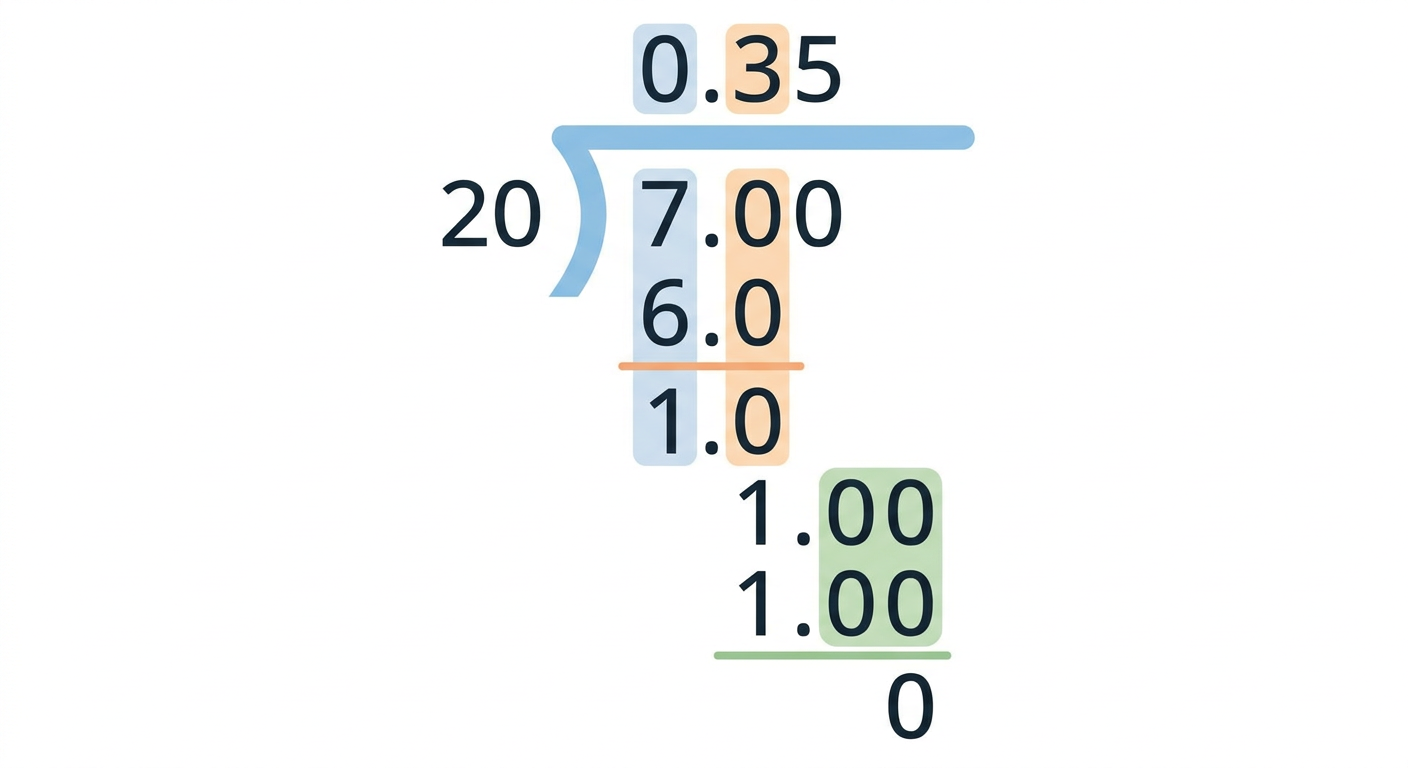
Checking by long division:
(i) Terminating;
(ii)
Step 1 · Analyse and Verify by Division
The fraction is in simplest form.
Prime factorisation of the denominator :
Since the denominator contains a prime factor (other than or ), the decimal expansion is repeating.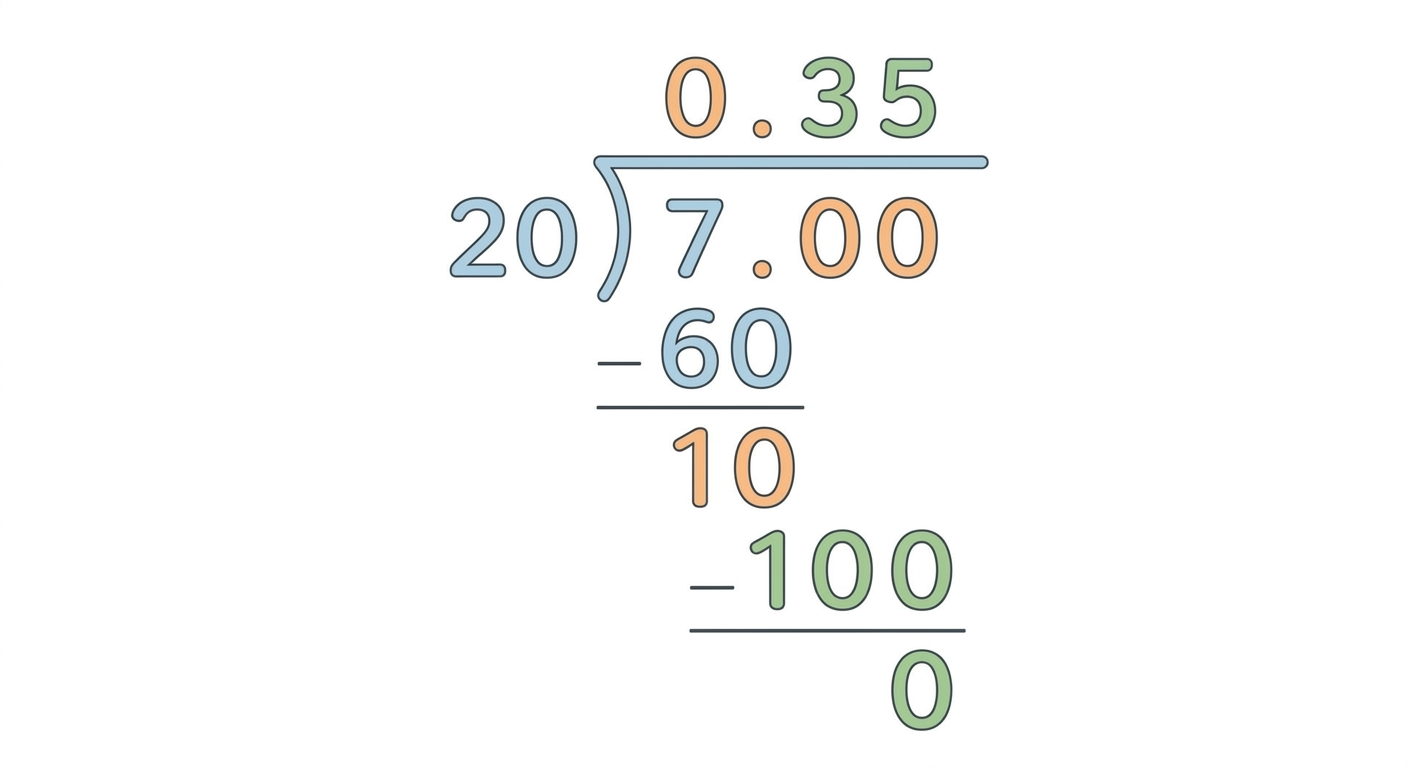
Checking by long division:
(ii) Repeating;
(iii)
Step 1 · Analyse and Verify by Division
The fraction is in simplest form.
Prime factorisation of the denominator :
Since the prime factors of the denominator are only and , the decimal expansion is terminating.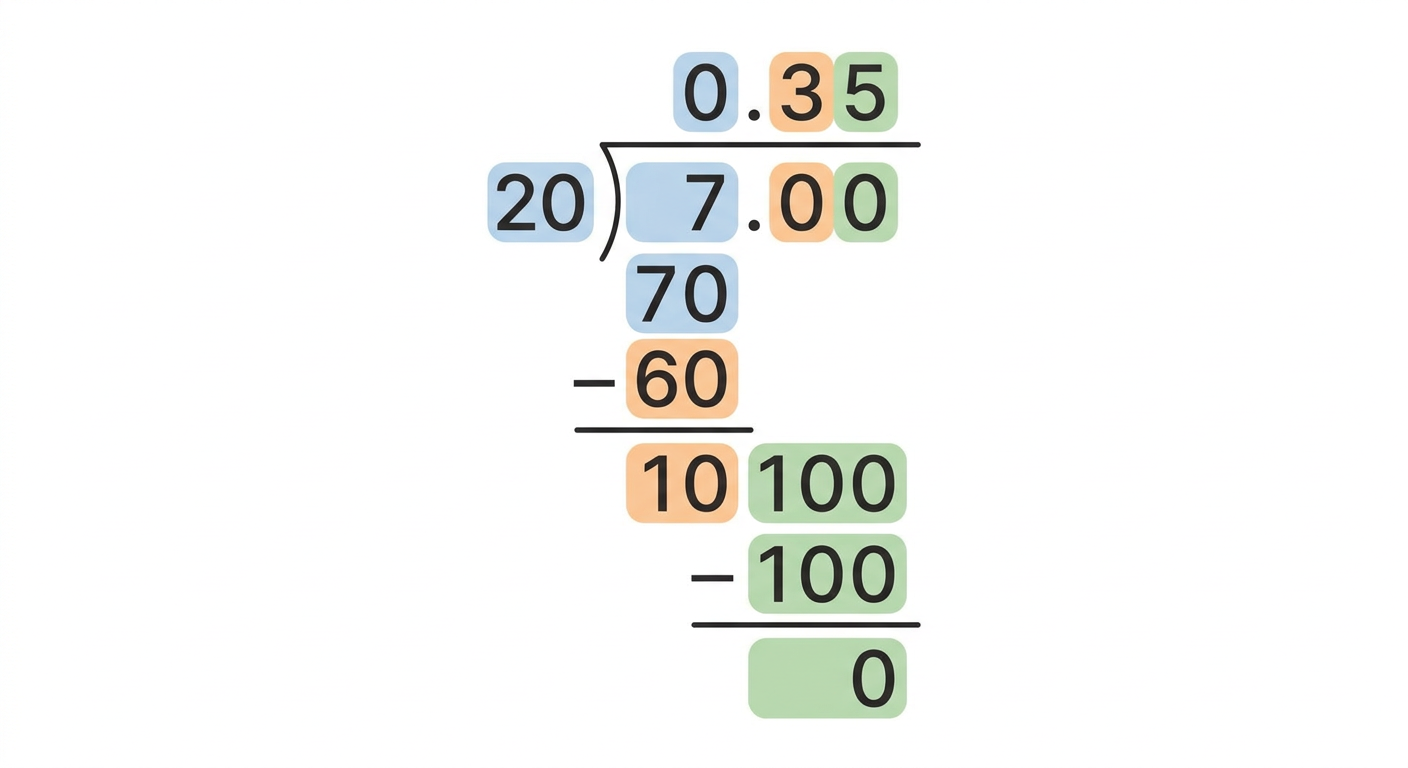
Checking by long division:
(iii) Terminating;
- Not Checking Simplest Form First: Always ensure is reduced to lowest terms (i.e., and are co-prime) before checking denominator factors, or extra common factors might mislead the test.
- Bar Placement on Repeating Decimals: Placing the repeating bar over non-repeating digits (e.g. writing instead of ).
More questions in Exercise 3.5
Without performing long division, determine which of the following rational numbers will have terminating decimals and which will be repeating: , and . Then check your answers by explicitly performing the long divisions and expressing these rational numbers as decimals.
Perform the long division for . Identify the repeating block of digits. Does it show cyclic properties if you evaluate ? Now compute , , etc. What do you notice?
Classify the following numbers as rational or irrational:
(i)
(ii)
(iii)
(iv)
(v) (Notice the pattern: Is it repeating a single block?)
(vi)
Find the explicit fractions in case they are rational.
The number (which means ) is a rational number. Using algebra (let , multiply by 10, and subtract), explain why is exactly equal to 1.
*5. We have seen that the repeating block of is a cyclic number. Try to find more numbers () whose reciprocals () produce decimals with repeating blocks that are cyclic.