The World of Numbers | Exercise 3.5

Question 2

Perform the long division for 113\dfrac{1}{13}. Identify the repeating block of digits. Does it show cyclic properties if you evaluate 213\dfrac{2}{13}? Now compute 313\dfrac{3}{13}, 413\dfrac{4}{13}, etc. What do you notice?

Check your answer with HomiSolve it yourself, then let Homi check your steps and spot mistakes.
Solution
Understand the Question
  • Converting a fraction pq\dfrac{p}{q} into decimal form by long division results in either a terminating decimal or a non-terminating repeating (recurring) decimal.
  • For 113\dfrac{1}{13}, the remainders repeat after a certain number of steps, creating a repeating block of digits (period).
  • When a prime denominator qq produces repeating decimals, its fractions nq\dfrac{n}{q} often share cyclic permutations of digit sequences. For denominator 1313, the 1212 possible remainders divide into two distinct cyclic groups of 6 digits each.

Step 1 · Perform Long Division for 113\dfrac{1}{13}

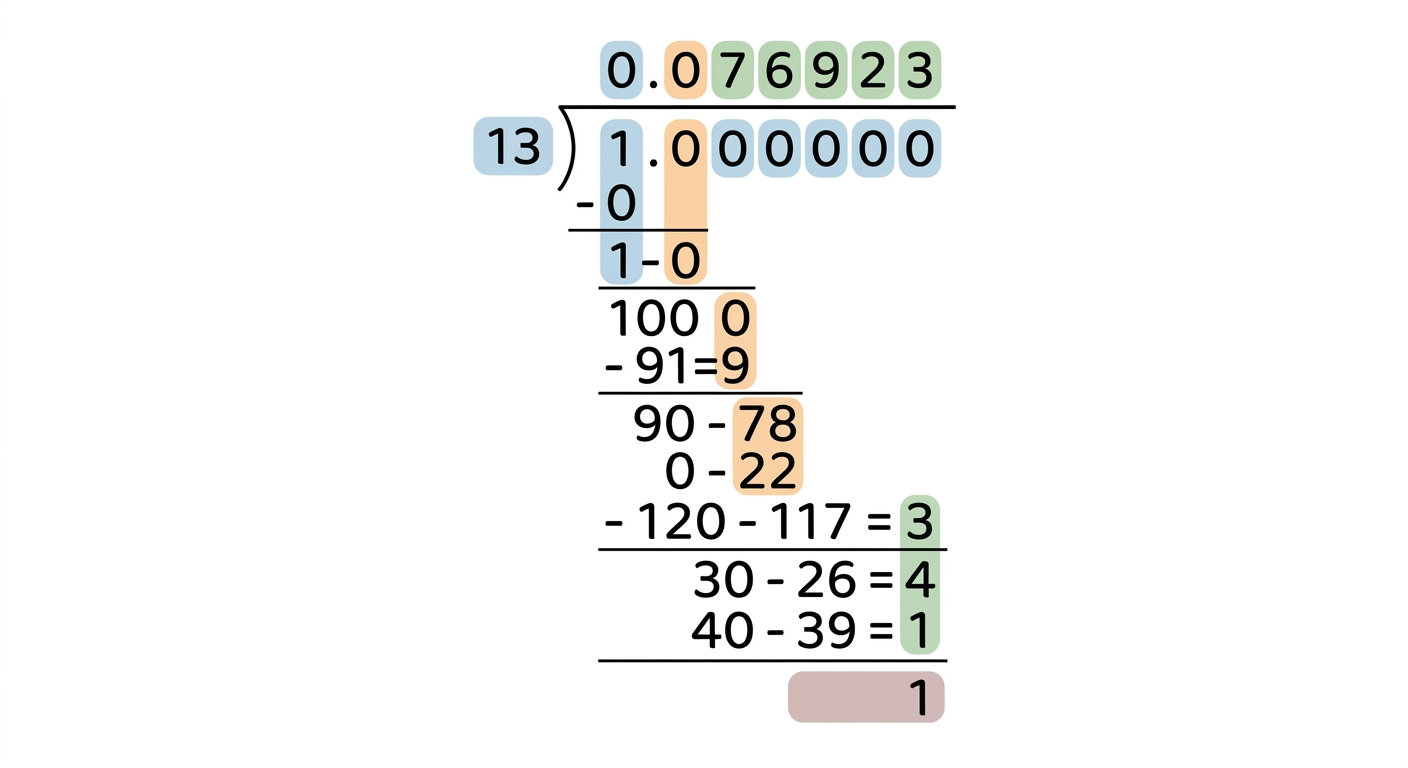
Perform long division of 11 by 1313:Diagram 1

0.076923131.0000000100100919078120117302640391\begin{array}{r} 0.076923\dots \\ 13\overline{|1.000000} \\ -0\downarrow \\ \hline 10\downarrow \\ -0\downarrow \\ \hline 100\downarrow \\ -91\downarrow \\ \hline 90\downarrow \\ -78\downarrow \\ \hline 120\downarrow \\ -117\downarrow \\ \hline 30\downarrow \\ -26\downarrow \\ \hline 40\downarrow \\ -39\downarrow \\ \hline 1 \\ \end{array}

The remainder 11 repeats after 66 division steps.

113=0.076923076923=0.076923\dfrac{1}{13} = 0.076923076923\dots = 0.\overline{076923}

The repeating block of digits is 076923076923.

Step 2 · Evaluate 213\dfrac{2}{13}

Computing the decimal expansion for 213\dfrac{2}{13} by long division:

213=0.153846153846=0.153846\dfrac{2}{13} = 0.153846153846\dots = 0.\overline{153846}

The repeating block is 153846153846.

This is a completely different block from 076923076923, meaning 213\dfrac{2}{13} is not a cyclic permutation of 113\dfrac{1}{13}.

Step 3 · Compute 313\dfrac{3}{13}, 413\dfrac{4}{13}, 513\dfrac{5}{13}, and 613\dfrac{6}{13}

Finding the decimal expansions for the remaining fractions:

313=0.230769230769=0.230769\dfrac{3}{13} = 0.230769230769\dots = 0.\overline{230769}

413=0.307692307692=0.307692\dfrac{4}{13} = 0.307692307692\dots = 0.\overline{307692}

513=0.384615384615=0.384615\dfrac{5}{13} = 0.384615384615\dots = 0.\overline{384615}

613=0.461538461538=0.461538\dfrac{6}{13} = 0.461538461538\dots = 0.\overline{461538}

Step 4 · Observe Cyclic Patterns

Comparing all the repeating blocks:

  • 113=0.076923\dfrac{1}{13} = 0.\overline{076923}
  • 213=0.153846\dfrac{2}{13} = 0.\overline{153846}
  • 313=0.230769\dfrac{3}{13} = 0.\overline{230769}
  • 413=0.307692\dfrac{4}{13} = 0.\overline{307692}
  • 513=0.384615\dfrac{5}{13} = 0.\overline{384615}
  • 613=0.461538\dfrac{6}{13} = 0.\overline{461538}

The decimal expansions form two distinct cyclic families:

  1. Family 1 (Digits {0,7,6,9,2,3}\{0, 7, 6, 9, 2, 3\}):

    • 113=0.076923\dfrac{1}{13} = 0.\overline{\mathbf{0}76923}
    • 313=0.230769\dfrac{3}{13} = 0.\overline{\mathbf{2}30769}
    • 413=0.307692\dfrac{4}{13} = 0.\overline{\mathbf{3}07692}
  2. Family 2 (Digits {1,5,3,8,4,6}\{1, 5, 3, 8, 4, 6\}):

    • 213=0.153846\dfrac{2}{13} = 0.\overline{\mathbf{1}53846}
    • 513=0.384615\dfrac{5}{13} = 0.\overline{\mathbf{3}84615}
    • 613=0.461538\dfrac{6}{13} = 0.\overline{\mathbf{4}61538}
Answer
  1. The repeating block for 113\dfrac{1}{13} is 076923076923 (period 66).
  1. 213=0.153846\dfrac{2}{13} = 0.\overline{153846} does not cycle the block of 113\dfrac{1}{13}; instead, it begins a second distinct cycle.
  2. The fractions split into two separate cyclic families: {113,313,413,913,1013,1213}\left\{\dfrac{1}{13}, \dfrac{3}{13}, \dfrac{4}{13}, \dfrac{9}{13}, \dfrac{10}{13}, \dfrac{12}{13}\right\} with digits {0,7,6,9,2,3}\{0, 7, 6, 9, 2, 3\}, and {213,513,613,713,813,1113}\left\{\dfrac{2}{13}, \dfrac{5}{13}, \dfrac{6}{13}, \dfrac{7}{13}, \dfrac{8}{13}, \dfrac{11}{13}\right\} with digits {1,5,3,8,4,6}\{1, 5, 3, 8, 4, 6\}.
Common Mistakes
  • Assuming a Single Cyclic Pattern: Unlike 17\dfrac{1}{7} (where all fractions n7\dfrac{n}{7} share one 66-digit cyclic block), fractions with denominator 1313 split into two distinct 66-digit cycles.
  • Stopping Division Early: Forgetting to divide until the remainder explicitly matches the initial dividend (11), which requires 66 steps.
  • Missing the Leading Zero in the Period: Omitting the leading zero in the recurring block of 113=0.076923\dfrac{1}{13} = 0.\overline{076923}, mistakenly writing 0.769230.\overline{76923}.

More questions in Exercise 3.5

Q1

Without performing long division, determine which of the following rational numbers will have terminating decimals and which will be repeating: 720\dfrac{7}{20}, 415\dfrac{4}{15} and 13250\dfrac{13}{250}. Then check your answers by explicitly performing the long divisions and expressing these rational numbers as decimals.

Q2

Perform the long division for 113\dfrac{1}{13}. Identify the repeating block of digits. Does it show cyclic properties if you evaluate 213\dfrac{2}{13}? Now compute 313\dfrac{3}{13}, 413\dfrac{4}{13}, etc. What do you notice?

Q3

Classify the following numbers as rational or irrational:

(i) 81\sqrt{81}

(ii) 12\sqrt{12}

(iii) 0.333330.33333 \dots

(iv) 0.1234512345123450.123451234512345 \dots

(v) 1.010010001000011.01001000100001 \dots (Notice the pattern: Is it repeating a single block?)

(vi) 23.56018561223987479012023.560185612239874790120

Find the explicit fractions in case they are rational.

Q4

The number 0.90.\overline{9} (which means 0.999990.99999\dots) is a rational number. Using algebra (let x=0.9x = 0.\overline{9}, multiply by 10, and subtract), explain why 0.90.\overline{9} is exactly equal to 1.

Q5

*5. We have seen that the repeating block of 17\dfrac{1}{7} is a cyclic number. Try to find more numbers (nn) whose reciprocals (1n\dfrac{1}{n}) produce decimals with repeating blocks that are cyclic.

← Back to The World of Numbers