Question 2
Perform the long division for . Identify the repeating block of digits. Does it show cyclic properties if you evaluate ? Now compute , , etc. What do you notice?
We will use long division to find repeating decimal expansions.
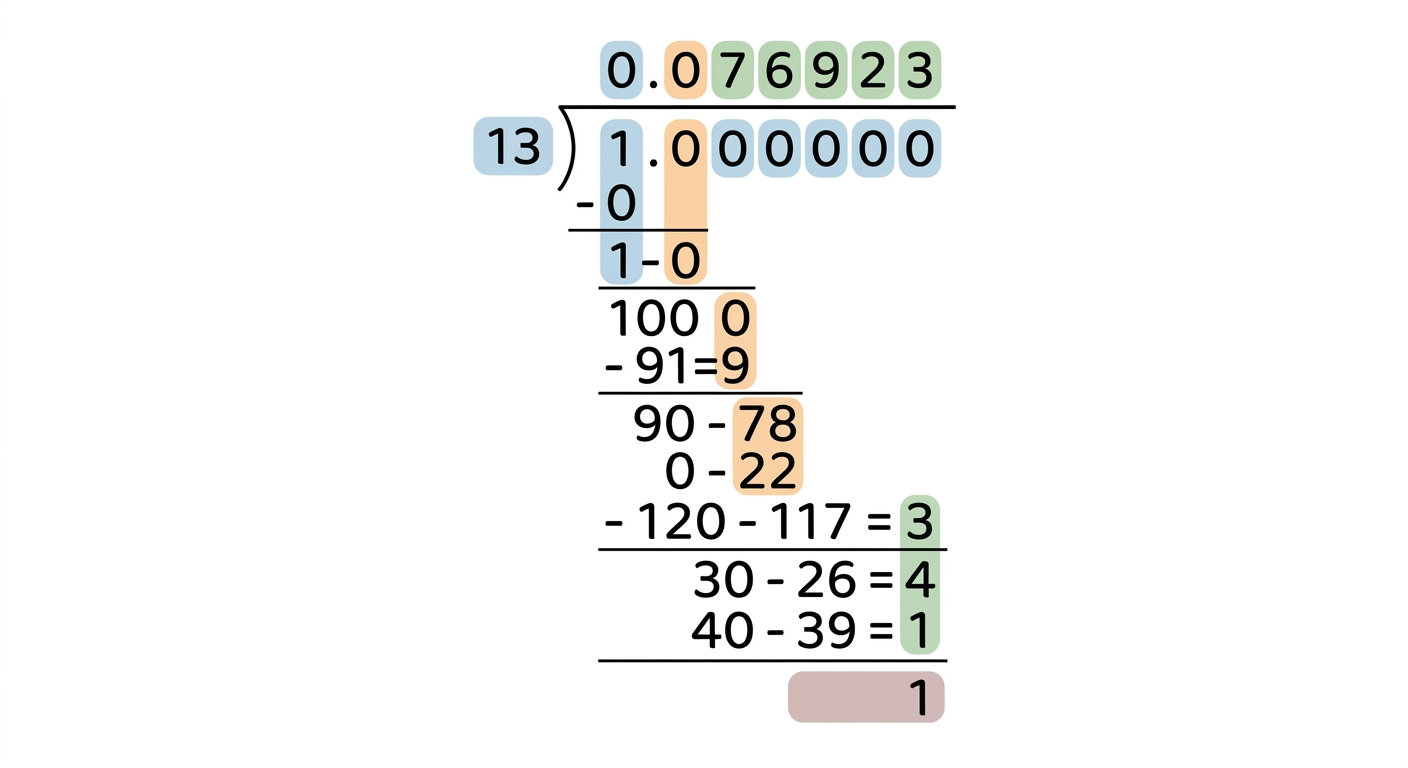
Step 1 — Long division for 1/13
Let's divide 1 by 13. We will perform long division.
The remainder 1 repeats. This means the digits will repeat from this point. The decimal expansion is .
Step 2 — Evaluate 2/13
Let's compute the decimal expansion for 2/13. We use long division.
The repeating block is 153846. This block is different from 076923. Thus, it does not show cyclic properties of the same block as 1/13.
Step 3 — Compute 3/13, 4/13, 5/13, 6/13
We will find the decimal expansions for these fractions.
Step 4 — Observe the patterns
Let's look at all the repeating blocks.
The repeating block for 1/13 is 076923. The repeating block for 2/13 is 153846. The repeating block for 3/13 is 230769. The repeating block for 4/13 is 307692. The repeating block for 5/13 is 384615. The repeating block for 6/13 is 461538.
We can see two distinct sets of digits. Set 1: {0, 7, 6, 9, 2, 3}. Set 2: {1, 5, 3, 8, 4, 6}.
The blocks for 1/13, 3/13, 4/13 are cyclic permutations of Set 1. For example, starting 076923 from '2' gives 230769. Starting 076923 from '3' gives 307692.
The blocks for 2/13, 5/13, 6/13 are cyclic permutations of Set 2. For example, starting 153846 from '3' gives 384615. Starting 153846 from '4' gives 461538.
Answer
(i) The repeating block of digits for is 076923. (ii) When evaluating , the repeating block is 153846. This block is not a cyclic permutation of the repeating block of . It shows a distinct cyclic property. (iii) The decimal expansions of , , and use cyclic permutations of the digits {0, 7, 6, 9, 2, 3}. The decimal expansions of , , and use cyclic permutations of the digits {1, 5, 3, 8, 4, 6}. These two groups exhibit distinct cyclic properties.
More questions in Exercise 3.5
Without performing long division, determine which of the following rational numbers will have terminating decimals and which will be repeating: , and . Then check your answers by explicitly performing the long divisions and expressing these rational numbers as decimals.
Perform the long division for . Identify the repeating block of digits. Does it show cyclic properties if you evaluate ? Now compute , , etc. What do you notice?
Classify the following numbers as rational or irrational:
(i)
(ii)
(iii)
(iv)
(v) (Notice the pattern: Is it repeating a single block?)
(vi)
Find the explicit fractions in case they are rational.
The number (which means ) is a rational number. Using algebra (let , multiply by 10, and subtract), explain why is exactly equal to 1.
*5. We have seen that the repeating block of is a cyclic number. Try to find more numbers () whose reciprocals () produce decimals with repeating blocks that are cyclic.