Question 4
Explain, using a real-world example of debt, why subtracting a negative number is the same as adding a positive number (e.g., ).
- Money you have represents a positive amount (), while money you owe (debt) represents a negative amount ().
- Subtracting represents taking away or removing something.
- Removing a debt frees up money and increases your overall net worth, which has the exact same effect as receiving (adding) positive money.
Step 1 · Represent Initial Amount and Debt
Let having represent a positive amount and owing represent a debt, which is a negative amount .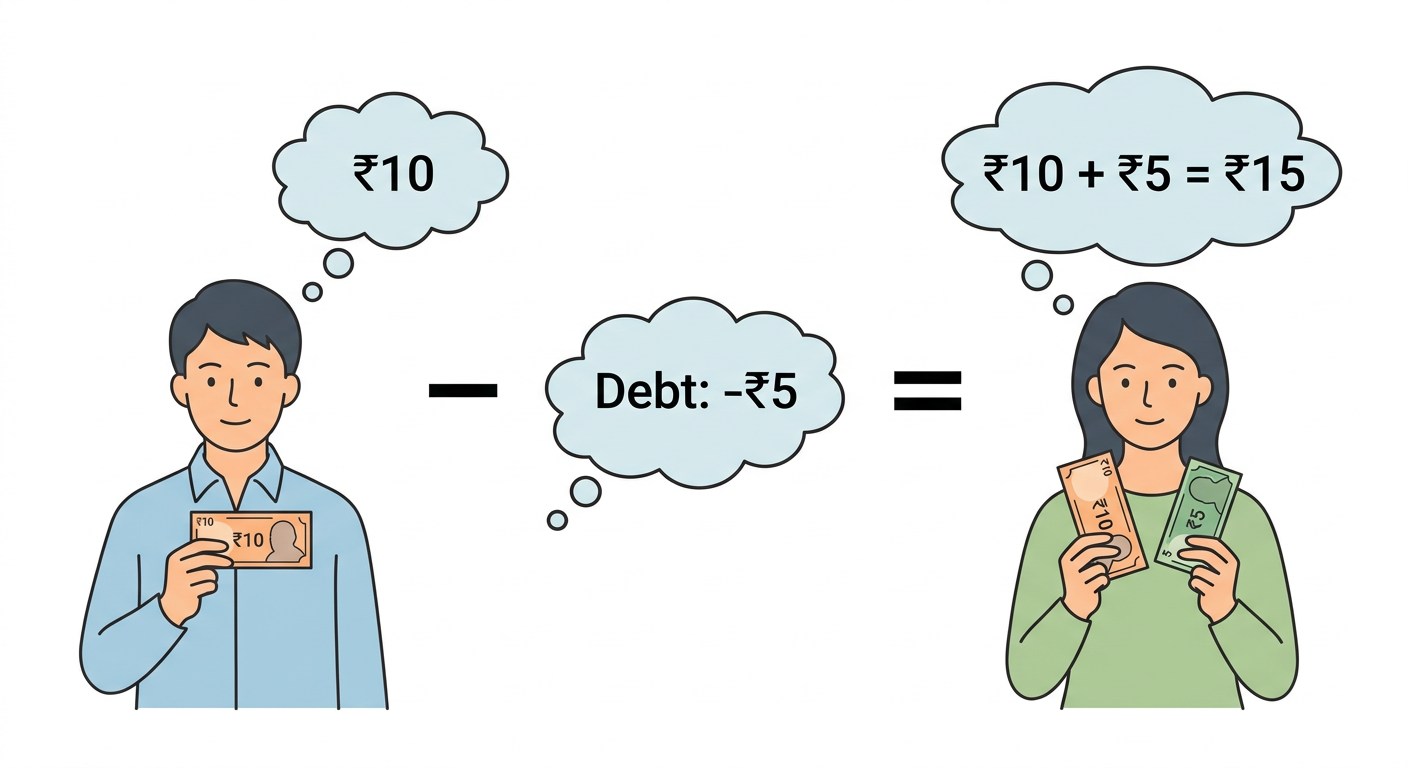
Step 2 · Remove Debt and Simplify
In the expression , subtracting corresponds to removing a debt of .
Taking away a debt increases your net worth by , which is equivalent to adding :
Subtracting a negative number removes a debt, increasing net worth:
- Confusing Adding Debt with Removing Debt: Adding a debt of decreases money (), whereas removing/subtracting a debt increases money ().
- Sign Error: Treating as by dropping one of the negative signs.
More questions in Exercise 3.2
The temperature in the high-altitude desert of Ladakh is recorded as at noon. By midnight, it drops by . What is the midnight temperature?
A spice trader takes a loan (debt) of ₹850. The next day, he makes a profit (fortune) of ₹1,200. The following week, he incurs a loss of ₹450. Write this sequence as an equation using integers and calculate his final financial standing.
Calculate the following using Brahmagupta's laws:
(i)
(ii)
(iii)
(iv)
Explain, using a real-world example of debt, why subtracting a negative number is the same as adding a positive number (e.g., ).