Question 3
Calculate the following using Brahmagupta's laws:
(i)
(ii)
(iii)
(iv)
Brahmagupta introduced foundational rules for arithmetic with positive numbers (Fortune), negative numbers (Debt), and zero:
- Debt Fortune = Debt: The product of a negative number and a positive number is negative ().
- Debt Debt = Fortune: The product of two negative numbers is positive ().
- Zero Debt = Fortune: Subtracting a negative number from zero results in a positive number ().
- Debt Fortune = Debt: The quotient of a negative number divided by a positive number is negative ().
(i)
Step 1 · Multiply a Negative and a Positive Number
According to Brahmagupta's law, the product of Debt (negative) and Fortune (positive) is Debt (negative).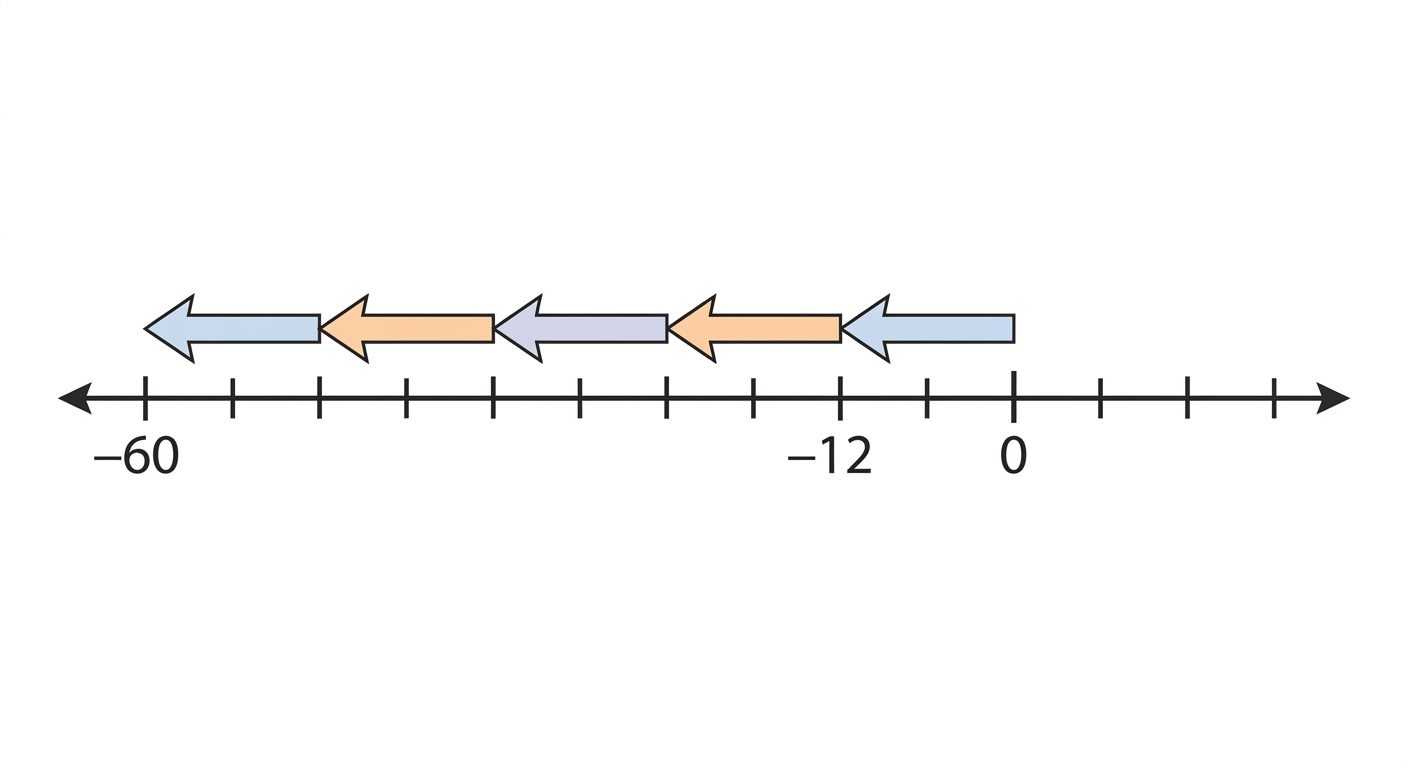
(i)
(ii)
Step 1 · Multiply Two Negative Numbers
According to Brahmagupta's law, the product of Debt (negative) and Debt (negative) is Fortune (positive).
(ii)
(iii)
Step 1 · Subtract a Negative Number from Zero
According to Brahmagupta's law, zero minus Debt (negative) is Fortune (positive).
(iii)
(iv)
Step 1 · Divide a Negative Number by a Positive Number
According to Brahmagupta's law, Debt (negative) divided by Fortune (positive) is Debt (negative).
(iv)
- Sign Rule in Multiplication: Forgetting that multiplying two negative numbers gives a positive product (, not ).
- Double Negative Subtraction: Mistaking for . Subtracting a negative number is equivalent to addition ().
- Division Sign Confusion: Confusing division of opposite signs with same signs; dividing a negative by a positive always yields a negative result.
More questions in Exercise 3.2
The temperature in the high-altitude desert of Ladakh is recorded as at noon. By midnight, it drops by . What is the midnight temperature?
A spice trader takes a loan (debt) of ₹850. The next day, he makes a profit (fortune) of ₹1,200. The following week, he incurs a loss of ₹450. Write this sequence as an equation using integers and calculate his final financial standing.
Calculate the following using Brahmagupta's laws:
(i)
(ii)
(iii)
(iv)
Explain, using a real-world example of debt, why subtracting a negative number is the same as adding a positive number (e.g., ).