Question 3
Two parallel chords of lengths and are on opposite sides of the centre of a circle. If the radius of the circle is , find the distance between the midpoints of the chords.
- The perpendicular drawn from the centre of a circle to a chord bisects the chord.
- Using the radius () and half the length of each chord, we form right-angled triangles to find the perpendicular distance of each chord from the centre using the Pythagoras theorem.
- Since the two parallel chords lie on opposite sides of the centre, the total distance between their midpoints is the sum of their individual distances from the centre: .
Step 1 · Find Distance of First Chord from Centre
Let the chord be and radius .
The perpendicular from the centre bisects the chord, so half the chord length is:
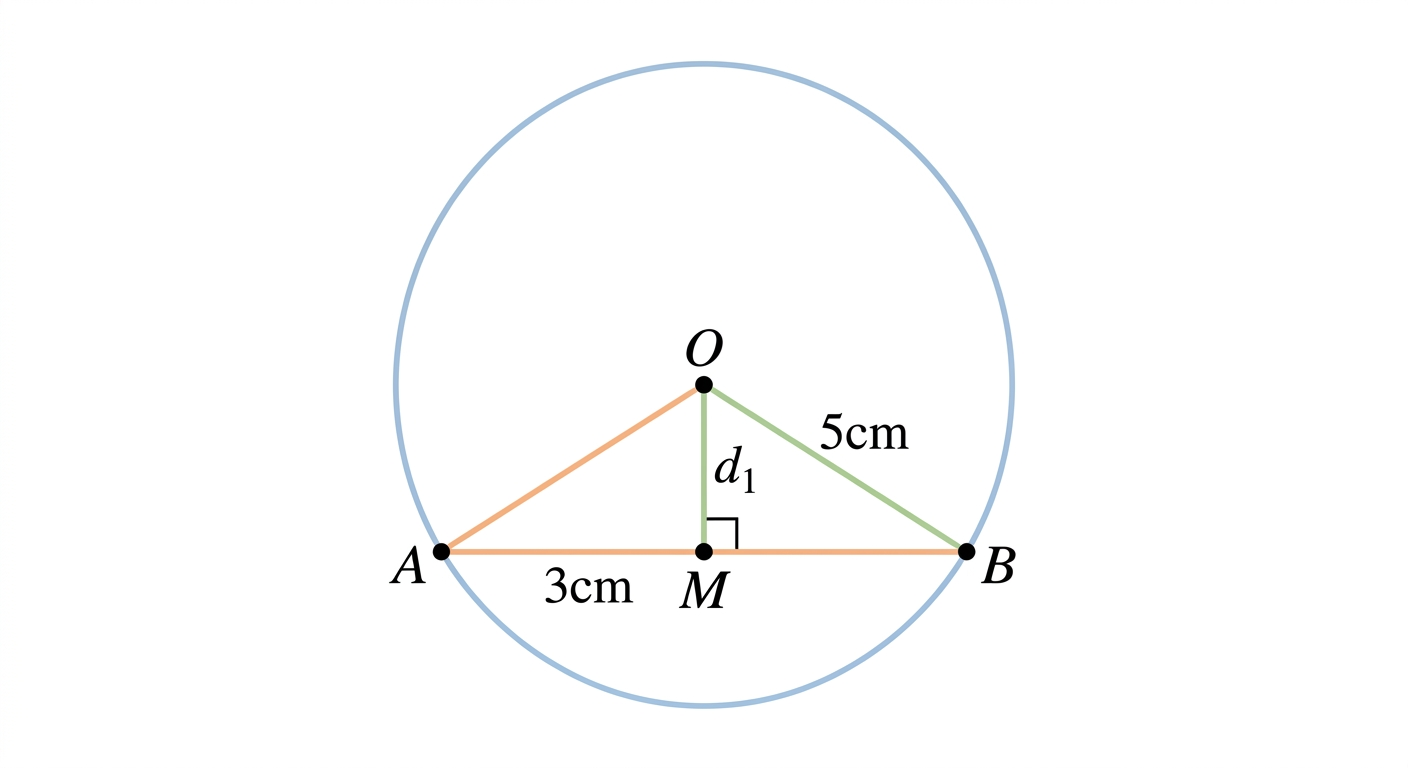
Let be the distance from the centre to chord . By Pythagoras theorem:
Step 2 · Find Distance of Second Chord from Centre
Let the chord be and radius .
The perpendicular from the centre bisects the chord, so half the chord length is:
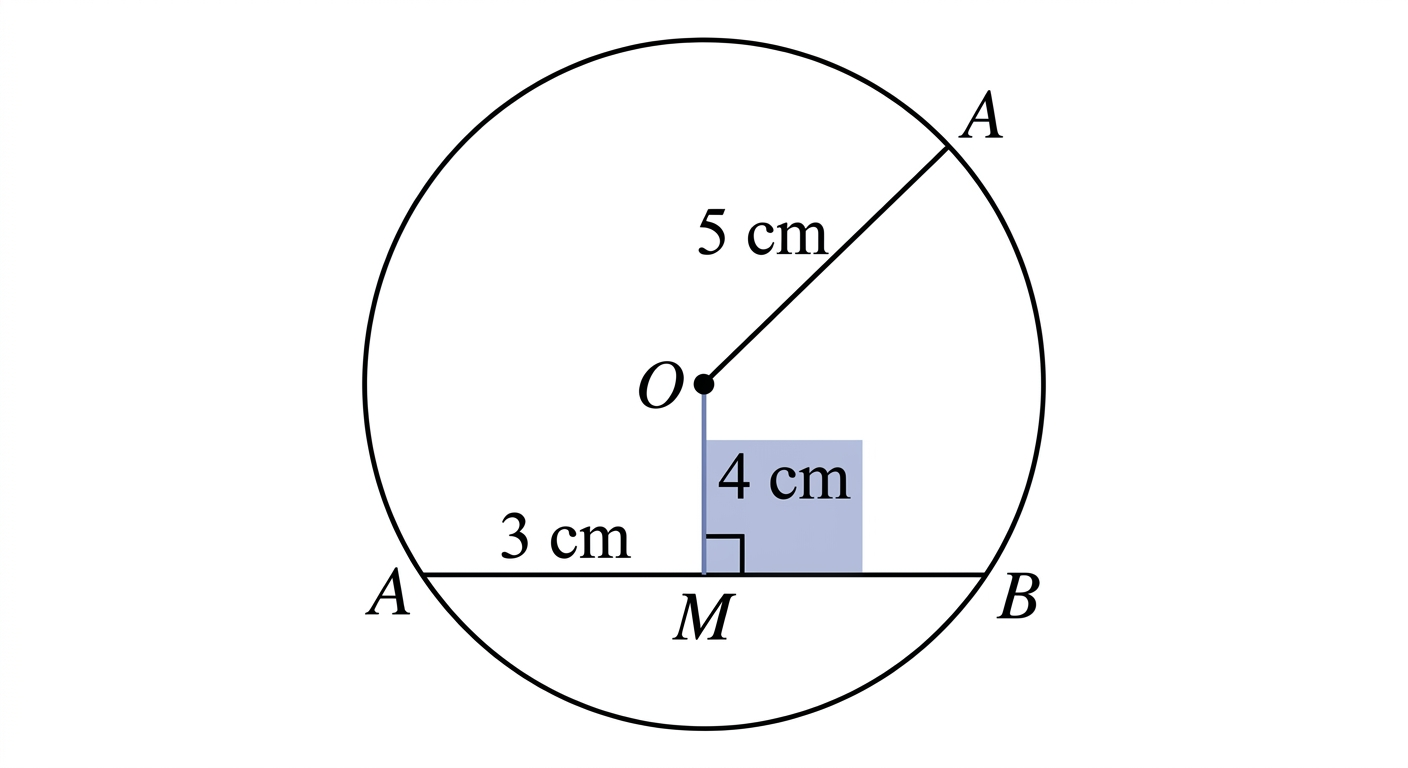
Let be the distance from the centre to chord . By Pythagoras theorem:
Step 3 · Calculate Total Distance between Midpoints
Since the chords are on opposite sides of the centre, the distance between their midpoints is the sum of and :
- Opposite vs. Same Side: Confusing opposite sides with same side. If the chords are on the same side, subtract the distances (). Since they are on opposite sides, add them ().
- Using Full Chord Length: Forgetting to bisect the chord length before applying the Pythagoras theorem (using and directly instead of half-lengths and ).
More questions in Exercise 5.3
Can you explain why the converse to Theorem 4 is true, i.e., why does the perpendicular from the centre of a circle to a chord of the circle bisect the chord?
(Hint: Use Fig. 5.12. You are told that . You need to show that .)
An isosceles triangle is inscribed in a circle, with . Show that the altitude from to passes through the centre of the circle.
Two parallel chords of lengths and are on opposite sides of the centre of a circle. If the radius of the circle is , find the distance between the midpoints of the chords.