Question 2
An isosceles triangle is inscribed in a circle, with . Show that the altitude from to passes through the centre of the circle.
- An isosceles triangle with is inscribed in a circle, and is the altitude drawn from to .
- A key property of circles is that the perpendicular bisector of any chord passes through the centre of the circle.
- To prove that the altitude passes through the centre, we first show that bisects the chord using triangle congruence, establishing as the perpendicular bisector of .
Step 1 · Show that Altitude Bisects
Let be the altitude drawn from vertex to base .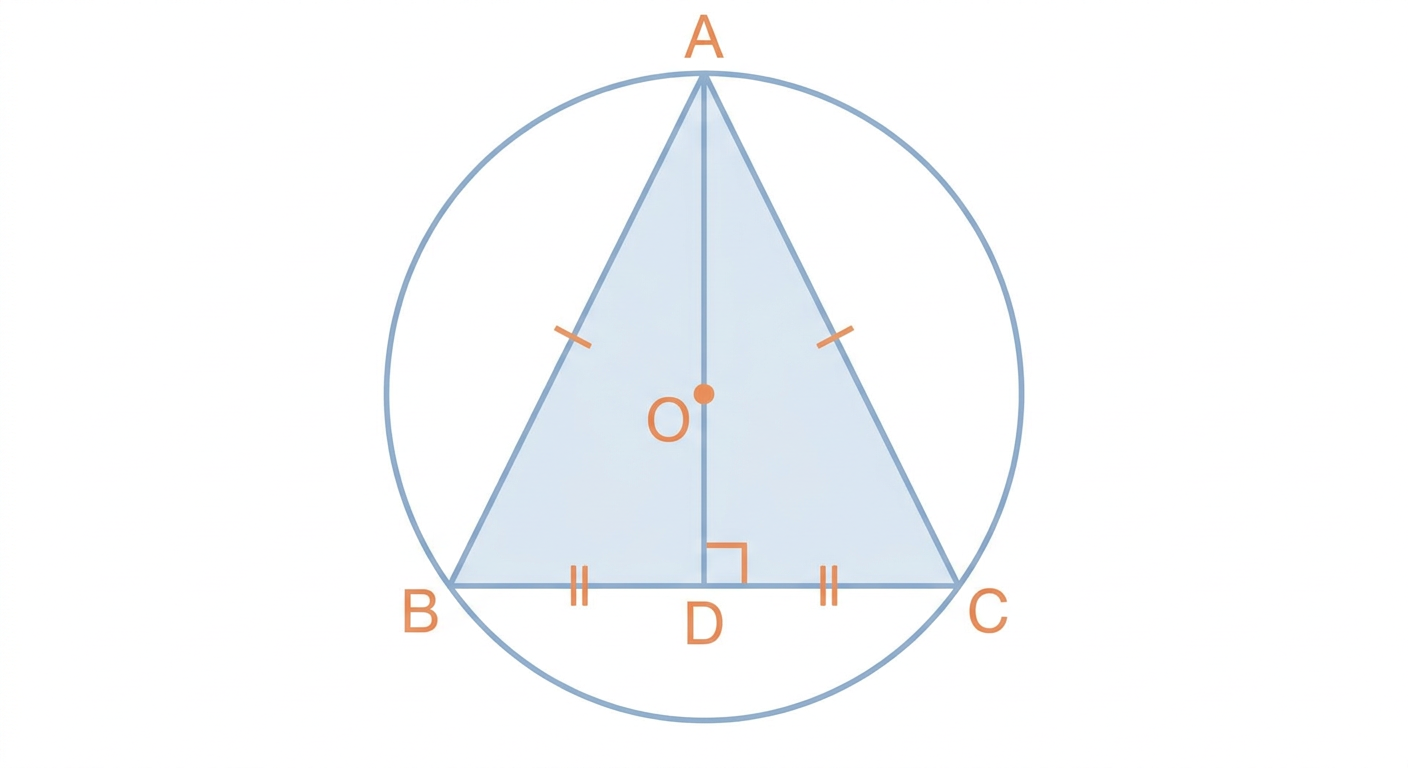
In right triangles and :
By the RHS congruence rule:
Therefore, by CPCT:
Thus, bisects the side .
Step 2 · Prove Passes Through the Centre
Since and , is the perpendicular bisector of .
Since is a chord of the circle and the perpendicular bisector of any chord passes through the centre of the circle, must pass through the centre.
Hence, the altitude from to passes through the centre of the circle.
Hence proved that the altitude from to passes through the centre of the circle.
- Assuming Bisector Directly: Do not assume bisects without proof; you must establish using the RHS congruence criterion first.
- Chord Property Application: Remember that the perpendicular bisector of any chord of a circle always passes through its centre.
More questions in Exercise 5.3
Can you explain why the converse to Theorem 4 is true, i.e., why does the perpendicular from the centre of a circle to a chord of the circle bisect the chord?
(Hint: Use Fig. 5.12. You are told that . You need to show that .)
An isosceles triangle is inscribed in a circle, with . Show that the altitude from to passes through the centre of the circle.
Two parallel chords of lengths and are on opposite sides of the centre of a circle. If the radius of the circle is , find the distance between the midpoints of the chords.