Question 2
Let and be two points on a circle with centre .
(i) Are there points on the circle, on the same side of , such that is different from ?
(ii) Is it true that if , then and lie on the same side of the circle?
(iii) If , and and do not lie on the circle, does the circle through , and also pass through ?
- Angles in the same segment: Any two angles subtended by the same chord at points on the same segment (or arc) of a circle are equal ().
- Cyclic quadrilateral property: Opposite angles of a cyclic quadrilateral sum to .
- Converse theorem (Concyclicity): If a line segment joining two points subtends equal angles at two other points lying on the same side of the line, then all four points lie on a circle (they are concyclic).
(i) Are there points on the circle, on the same side of , such that is different from ?
Step 1 · Analyze Angles Subtended in the Same Segment
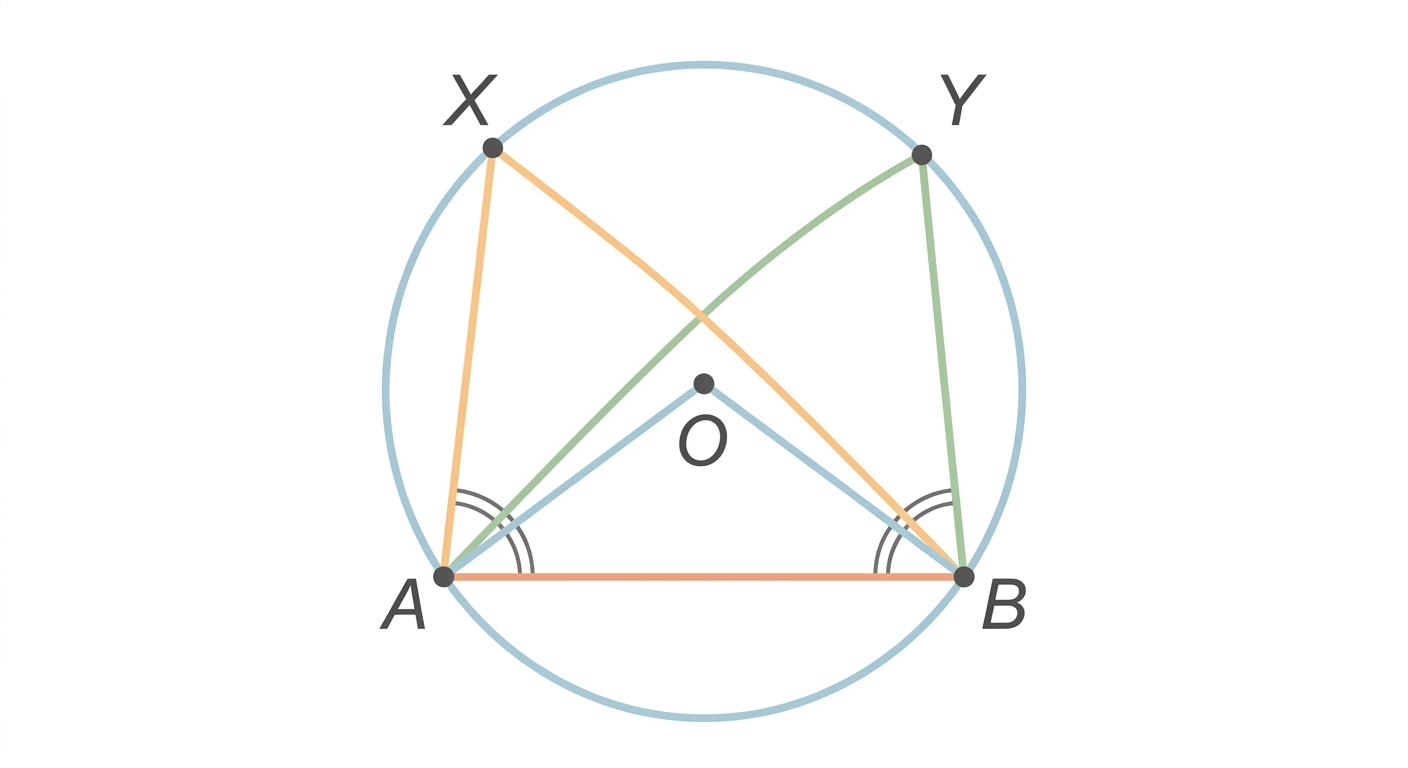
By the theorem on angles in a circle, angles subtended by the same chord in the same segment are equal:
Since and lie on the same side of , they are in the same segment. Therefore, and must always be equal.
(i) No
(ii) Is it true that if , then and lie on the same side of the circle?
Step 1 · Check the Counterexample with a Diameter
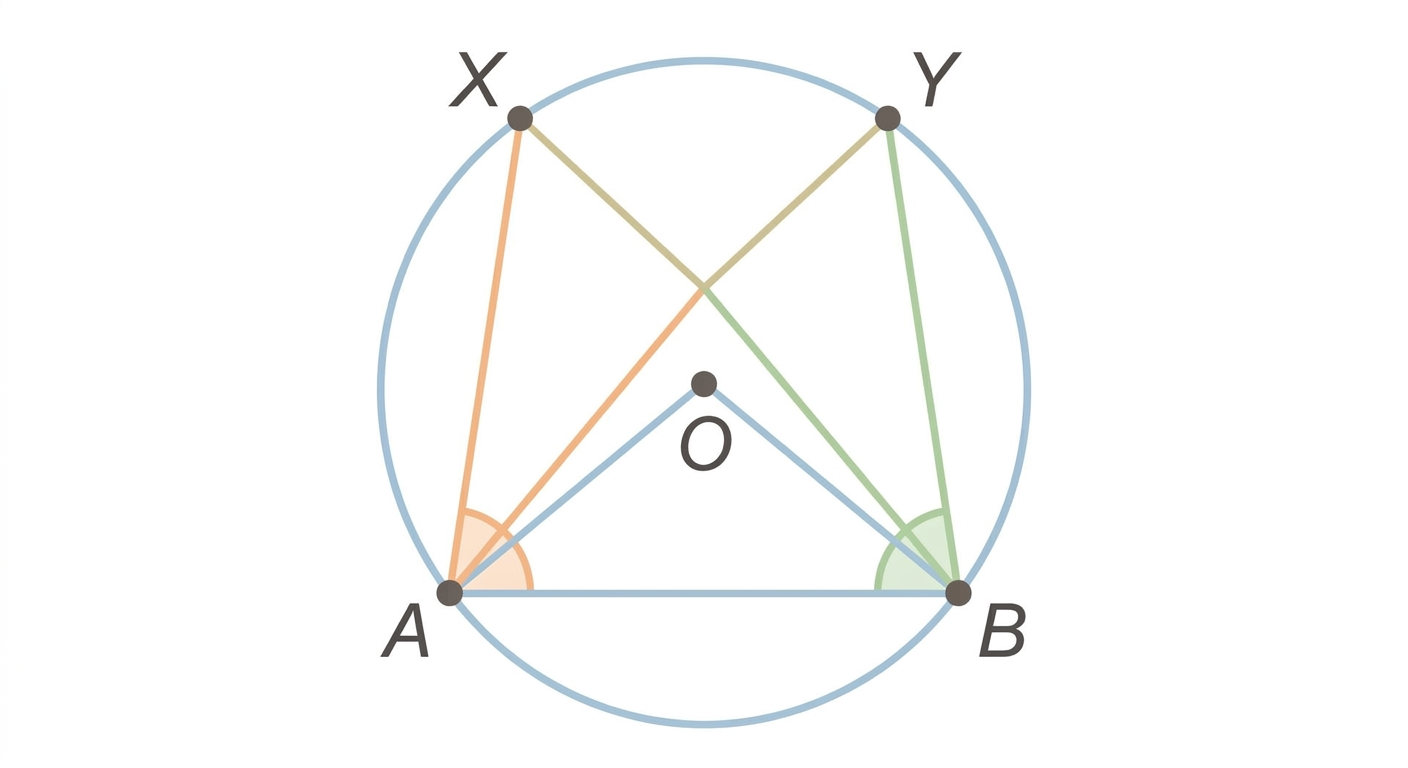
Consider and on opposite sides of chord on the circle. Quadrilateral is cyclic, so its opposite angles are supplementary:
If :
When is a diameter, , even though and lie on opposite sides of .
(ii) No, not always true
(iii) If , and and do not lie on the circle, does the circle through , and also pass through ?
Step 1 · Apply the Converse of the Same-Segment Theorem
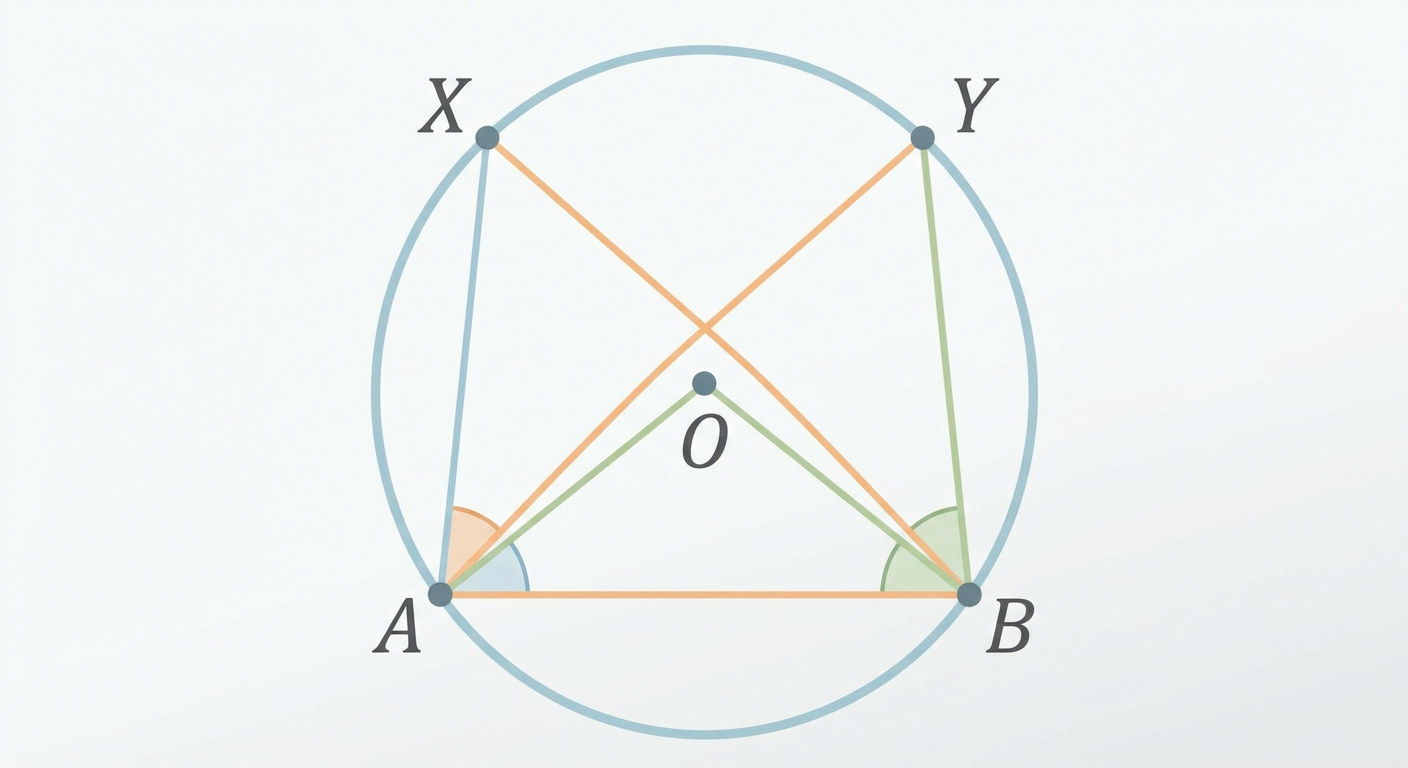
By the converse of the theorem for angles in the same segment: If a line segment subtends equal angles at two points and lying on the same side of the line containing the segment: then the four points are concyclic.
Assuming and lie on the same side of , the circle passing through must also pass through .
(iii) Yes
- Assuming points must be on the same side: In part (ii), forgetting the case where is a diameter, which makes both angles even when and are on opposite sides of .
- Missing the 'same side' condition: The converse theorem for concyclicity in part (iii) strictly requires points and to lie on the same side of line segment .
More questions in Exercise 5.6
In a circle with centre , the central angle is . If the radius of the circle is , what is the length of the chord ?
Let and be two points on a circle with centre .
(i) Are there points on the circle, on the same side of , such that is different from ?
(ii) Is it true that if , then and lie on the same side of the circle?
(iii) If , and and do not lie on the circle, does the circle through , and also pass through ?
Find in Fig. 5.26.