Circles and Geometric Shapes | Exercise 5.6
Question 3
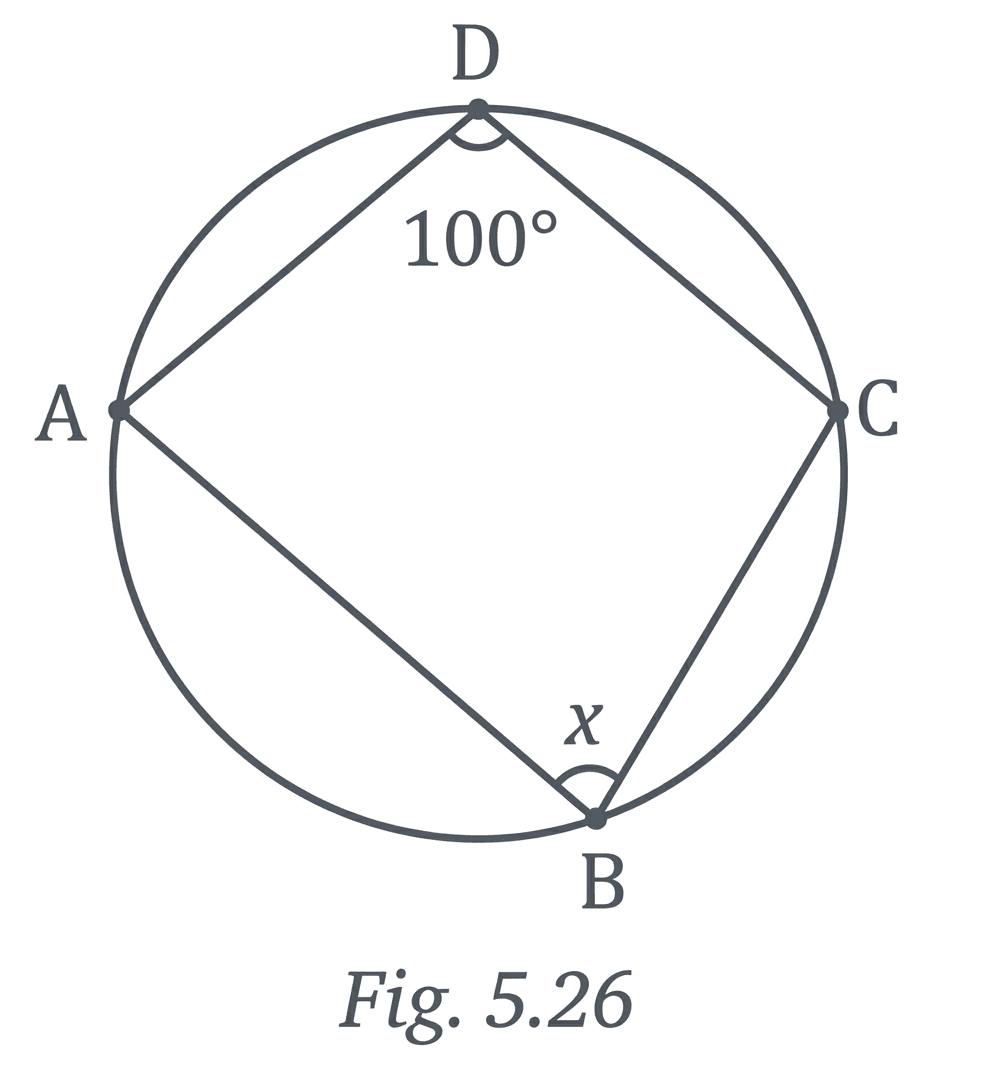
Find in Fig. 5.26.
Solution
Understand the Question
- A quadrilateral whose all four vertices lie on a circle is called a cyclic quadrilateral.
- The sum of either pair of opposite angles of a cyclic quadrilateral is (supplementary).
- Here, all four vertices , , , and lie on the circle, making a cyclic quadrilateral where and are opposite angles.
Step 1 · Find the Value of
Since vertices , , , and lie on the circle, is a cyclic quadrilateral.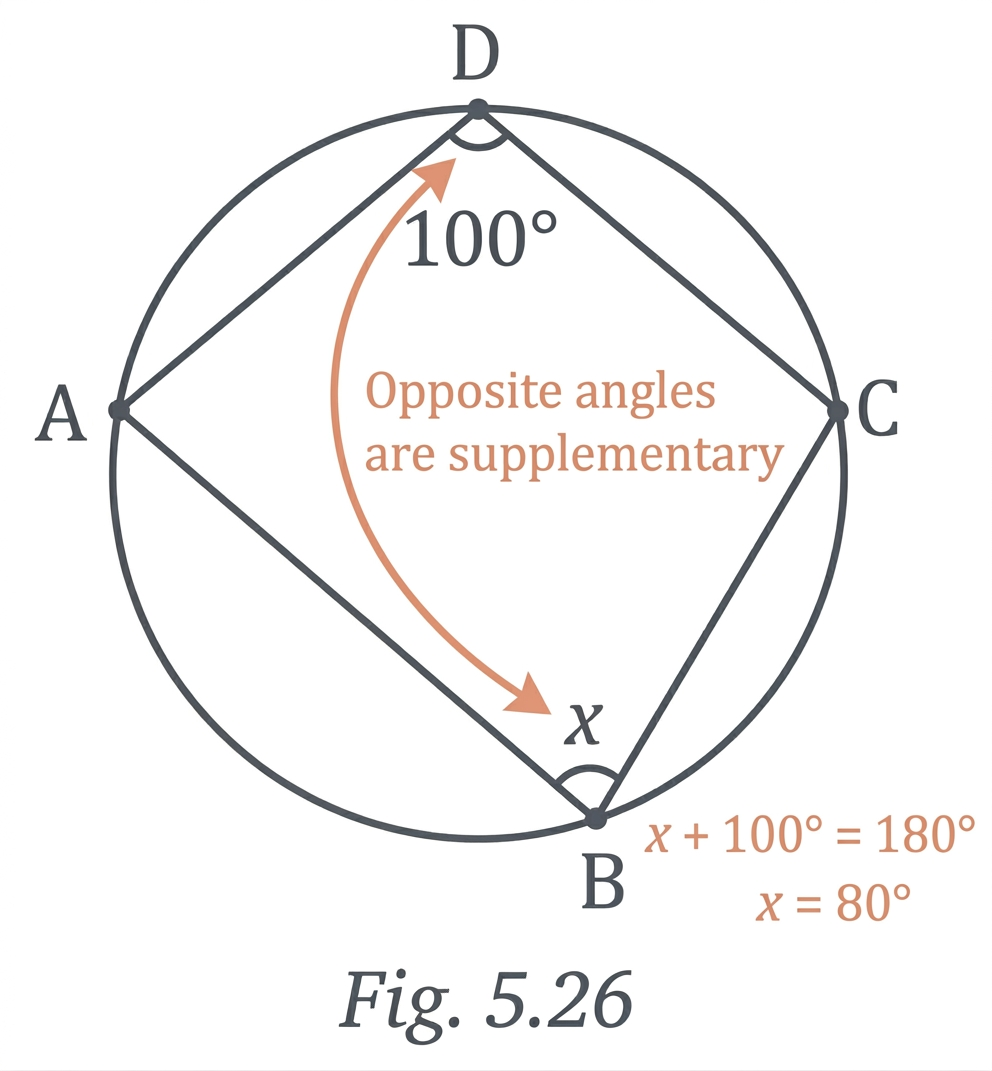
The sum of opposite angles of a cyclic quadrilateral is
Substitute and
Answer
Common Mistakes
- Opposite vs. Adjacent Angles: Misidentifying which angles are opposite. In a cyclic quadrilateral, only opposite pairs sum to , not adjacent pairs.
- Center Angle Confusion: Confusing the cyclic quadrilateral angle sum property () with the theorem that an angle subtended at the center is double the angle at the circumference.
More questions in Exercise 5.6
Q1Q2Q3
In a circle with centre , the central angle is . If the radius of the circle is , what is the length of the chord ?
Let and be two points on a circle with centre .
(i) Are there points on the circle, on the same side of , such that is different from ?
(ii) Is it true that if , then and lie on the same side of the circle?
(iii) If , and and do not lie on the circle, does the circle through , and also pass through ?
Find in Fig. 5.26.