Question 9
How many tiny squares are there in the following picture? Write the prime factorisation of the number of tiny squares.
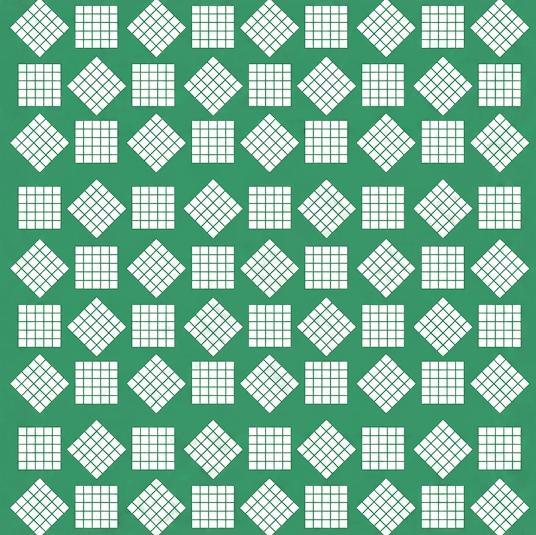
- The given image consists of a large grid arranged into rows and columns of big squares.
- Each big square is further divided into a smaller grid of tiny squares.
- To find the total number of tiny squares, multiply the total number of big squares by the number of tiny squares in each big square.
- The prime factorisation is obtained by expressing the total count as a product of prime powers.
Step 1 · Count Total Number of Big Squares
Number of big squares in a row
Number of big squares in a column 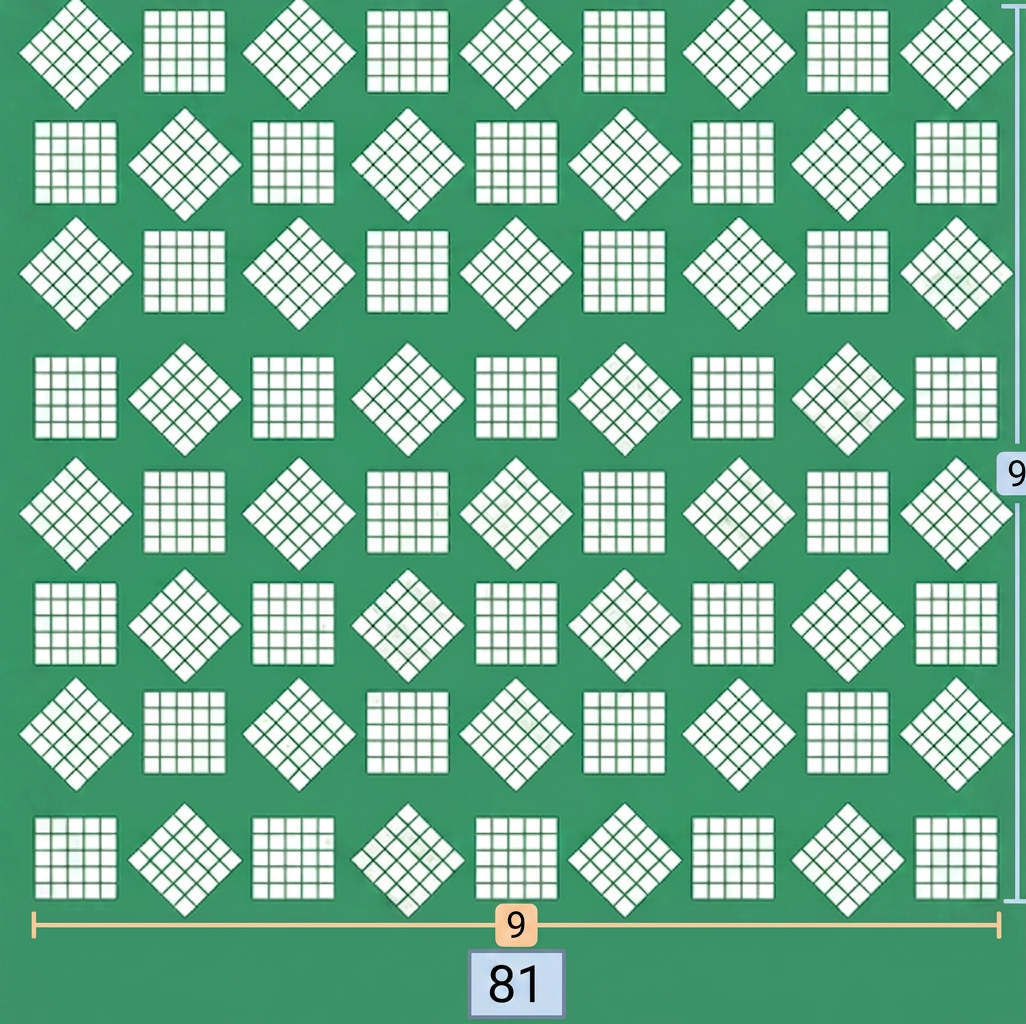
Step 2 · Count Tiny Squares in Each Big Square
Number of tiny squares along one side of a big square
Step 3 · Calculate Total Number of Tiny Squares
Step 4 · Find Prime Factorisation of Total Tiny Squares
Dividing by prime factors:
Since :
Total tiny squares ; Prime factorisation
- Manual Counting: Attempting to count all tiny squares individually instead of multiplying grid dimensions ().
- Incomplete Prime Factorisation: Leaving factors with composite bases like or instead of reducing to prime base .
- Direct Factorisation Shortcut: can be factored directly from the sub-counts without needing long division.
More questions in FIO
Which of the following numbers are not perfect squares?
(i) 2032 (ii) 2048 (iii) 1027 (iv) 1089
Which one among , , , has last digit 4?
Given , what is the value of ?
(i)
(ii)
(iii)
(iv)
(v)
Find the length of the side of a square whose area is .
Find the smallest square number that is divisible by each of the following numbers: 4, 9, and 10.
Find the smallest number by which 9408 must be multiplied so that the product is a perfect square. Find the square root of the product.
How many numbers lie between the squares of the following numbers?
(i) 16 and 17 (ii) 99 and 100
In the following pattern, fill in the missing numbers:
(a)
(b)
How many tiny squares are there in the following picture? Write the prime factorisation of the number of tiny squares.
Find the cube roots of and .
What number will you multiply by 1323 to make it a cube number?
State true or false. Explain your reasoning.
(i) The cube of any odd number is even.
(ii) There is no perfect cube that ends with 8.
(iii) The cube of a 2-digit number may be a 3-digit number.
(iv) The cube of a 2-digit number may have seven or more digits.
(v) Cube numbers have an odd number of factors.
You are told that is a perfect cube. Can you guess without factorisation what its cube root is? Similarly, guess the cube roots of , , and .
Which of the following is the greatest? Explain your reasoning.
(i)
(ii)
(iii)
(iv)