Proportional Reasoning - 1 | A

Question 4

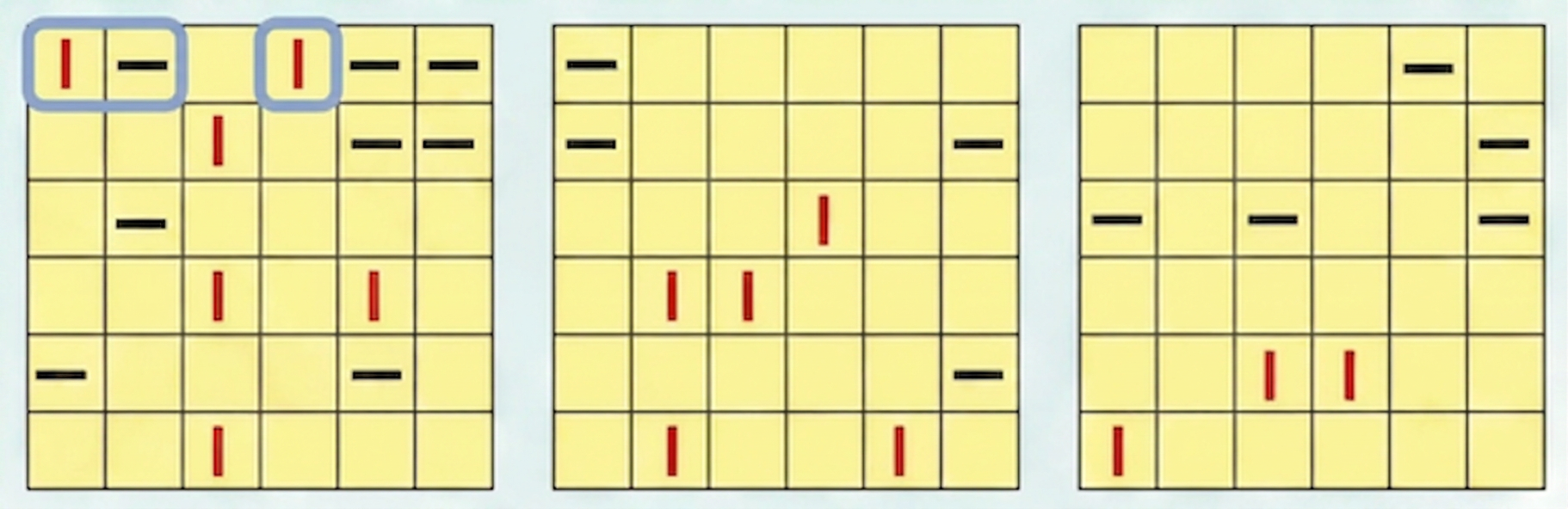
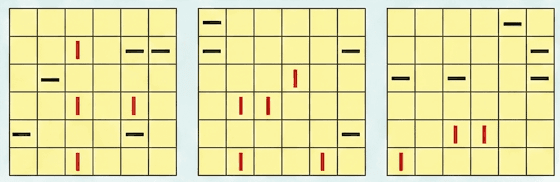
Solve the following Binairo puzzles:
Question diagram 1
Check your answer with HomiSolve it yourself, then let Homi check your steps and spot mistakes.
Solution
Understand the Question

A Binairo (or Takuzu) puzzle is a logic grid game played on a grid (here, 6×66 \times 6). We represent black dashes as 00 (or -) and red vertical lines as 11 (or |).

  • Equal Count: Each row and column must contain an equal number of both symbols (exactly three 00s and three 11s in a 6×66 \times 6 grid).
  • No Triples: No more than two identical symbols can be adjacent horizontally or vertically (no 000000 or 111111).
  • Uniqueness: Each row and column configuration must be unique and valid.

(i) Solve Grid 1

Step 1 · Fill Grid 1 using Binairo Rules

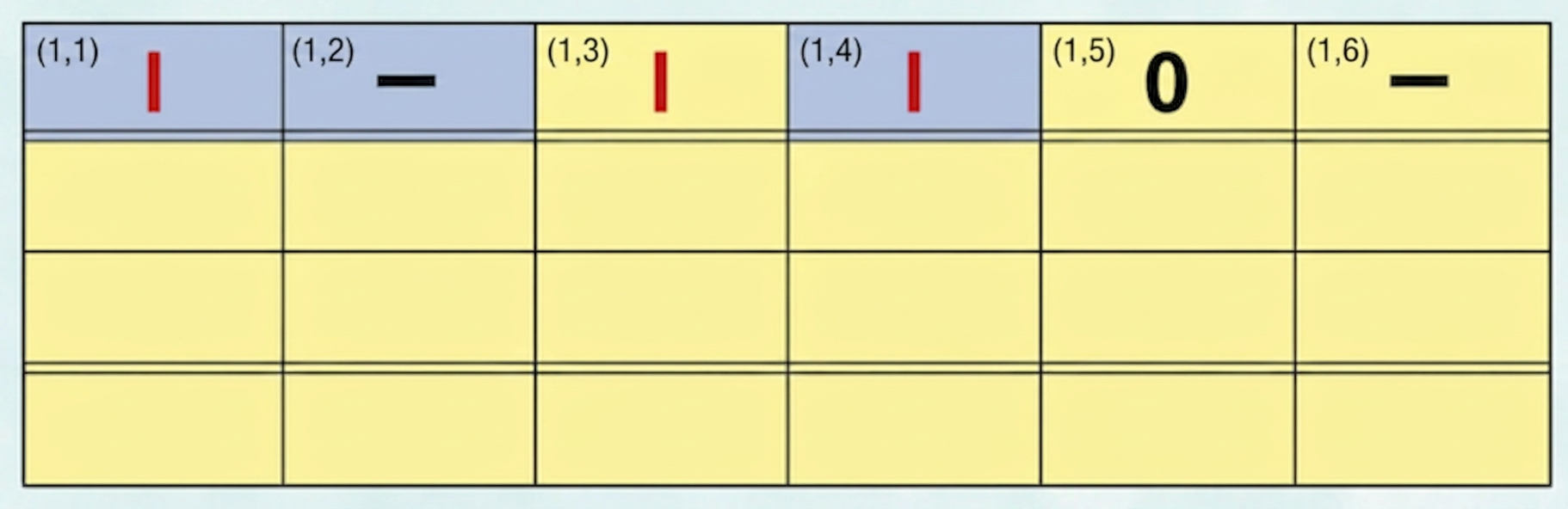
Let black dashes be 00 and red vertical lines be 11.Diagram 1

  • Cells (1,5)(1,5) and (1,6)(1,6) are 0,0    0, 0 \implies cell (1,4)=1(1,4) = 1.

  • Cells (1,3)(1,3) and (1,4)(1,4) are 1,1    1, 1 \implies cell (1,2)=0(1,2) = 0.

  • Balancing Row 1 (needs three 11s and three 00s)     \implies cell (1,1)=1(1,1) = 1. R1: 1 0 1 1 0 0\boxed{\text{R1: } 1\ 0\ 1\ 1\ 0\ 0}

  • Column 3 has 11 at (1,3)(1,3), (3,3)(3,3), and (5,3)(5,3) (already three 11s)     (2,3)=(4,3)=(6,3)=0\implies (2,3) = (4,3) = (6,3) = 0. C3: 1 0 1 0 1 0\boxed{\text{C3: } 1\ 0\ 1\ 0\ 1\ 0}

  • Column 2 has 00 at (1,2)(1,2) and (2,2)    (3,2)=1(2,2) \implies (3,2) = 1.

  • Row 3 now has three 11s at (3,2),(3,3),(3,5)    (3,1)=(3,4)=(3,6)=0(3,2), (3,3), (3,5) \implies (3,1) = (3,4) = (3,6) = 0. R3: 0 1 1 0 1 0\boxed{\text{R3: } 0\ 1\ 1\ 0\ 1\ 0}

  • In Row 2, (2,2)(2,2) and (2,3)(2,3) are 0,0    (2,1)=10, 0 \implies (2,1) = 1 and (2,4)=1(2,4) = 1. R2: 1 0 0 1 _ _\boxed{\text{R2: } 1\ 0\ 0\ 1\ \_\ \_}

  • In Column 1, (3,1)(3,1) and (4,1)(4,1) are 0,0    (5,1)=10, 0 \implies (5,1) = 1. Column 1 now has three 11s     (6,1)=0\implies (6,1) = 0. C1: 1 1 0 0 1 0\boxed{\text{C1: } 1\ 1\ 0\ 0\ 1\ 0}

  • In Row 6, (6,1)(6,1) and (6,3)(6,3) are 0,0    (6,2)=10, 0 \implies (6,2) = 1. R6: 0 1 0 1 _ _\boxed{\text{R6: } 0\ 1\ 0\ 1\ \_\ \_}

  • In Row 4, (4,1)(4,1) and (4,3)(4,3) are 0,0    (4,2)=10, 0 \implies (4,2) = 1.

  • Column 2 now has three 11s     (5,2)=0\implies (5,2) = 0. C2: 0 0 1 1 0 1\boxed{\text{C2: } 0\ 0\ 1\ 1\ 0\ 1}

  • Column 4 has three 11s     (4,4)=0\implies (4,4) = 0. C4: 1 1 0 0 0 1\boxed{\text{C4: } 1\ 1\ 0\ 0\ 0\ 1}

  • In Row 4, (4,3)(4,3) and (4,4)(4,4) are 0,0    (4,5)=10, 0 \implies (4,5) = 1. Balancing Row 4 gives (4,6)=1(4,6) = 1. R4: 0 1 0 0 1 1\boxed{\text{R4: } 0\ 1\ 0\ 0\ 1\ 1}

  • In Column 5, (3,5)(3,5) and (4,5)(4,5) are 1,1    (2,5)=01, 1 \implies (2,5) = 0 and (5,5)=0(5,5) = 0. Balancing Column 5 gives (6,5)=1(6,5) = 1. C5: 0 0 1 1 0 1\boxed{\text{C5: } 0\ 0\ 1\ 1\ 0\ 1}

  • Balancing remaining rows:

    • Row 2: (2,6)=1    R2: 1 0 0 1 0 1(2,6) = 1 \implies \boxed{\text{R2: } 1\ 0\ 0\ 1\ 0\ 1}
    • Row 5: (5,6)=1    R5: 1 0 1 0 0 1(5,6) = 1 \implies \boxed{\text{R5: } 1\ 0\ 1\ 0\ 0\ 1}
    • Row 6: (6,6)=0    R6: 0 1 0 1 1 0(6,6) = 0 \implies \boxed{\text{R6: } 0\ 1\ 0\ 1\ 1\ 0}
Answer

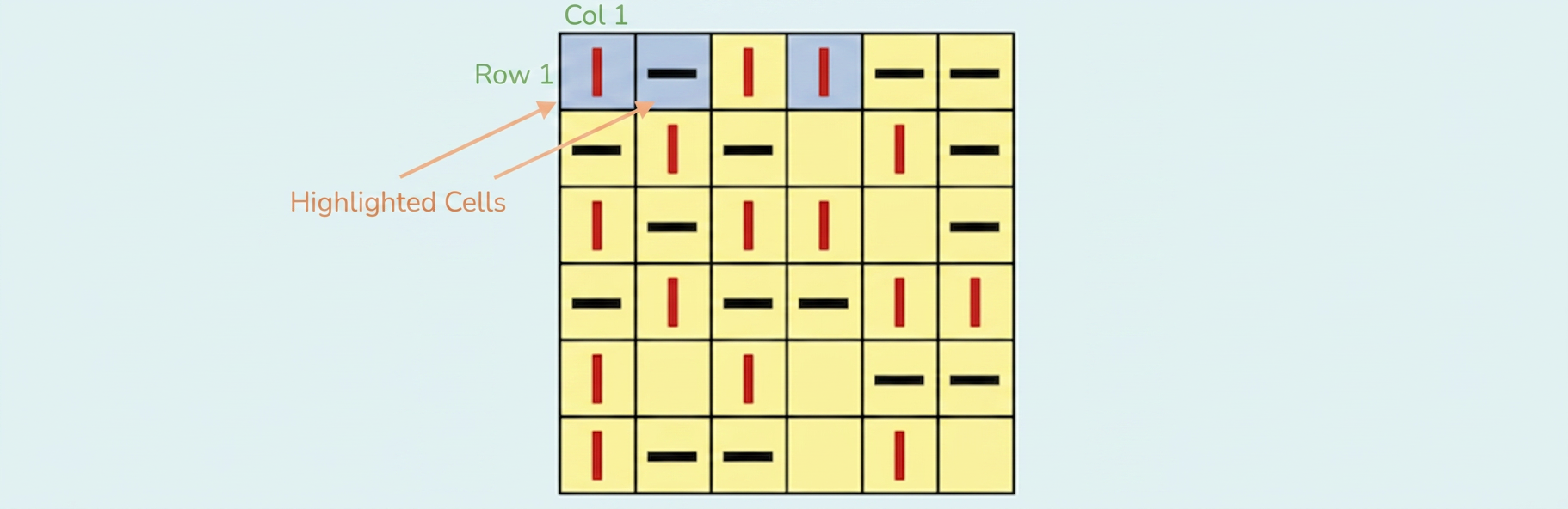
(i) \begin{array}{|c|c|c|c|c|c|}\hline | & - & | & | & - & - \\\hline | & - & - & | & - & | \\\hline - & | & | & - & | & - \\\hline - & | & - & - & | & | \\\hline | & - & | & - & - & | \\\hline - & | & - & | & | & - \\\hline\end{array}

(ii) Solve Grid 2

Step 1 · Fill Grid 2 using Binairo Rules

Let black dashes be 00 and red vertical lines be 11.Diagram 2

  • Column 1 has (1,1)=0(1,1) = 0 and (2,1)=0    (3,1)=1(2,1) = 0 \implies (3,1) = 1. C1: 0 0 1 _ _ _\boxed{\text{C1: } 0\ 0\ 1\ \_\ \_\ \_}

  • Row 3 already contains three 11s at (3,1),(3,3),(3,5)    (3,2)=(3,4)=(3,6)=0(3,1), (3,3), (3,5) \implies (3,2) = (3,4) = (3,6) = 0. R3: 1 0 1 0 1 0\boxed{\text{R3: } 1\ 0\ 1\ 0\ 1\ 0}

  • Column 3 has three 11s at (3,3),(4,3),(6,3)    (1,3)=(2,3)=(5,3)=0(3,3), (4,3), (6,3) \implies (1,3) = (2,3) = (5,3) = 0. C3: 0 0 1 1 0 1\boxed{\text{C3: } 0\ 0\ 1\ 1\ 0\ 1}

  • In Row 1, (1,1)(1,1) and (1,3)(1,3) are 0,0    (1,2)=10, 0 \implies (1,2) = 1. R1: 0 1 0 _ _ _\boxed{\text{R1: } 0\ 1\ 0\ \_\ \_\ \_}

  • In Row 2, (2,1)(2,1) and (2,3)(2,3) are 0,0    (2,2)=10, 0 \implies (2,2) = 1. R2: 0 1 0 _ _ _\boxed{\text{R2: } 0\ 1\ 0\ \_\ \_\ \_}

  • In Row 4, (4,3)(4,3) and (4,5)(4,5) are 1,1    (4,4)=01, 1 \implies (4,4) = 0. R4: _ _ 1 0 1 _\boxed{\text{R4: } \_\ \_\ 1\ 0\ 1\ \_}

  • In Row 5, (5,3)(5,3) and (5,6)(5,6) are 0,0    (5,4)=10, 0 \implies (5,4) = 1. R5: _ _ 0 1 _ 0\boxed{\text{R5: } \_\ \_\ 0\ 1\ \_\ 0}

  • In Row 6, (6,3)(6,3) and (6,6)(6,6) are 1,1    (6,5)=01, 1 \implies (6,5) = 0. R6: _ _ 1 _ 0 1\boxed{\text{R6: } \_\ \_\ 1\ \_\ 0\ 1}

  • Column 5 has (3,5)=1,(4,5)=1    (5,5)=0(3,5) = 1, (4,5) = 1 \implies (5,5) = 0. C5: _ _ 1 1 0 0\boxed{\text{C5: } \_\ \_\ 1\ 1\ 0\ 0}

  • Row 5 has three 00s     (5,2)=1\implies (5,2) = 1 and (5,1)=1(5,1) = 1. R5: 1 1 0 1 0 0\boxed{\text{R5: } 1\ 1\ 0\ 1\ 0\ 0}

  • Column 1 has (3,1)=1,(5,1)=1    (4,1)=0(3,1) = 1, (5,1) = 1 \implies (4,1) = 0, giving (6,1)=1(6,1) = 1. C1: 0 0 1 0 1 1\boxed{\text{C1: } 0\ 0\ 1\ 0\ 1\ 1}

  • Column 2 has (2,2)=1,(5,2)=1    (4,2)=0(2,2) = 1, (5,2) = 1 \implies (4,2) = 0, giving (6,2)=0(6,2) = 0. C2: 1 1 0 0 1 0\boxed{\text{C2: } 1\ 1\ 0\ 0\ 1\ 0}

  • Balancing remaining cells:

    • Row 4: (4,6)=1    R4: 0 0 1 0 1 1(4,6) = 1 \implies \boxed{\text{R4: } 0\ 0\ 1\ 0\ 1\ 1}
    • Column 4: (2,4)=1,(6,4)=0    C4: 1 1 0 0 1 0(2,4) = 1, (6,4) = 0 \implies \boxed{\text{C4: } 1\ 1\ 0\ 0\ 1\ 0}
    • Row 1: (1,5)=0,(1,6)=1    R1: 0 1 0 1 0 1(1,5) = 0, (1,6) = 1 \implies \boxed{\text{R1: } 0\ 1\ 0\ 1\ 0\ 1}
    • Column 6: (2,6)=0    C6: 1 0 0 1 0 1(2,6) = 0 \implies \boxed{\text{C6: } 1\ 0\ 0\ 1\ 0\ 1}
    • Row 2: (2,5)=1    R2: 0 1 0 1 1 0(2,5) = 1 \implies \boxed{\text{R2: } 0\ 1\ 0\ 1\ 1\ 0}
Answer

(ii) \begin{array}{|c|c|c|c|c|c|}\hline - & | & - & | & - & | \\\hline - & | & - & | & | & - \\\hline | & - & | & - & | & - \\\hline - & - & | & - & | & | \\\hline | & | & - & | & - & - \\\hline | & - & | & - & - & | \\\hline\end{array}

(iii) Solve Grid 3

Step 1 · Fill Grid 3 using Binairo Rules

Let black dashes be 00 and red vertical lines be 11.Diagram 3

  • In Column 6, (2,6)(2,6) and (3,6)(3,6) are 0,0    (1,6)=10, 0 \implies (1,6) = 1. C6: _ _ _ _ _ 1 0 0\boxed{\text{C6: } \_\ \_\ \_\ \_\ \_\ 1\ 0\ 0}

  • In Row 1, (1,5)=0    (1,4)=1(1,5) = 0 \implies (1,4) = 1. R1: _ _ _ 1 0 1\boxed{\text{R1: } \_\ \_\ \_\ 1\ 0\ 1}

  • In Row 3, (3,2)=0    (3,1)=1(3,2) = 0 \implies (3,1) = 1. R3: 1 0 _ _ _ 0\boxed{\text{R3: } 1\ 0\ \_\ \_\ \_\ 0}

  • Column 1 has (3,1)=1,(6,1)=1    (1,1)=0,(2,1)=0(3,1) = 1, (6,1) = 1 \implies (1,1) = 0, (2,1) = 0. C1: 0 0 1 _ _ 1\boxed{\text{C1: } 0\ 0\ 1\ \_\ \_\ 1}

  • In Row 2, (2,6)=0    (2,5)=1(2,6) = 0 \implies (2,5) = 1. R2: 0 _ _ _ 1 0\boxed{\text{R2: } 0\ \_\ \_\ \_\ 1\ 0}

  • In Column 5, (2,5)=1    (3,5)=0(2,5) = 1 \implies (3,5) = 0. C5: 0 1 0 _ _ _\boxed{\text{C5: } 0\ 1\ 0\ \_\ \_\ \_}

  • In Row 3, (3,2)=0,(3,5)=0    (3,3)=1(3,2) = 0, (3,5) = 0 \implies (3,3) = 1. Balancing Row 3 gives (3,4)=1(3,4) = 1. R3: 1 0 1 1 0 0\boxed{\text{R3: } 1\ 0\ 1\ 1\ 0\ 0}

  • Column 3 already contains three 11s     (2,3)=(4,3)=(6,3)=0\implies (2,3) = (4,3) = (6,3) = 0. C3: 1 0 1 0 1 0\boxed{\text{C3: } 1\ 0\ 1\ 0\ 1\ 0}

  • In Column 4, to avoid violating Row 2 rules, (2,4)=1(2,4) = 1. Column 4 now has three 11s     (4,4)=(5,4)=(6,4)=0\implies (4,4) = (5,4) = (6,4) = 0. C4: 1 1 1 0 0 0\boxed{\text{C4: } 1\ 1\ 1\ 0\ 0\ 0}

  • Row 2 has three 00s     (2,2)=1\implies (2,2) = 1. R2: 0 1 0 1 1 0\boxed{\text{R2: } 0\ 1\ 0\ 1\ 1\ 0}

  • Column 2 has (3,2)=0    (4,2)=1(3,2) = 0 \implies (4,2) = 1. Balancing gives (6,2)=0(6,2) = 0. C2: 0 1 0 1 1 0\boxed{\text{C2: } 0\ 1\ 0\ 1\ 1\ 0}

  • Balancing remaining rows:

    • Row 1: (1,3)=1    R1: 0 0 1 1 0 1(1,3) = 1 \implies \boxed{\text{R1: } 0\ 0\ 1\ 1\ 0\ 1}
    • Row 4: (4,5)=1,(4,6)=1    R4: 0 1 0 0 1 1(4,5) = 1, (4,6) = 1 \implies \boxed{\text{R4: } 0\ 1\ 0\ 0\ 1\ 1}
    • Row 5: (5,5)=0,(5,6)=0    R5: 1 1 1 0 0 0(5,5) = 0, (5,6) = 0 \implies \boxed{\text{R5: } 1\ 1\ 1\ 0\ 0\ 0}
    • Row 6: (6,5)=1,(6,6)=1    R6: 1 0 0 0 1 1(6,5) = 1, (6,6) = 1 \implies \boxed{\text{R6: } 1\ 0\ 0\ 0\ 1\ 1}
Answer

(iii) \begin{array}{|c|c|c|c|c|c|}\hline - & - & | & | & - & | \\\hline - & | & - & | & | & - \\\hline | & - & | & | & - & - \\\hline - & | & - & - & | & | \\\hline | & | & | & - & - & - \\\hline | & - & - & - & | & | \\\hline\end{array}

Common Mistakes
  • Consecutive Symbols Violation: Placing three identical symbols consecutively in any row or column (e.g., --- or ||| is not permitted).
  • Incorrect Symbol Count: Exceeding the maximum allowed count of 3 dashes (-) or 3 vertical lines (|) in any 6×66 \times 6 row or column.
  • Overlooking Between-Pairs Rule: Failing to notice that two identical symbols with a one-cell gap (e.g., 0_00 \_ 0) must have the opposite symbol between them (0100 1 0).

More questions in A

Q1

Take your favourite dish. Find out all the ingredients and their respective quantities needed to make the dish for your family. Suppose you are celebrating a festival and you want to invite 15 guests. Find out the quantities of the ingredients required to cook the same dish for them.

Q2

Go to the market and collect the prices of different sizes of shampoo containers of the same shampoo and create a table like the one given below. See if the volume of shampoo is proportional to the price.

Q3

Activity 3: Form a pair. Collect 12 countable objects or counters (it can be coins, seeds, or pebbles). Now, share them between the two of you in different ways.

Q4

Solve the following Binairo puzzles:

← Back to Proportional Reasoning - 1