Question 2
Go to the market and collect the prices of different sizes of shampoo containers of the same shampoo and create a table like the one given below. See if the volume of shampoo is proportional to the price.
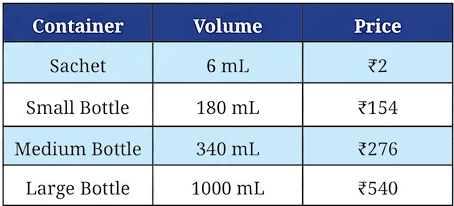
- Two quantities are proportional if the ratio of one quantity to the other remains constant throughout (i.e. ).
- To determine if the volume of shampoo is proportional to its price, we calculate the unit rate (price per ) for each container size:
- If the unit rates are equal across all sizes, the quantities are directly proportional; if they differ, they are not proportional.
Step 1 · Calculate Price per mL for Sachet
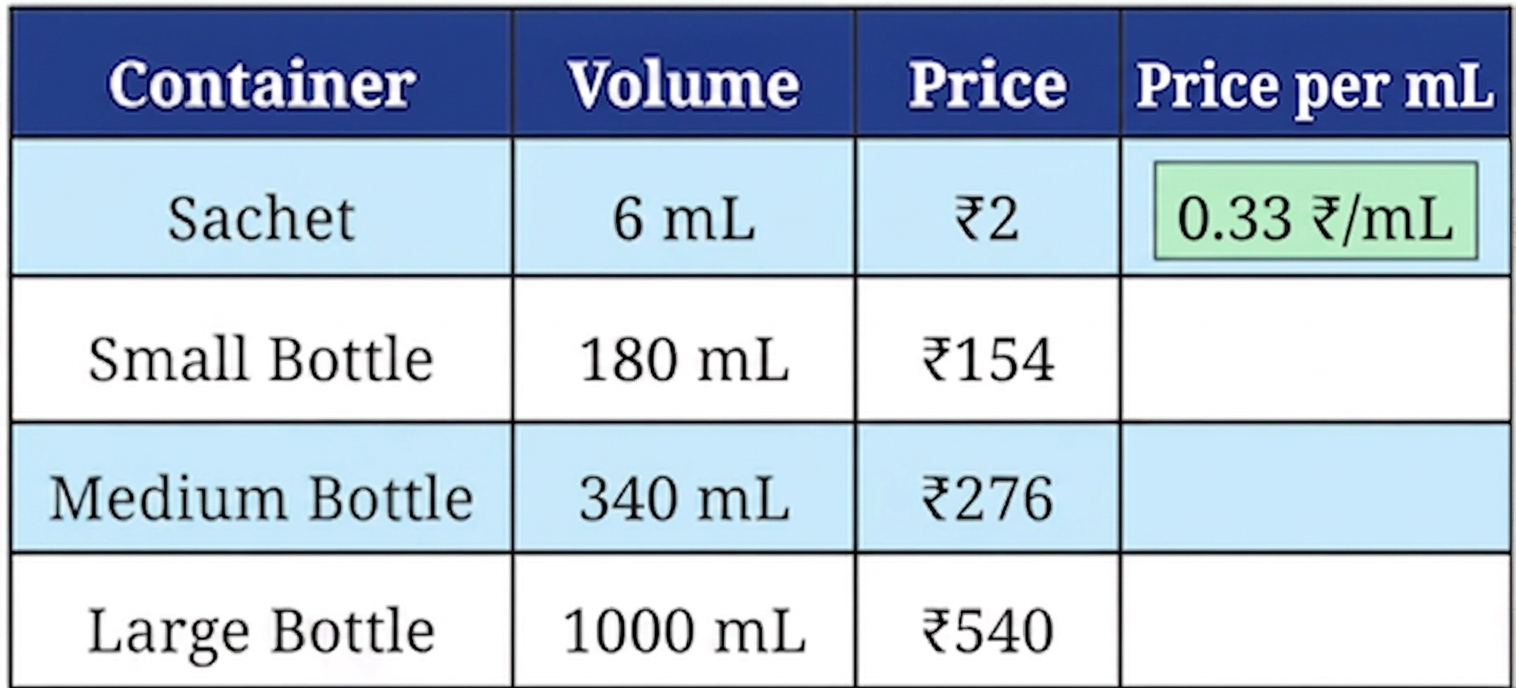
Step 2 · Calculate Price per mL for Small Bottle
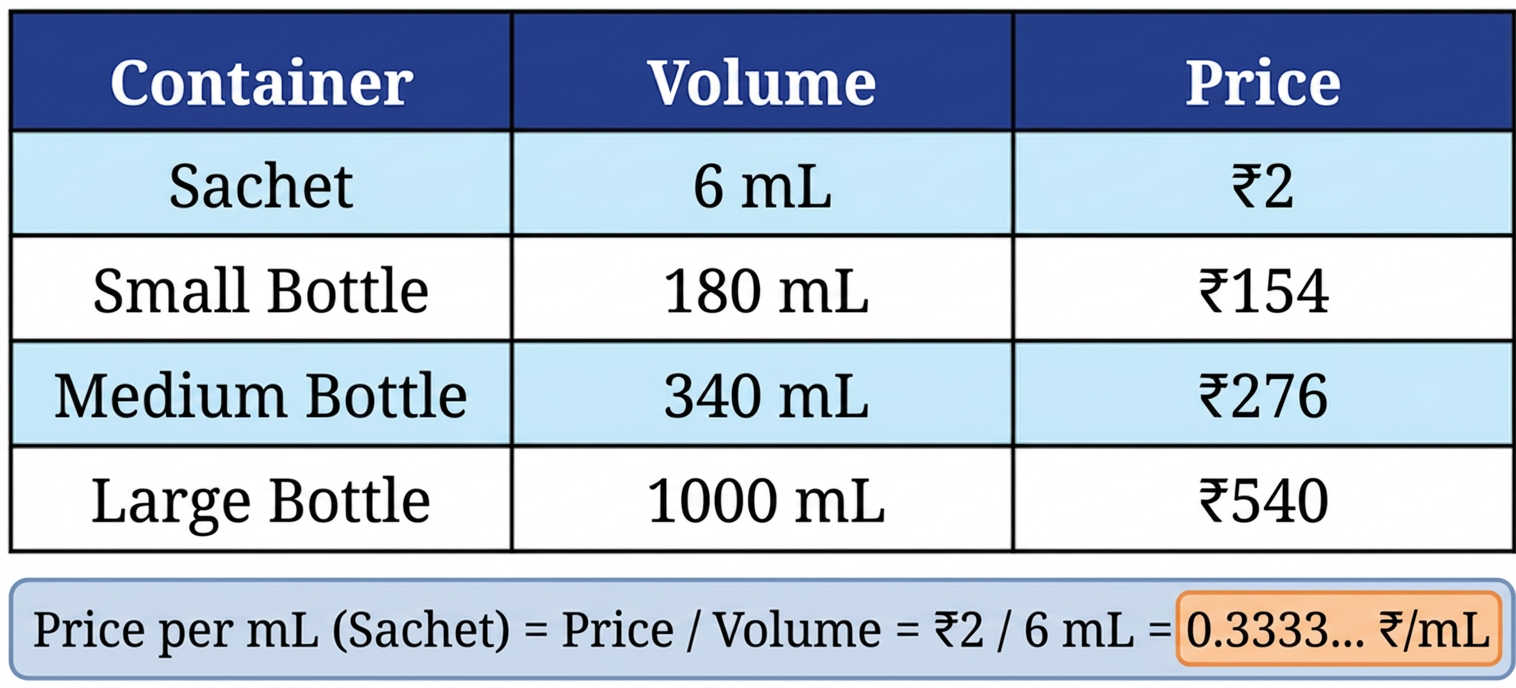
Step 3 · Calculate Price per mL for Medium Bottle
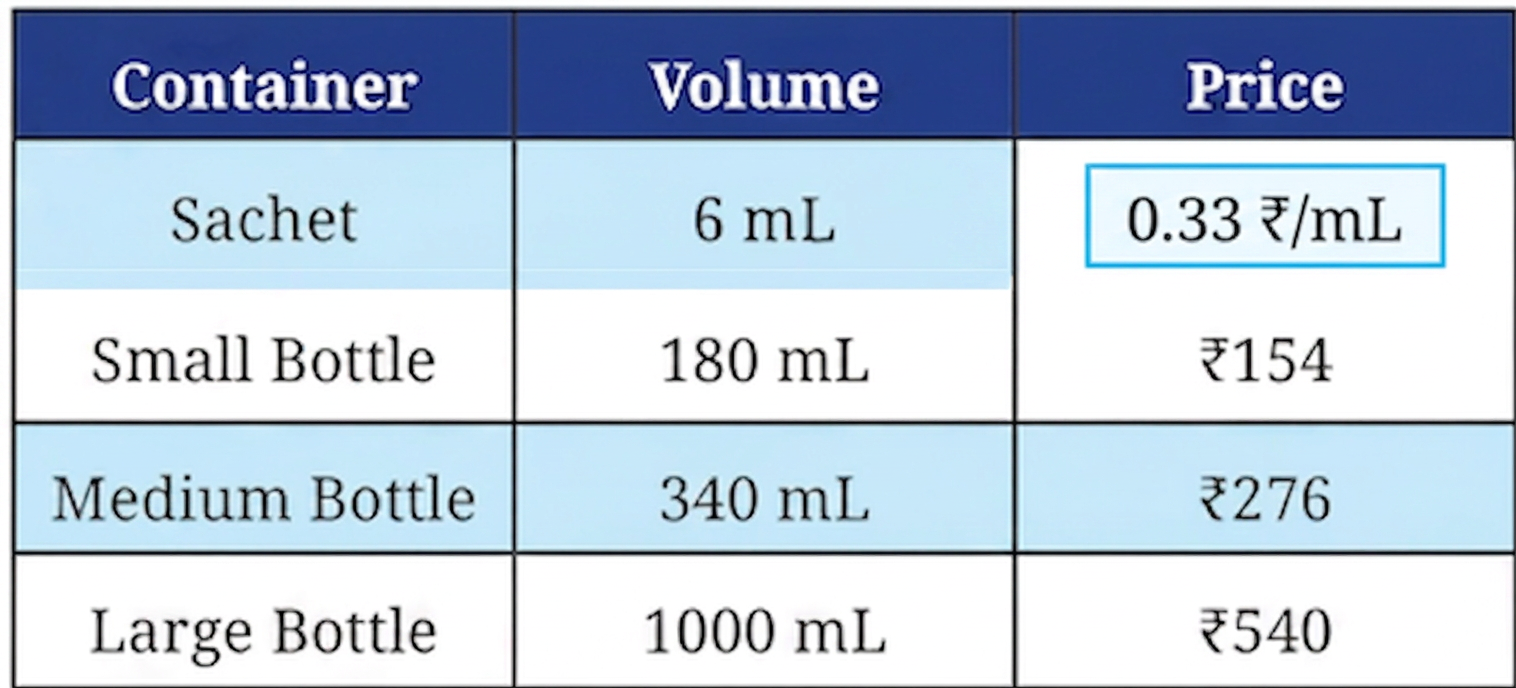
Step 4 · Calculate Price per mL for Large Bottle
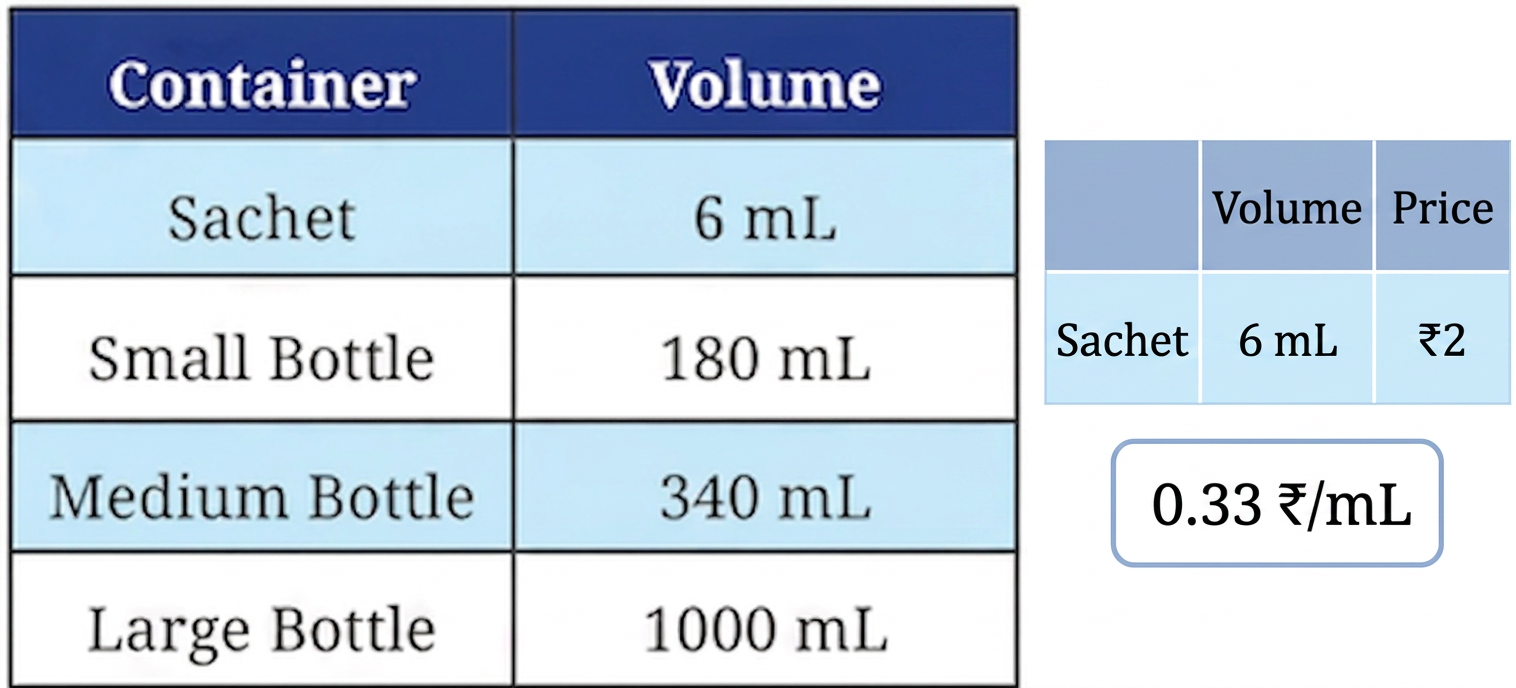
Step 5 · Compare Price per mL Values
Summarizing the unit prices:
- Sachet:
- Small Bottle:
- Medium Bottle:
- Large Bottle:
Since the ratio is not constant across all sizes, the volume of shampoo is not proportional to its price.
No, the volume of shampoo is not proportional to the price because the price per varies across different container sizes.
- Assuming Larger Always Means Cheaper Unit Price: Students often assume unit rates strictly decrease as bottle size increases, but packaging strategies (like low-cost promotional sachets) may result in unexpected variations.
- Inverting the Ratio: Dividing () for some items and () for others. Keep the unit rate definition consistent across all comparisons.
More questions in A
Take your favourite dish. Find out all the ingredients and their respective quantities needed to make the dish for your family. Suppose you are celebrating a festival and you want to invite 15 guests. Find out the quantities of the ingredients required to cook the same dish for them.
Go to the market and collect the prices of different sizes of shampoo containers of the same shampoo and create a table like the one given below. See if the volume of shampoo is proportional to the price.
Activity 3: Form a pair. Collect 12 countable objects or counters (it can be coins, seeds, or pebbles). Now, share them between the two of you in different ways.
Solve the following Binairo puzzles: