Question 3
Activity 3: Form a pair. Collect 12 countable objects or counters (it can be coins, seeds, or pebbles). Now, share them between the two of you in different ways.
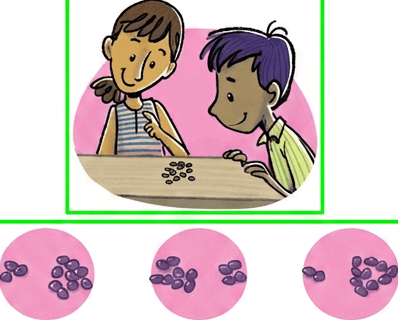
- Sharing countable objects between two people means dividing the total so that the sum of both shares equals .
- If Person 1 receives objects, then Person 2 receives objects, where is any whole number from to .
Step 1 · Identify Total Objects and Sharing Rule
Total number of objects to share:
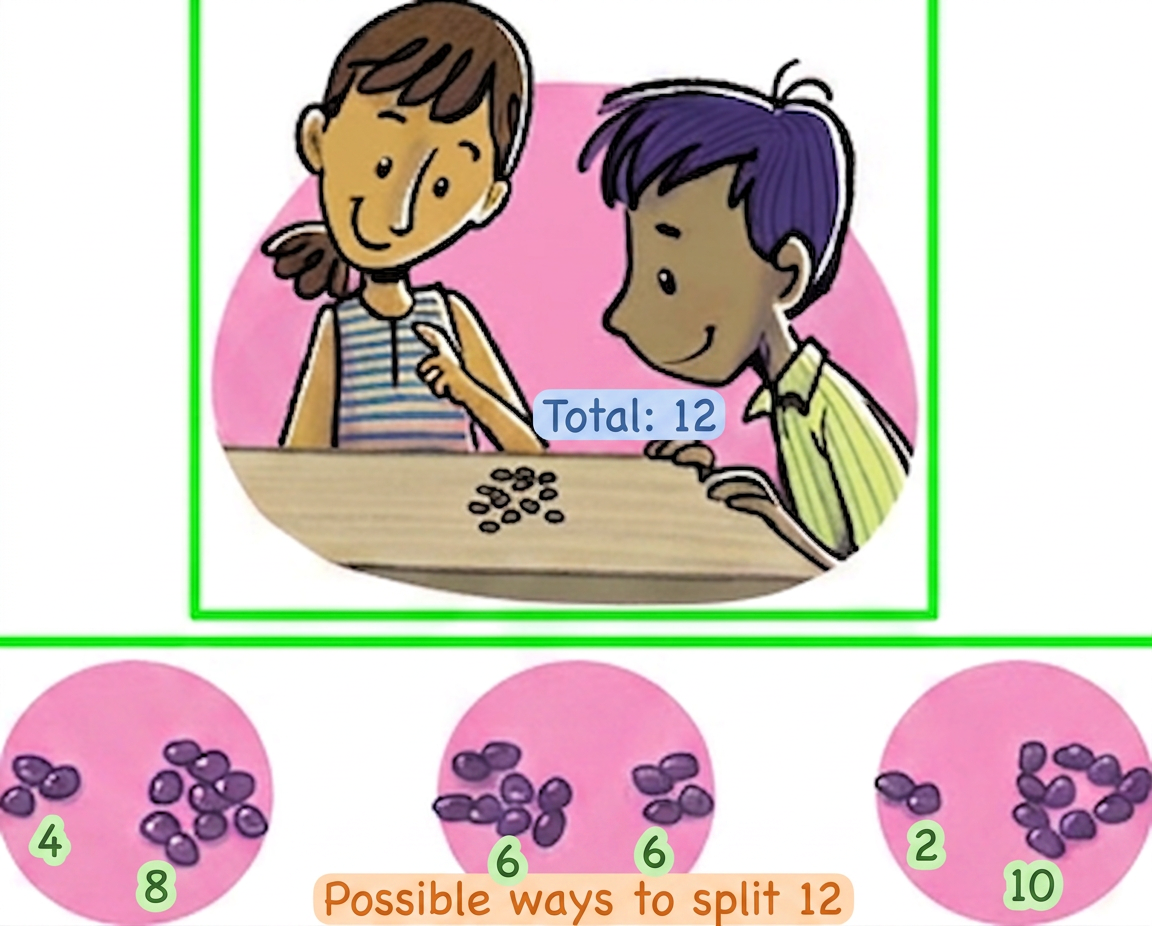
If Person 1 receives objects, Person 2 receives objects, where can be any whole number from to .
Step 2 · Examples of Sharing
Examples of dividing the objects into two parts:
The possible ways to share the objects between Person 1 and Person 2 (Person 1, Person 2) are:
- Overlooking Zero: Forgetting that giving objects to one person and all to the other is a valid mathematical partition.
- Sum Mismatch: Ensuring that for every combination , the condition is strictly satisfied.
More questions in A
Take your favourite dish. Find out all the ingredients and their respective quantities needed to make the dish for your family. Suppose you are celebrating a festival and you want to invite 15 guests. Find out the quantities of the ingredients required to cook the same dish for them.
Go to the market and collect the prices of different sizes of shampoo containers of the same shampoo and create a table like the one given below. See if the volume of shampoo is proportional to the price.
Activity 3: Form a pair. Collect 12 countable objects or counters (it can be coins, seeds, or pebbles). Now, share them between the two of you in different ways.
Solve the following Binairo puzzles: