Question 16
Calculate and write the answer in scientific notation:
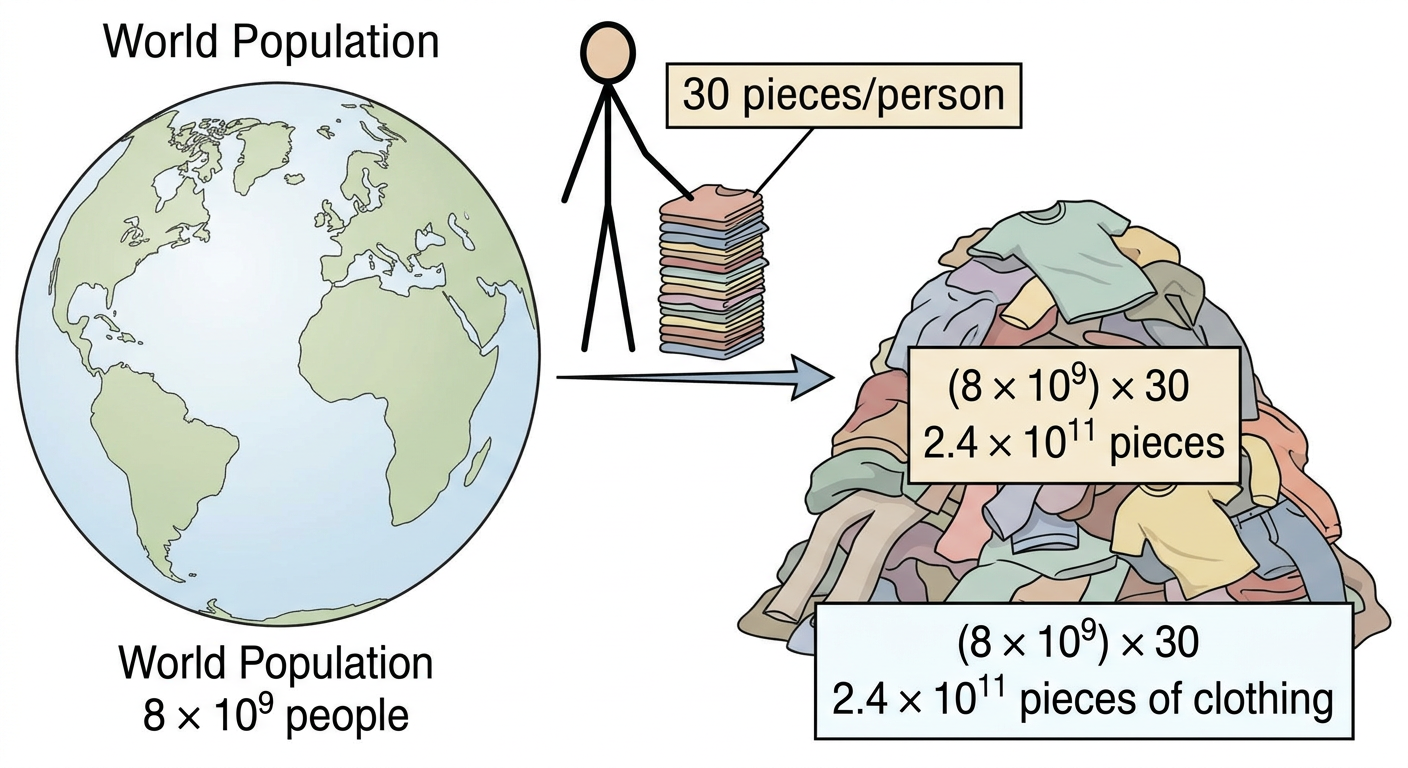
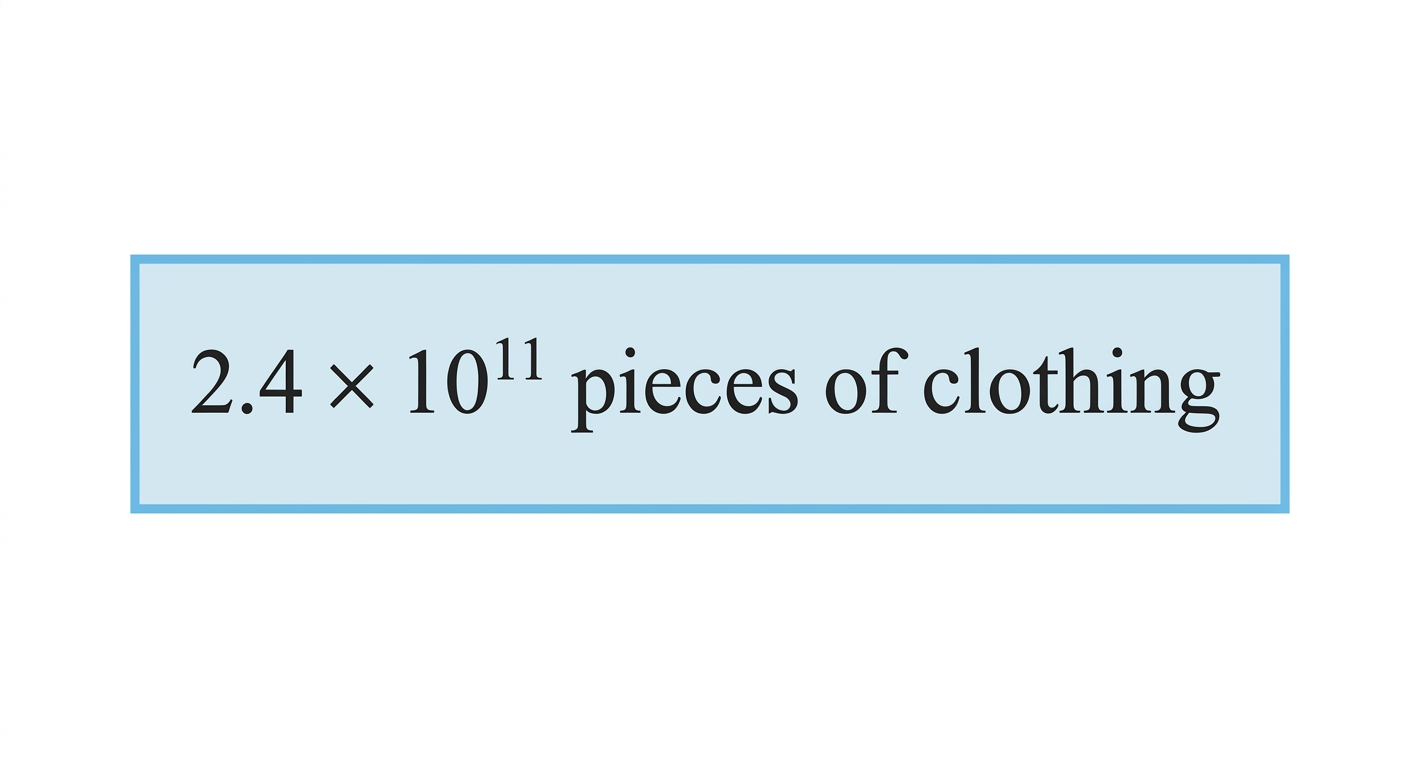
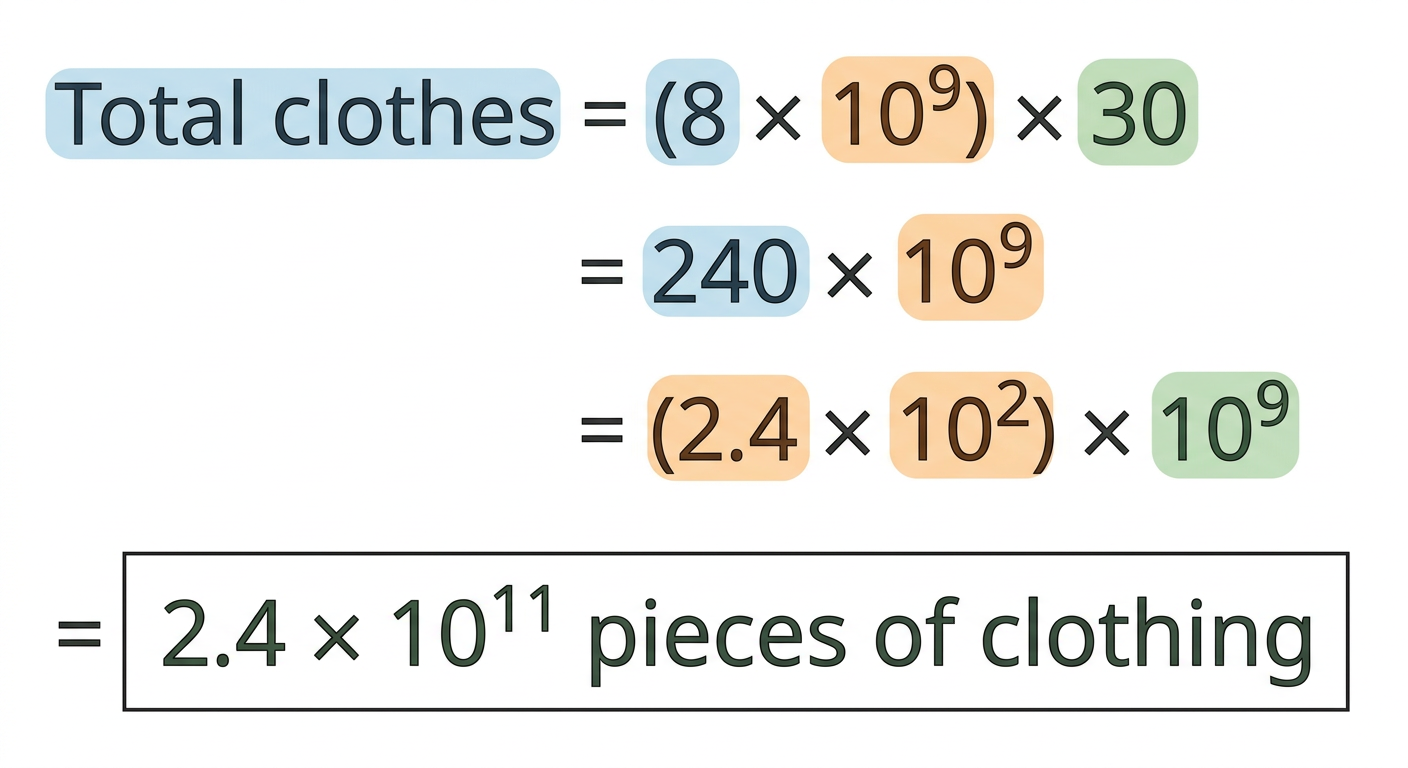
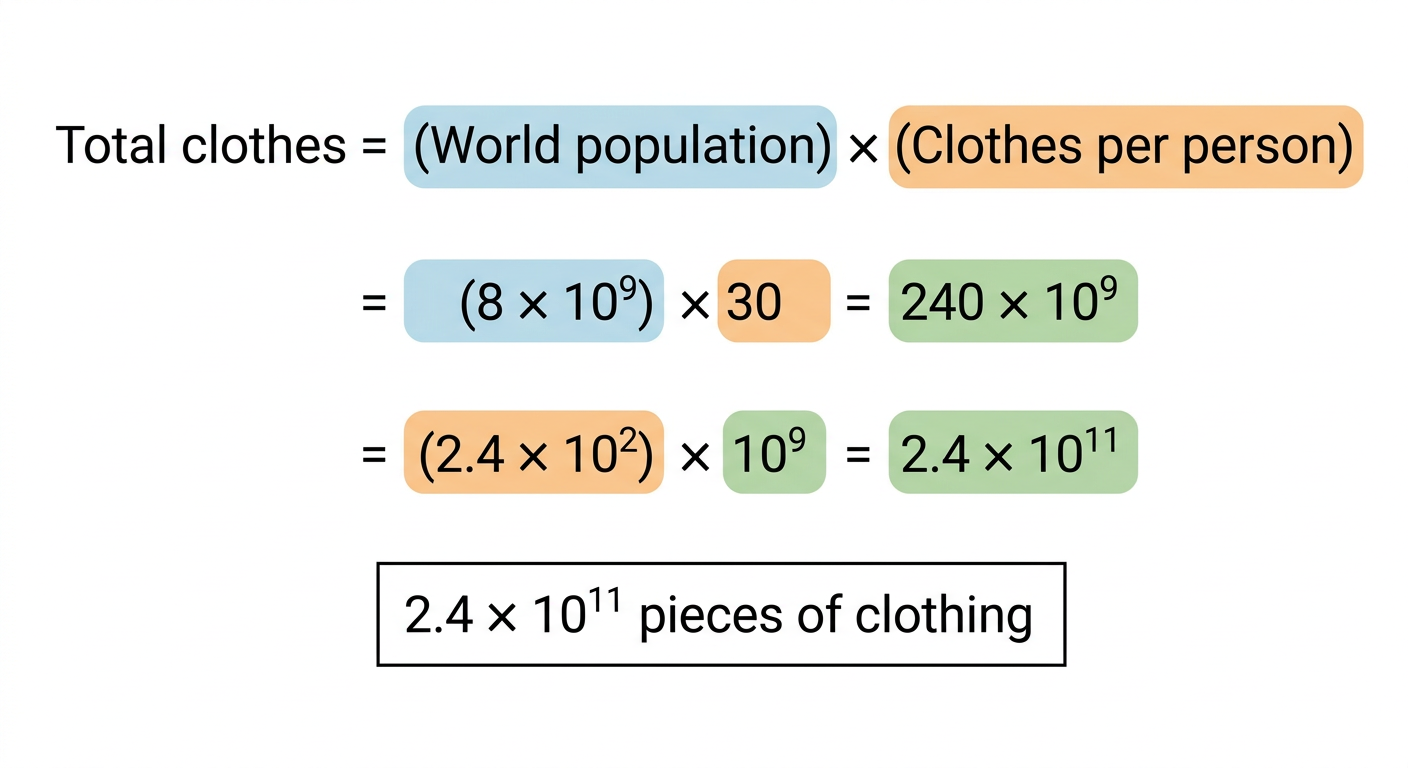
(i) If each person in the world had 30 pieces of clothing, find the total number of pieces of clothing.
(ii) There are about 100 million bee colonies in the world. Find the number of honeybees if each colony has about 50,000 bees.
(iii) The human body has about 38 trillion bacterial cells. Find the bacterial population residing in all humans in the world.
(iv) Total time spent eating in a lifetime in seconds.
We will use scientific notation to express very large numbers in a compact way. Scientific notation writes a number as a product of a number between 1 and 10 and a power of 10.
Step 1 — Total clothing pieces
Let us find the total number of clothes. We multiply the world population by clothes per person. The world population is about people. Each person has 30 pieces of clothing.
To write this in scientific notation, we change 240 to .
Step 2 — Total honeybees
We need to find the total number of honeybees. We multiply the number of bee colonies by bees per colony. There are 100 million bee colonies. One million is . So, 100 million is . Each colony has 50,000 bees. 50,000 is .
Step 3 — Total bacterial population
Let us calculate the total bacterial cells. We multiply the world population by bacterial cells per human. The world population is . Each human body has 38 trillion bacterial cells. One trillion is . So, 38 trillion is . We write as . So, .
To write this in scientific notation, we change 30.4 to .
Step 4 — Total eating time in a lifetime
We need to find the total time spent eating in seconds. First, we convert daily eating time to seconds. Average eating time per day is 1.5 hours. There are 60 minutes in an hour and 60 seconds in a minute.
Next, we find the number of days in an average lifespan. Average lifespan is 70 years. There are 365 days in a year.
Finally, we multiply daily eating time by the number of days in a lifespan.
To write this in scientific notation, we move the decimal point 8 places to the left.
Answer
(i) The total number of pieces of clothing is . (ii) The total number of honeybees is . (iii) The total bacterial population residing in all humans is . (iv) The total time spent eating in a lifetime is seconds.
More questions in FIO
Express the following in exponential form:
(i)
(ii)
(iii)
(iv)
(v)
(vi)
Express each of the following as a product of powers of their prime factors in exponential form:
(i) 648
(ii) 405
(iii) 540
(iv) 3600
Write the numerical value of each of the following:
(i)
(ii)
(iii)
(iv)
(v)
(vi)
Find out the units digit in the value of ? [Hint: ]
There are 5 bottles in a container. Every day, a new container is brought in. How many bottles would there be after 40 days?
Write the given number as the product of two or more powers in three different ways. The powers can be any integers.
(i) (ii) (iii)
Examine each statement below and find out if it is 'Always True', 'Only Sometimes True', or 'Never True'. Explain your reasoning.
(i) Cube numbers are also square numbers.
(ii) Fourth powers are also square numbers.
(iii) The fifth power of a number is divisible by the cube of that number.
(iv) The product of two cube numbers is a cube number.
(v) is both a 4th power and a 6th power ( is a prime number).
Simplify and write these in the exponential form.
(i)
(ii)
(iii)
(iv)
(v)
If what is
(i)
(ii)
(iii)
(iv)
Circle the numbers that are the same—
Identify the greater number in each of the following—
(i) or
(ii) or
(iii) or
A dairy plans to produce 8.5 billion packets of milk in a year. They want a unique ID (identifier) code for each packet. If they choose to use the digits 0–9, how many digits should the code consist of?
64 is a square number () and a cube number (). Are there other numbers that are both squares and cubes? Is there a way to describe such numbers in general?
A digital locker has an alphanumeric (it can have both digits and letters) passcode of length 5. Some example codes are G89P0, 38098, BRJKW, and 003AZ. How many such codes are possible?
The worldwide population of sheep (2024) is about , and that of goats is also about the same. What is the total population of sheep and goats?
(ii)
(ii)
(iii)
(iv)
(v)
(vi)
Calculate and write the answer in scientific notation:
(i) If each person in the world had 30 pieces of clothing, find the total number of pieces of clothing.
(ii) There are about 100 million bee colonies in the world. Find the number of honeybees if each colony has about 50,000 bees.
(iii) The human body has about 38 trillion bacterial cells. Find the bacterial population residing in all humans in the world.
(iv) Total time spent eating in a lifetime in seconds.
What was the date 1 arab/1 billion seconds ago?