Question 4
Mark the sides of a square into thirds and cut off each of its corners as far as the marks. What shape is left?
- Dividing each of the sides of a square into thirds marks points on each side.
- Cutting off each corner "as far as the marks" removes a small right-angled triangle from each of the corners.
- The remaining shape retains the middle third of each original side ( edges) and gains a new straight edge at each cut corner ( edges), resulting in an -sided polygon.
Step 1 · Divide Sides and Cut Corners
Let the square have a side length of . Dividing each side into three equal parts gives segments of length:
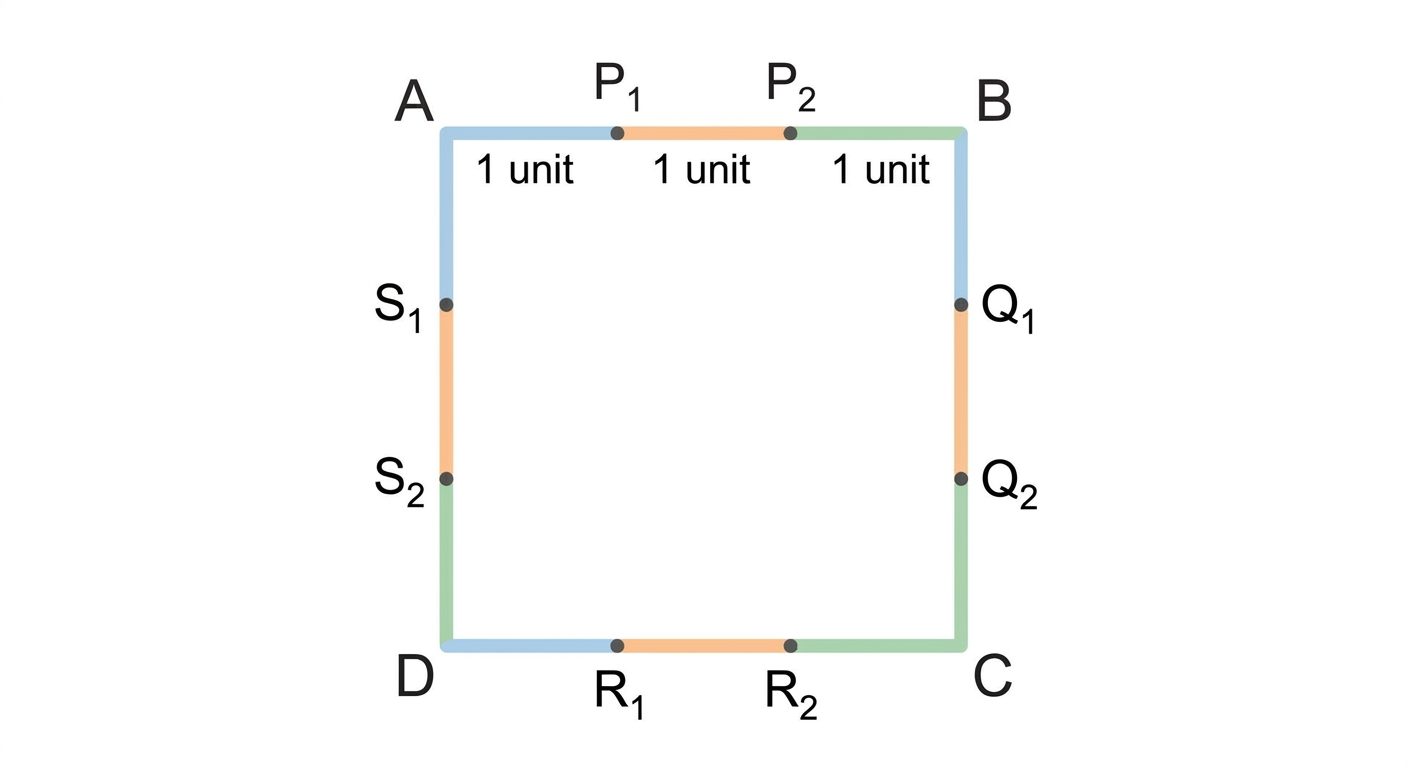
Cutting off each corner as far as the marks connects the first mark on one side to the adjacent mark on the perpendicular side, removing corner triangles.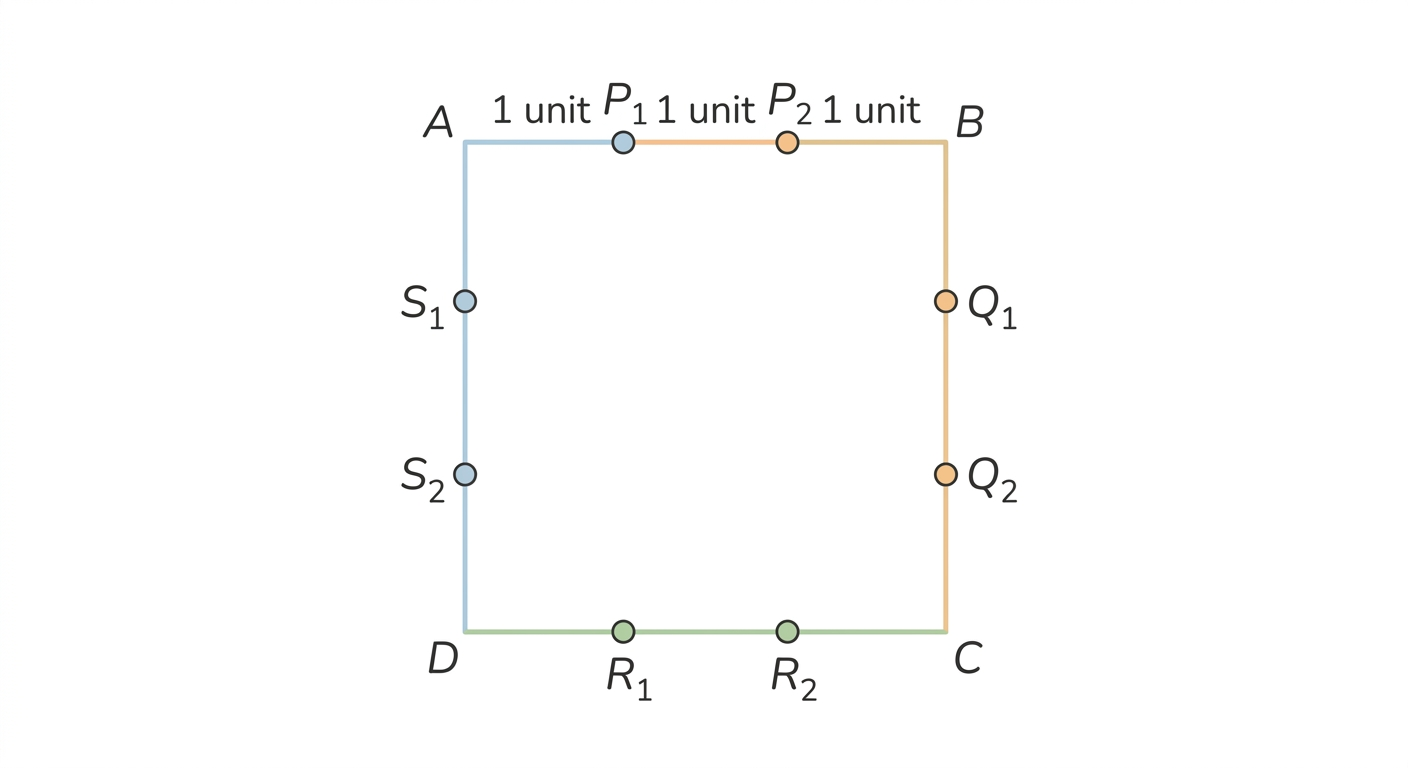
Step 2 · Count Sides and Identify the Shape
Each corner cut introduces new straight edge, and the middle segment of each original side remains:
A closed polygon with straight sides is called an octagon.
Octagon
- Assuming it is a Regular Octagon: While the shape has sides (an octagon), the straight edges have length and the cut diagonal edges have length , so the sides are not all equal.
- Under-counting Sides: Forgetting that cutting a corner replaces vertex with new flat side instead of reducing the total number of sides.
More questions in A
Build it in Your Imagination
We will start this section by practising visualisation. For each prompt, feel free to talk to your partner, gesture, draw it in the air — but do not actually draw on paper!
- Picture your name, then read off the letters backwards. Make sure to do this by sight, not by sound — really see your name! Now try with your friend's name.
Cut off the four corners of an imaginary square, with each cut going between midpoints of adjacent edges. What shape is left over? How can you reassemble the four corners to make another square?
Mark the sides of an equilateral triangle into thirds. Cut off each corner of the triangle, as far as the marks. What shape do you get?
Mark the sides of a square into thirds and cut off each of its corners as far as the marks. What shape is left?
Net of a sphere? Experiment and see if you can make a paper cutout that can perfectly wrap around a ball without leaving any wrinkles, gaps or overlaps.
Place an object in front of a plane, such as a wall of your room. Shine a torch light on the object in a direction perpendicular to the wall.
What do you see?
Observe what happens to the size of the shadow as you vary the distance between your torch and your object.
Context: Observe what happens to the size of the shadow as you vary the distance between your torch and your object.
Q. Why does this happen?
Construct a model of a cube and use your hands to keep it balanced on one corner vertex. Can you try to understand why all the projected edges have equal length?