Question 5
Here is another activity for you to try.
- Take a square sheet of paper, fold it in the middle and unfold it.
- Fold the edges towards the centre line and unfold them.
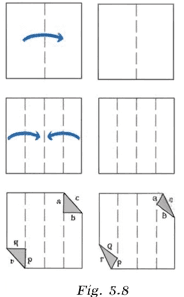
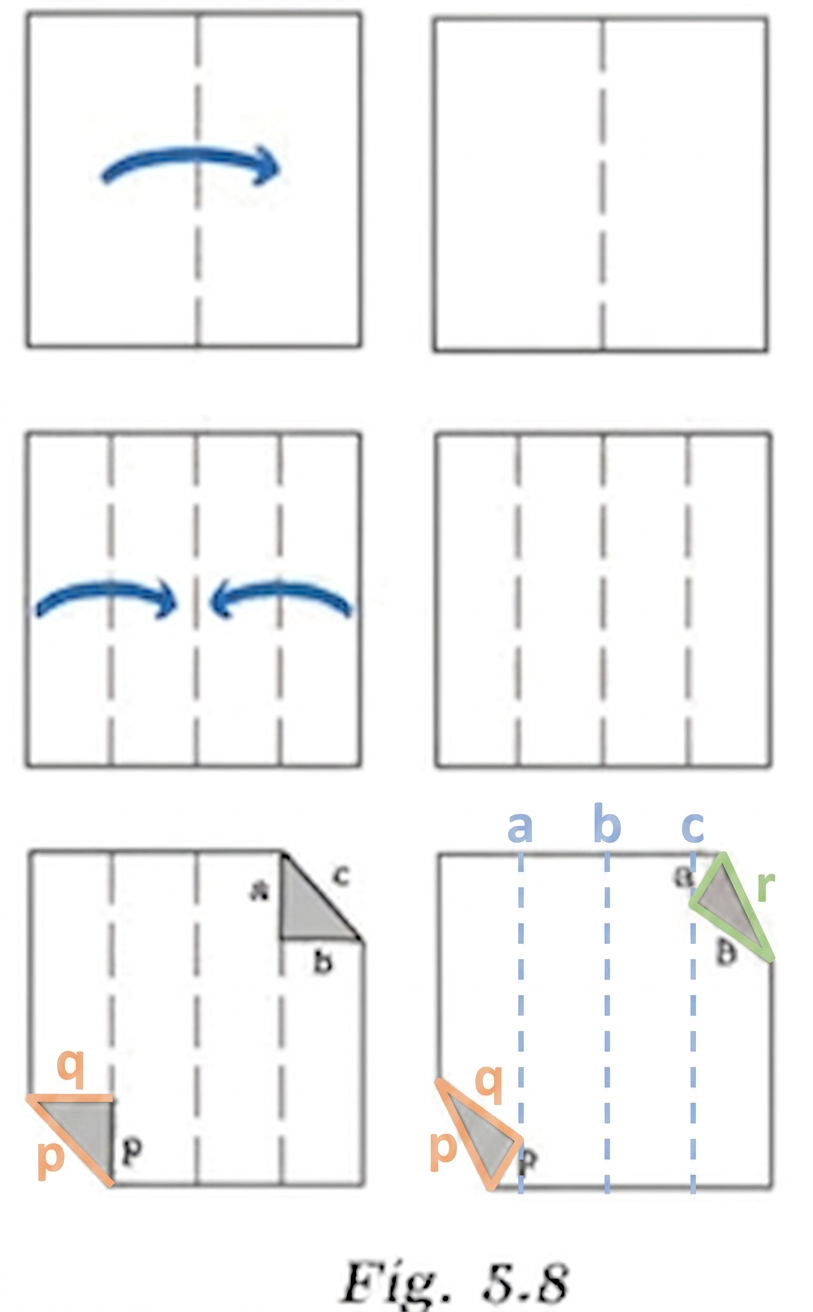
- Fold the top right and bottom left corners onto the creased line to create triangles. Refer to Fig. 5.8.
- The triangles should not cross the crease lines.
- Are , and parallel to , and respectively? Why or why not?
- Parallel lines are straight lines in the same plane that never intersect and always maintain an equal distance from each other.
- In this paper-folding activity, lines , , and represent vertical creases, whereas lines , , and represent slanted (diagonal) edges formed by folding the corners.
- Since vertical lines and diagonal lines have different directions, they will intersect if extended and are therefore not parallel.
Step 1 · Identify the Orientations of the Lines
From the folding activity:
- Lines , , and are vertical crease lines.
- Lines , , and are slanted (diagonal) crease lines forming the edges of the folded corner triangles.
Step 2 · Check if the Lines are Parallel
Parallel lines never meet and always remain at a constant distance apart.
Since lines , , and are vertical and lines , , and are diagonal, they do not have the same direction and will intersect if extended.
Therefore, lines , , and are not parallel to , , and respectively.
No, they are not parallel because lines , , and are vertical lines while lines , , and are diagonal lines that will intersect them if extended.
- Assuming Fold Lines are Parallel: Mistakenly assuming that all creases formed by paper folding must be parallel, regardless of their angle.
- Ignoring Intersection: Forgetting that lines in a plane that are not in the exact same direction will eventually intersect when extended.
More questions in A
Take a piece of square paper and fold it in different ways. Now, on the creases formed by the folds, draw lines using a pencil and a scale. You will notice different lines on the paper. Take any pair of lines and observe their relationship with each other. Do they meet? If they do not meet within the paper, do you think they would meet if they were extended beyond the paper?
Draw two lines on a plain sheet of paper so that they intersect. Measure the four angles formed with a protractor. Draw four such pairs of intersecting lines and measure the angles formed at the points of intersection.
What patterns do you observe among these angles?
Activity 2 Take a plain square sheet of paper (use a newspaper for this activity).
- How would you describe the opposite edges of the sheet? They are _______________________ to each other.
- How would you describe the adjacent edges of the sheet? The adjacent edges are _______________________ to each other. They meet at a point. They form right angles.
- Fold the sheet horizontally in half. A new line is formed (see Fig. 5.7).
- How many parallel lines do you see now? How does the new line segment relate to the vertical sides?
- Make one more horizontal fold in the folded sheet. How many parallel lines do you see now?
- What will happen if you do it once more? How many parallel lines will you get? Is there a pattern? Check if the pattern extends further, if you make another horizontal fold.
- Make a vertical fold in the square sheet. This new vertical line is _______________________ to the previous horizontal lines.
- Fold the sheet along a diagonal. Can you find a fold that creates a line parallel to the diagonal line?
Here is another activity for you to try.
- Take a square sheet of paper, fold it in the middle and unfold it.
- Fold the edges towards the centre line and unfold them.
- Fold the top right and bottom left corners onto the creased line to create triangles. Refer to Fig. 5.8.
- The triangles should not cross the crease lines.
- Are , and parallel to , and respectively? Why or why not?
Draw a pair of lines and a transversal such that they form two distinct angles.
Fig. 5.19 has a pair of parallel lines and (what is the notation used in the figure to indicate they are parallel?). Line is the transversal across these two lines. and are corresponding angles. Take a tracing paper and trace on it. Now place this tracing paper over and see if the angles align exactly. You will observe that the angles match. Check the other corresponding angles in the figure using a protractor. Are all the corresponding angles equal to each other?
In Fig. 5.20, draw a transversal to the lines and such that one pair of corresponding angles is equal. You can measure the angles with a protractor.