Question 1
Calculate the product to uncover the fact. Once you find the product, read the number in both Indian and American naming systems. Share your thoughts and questions about the fact with the class after you discover each number.
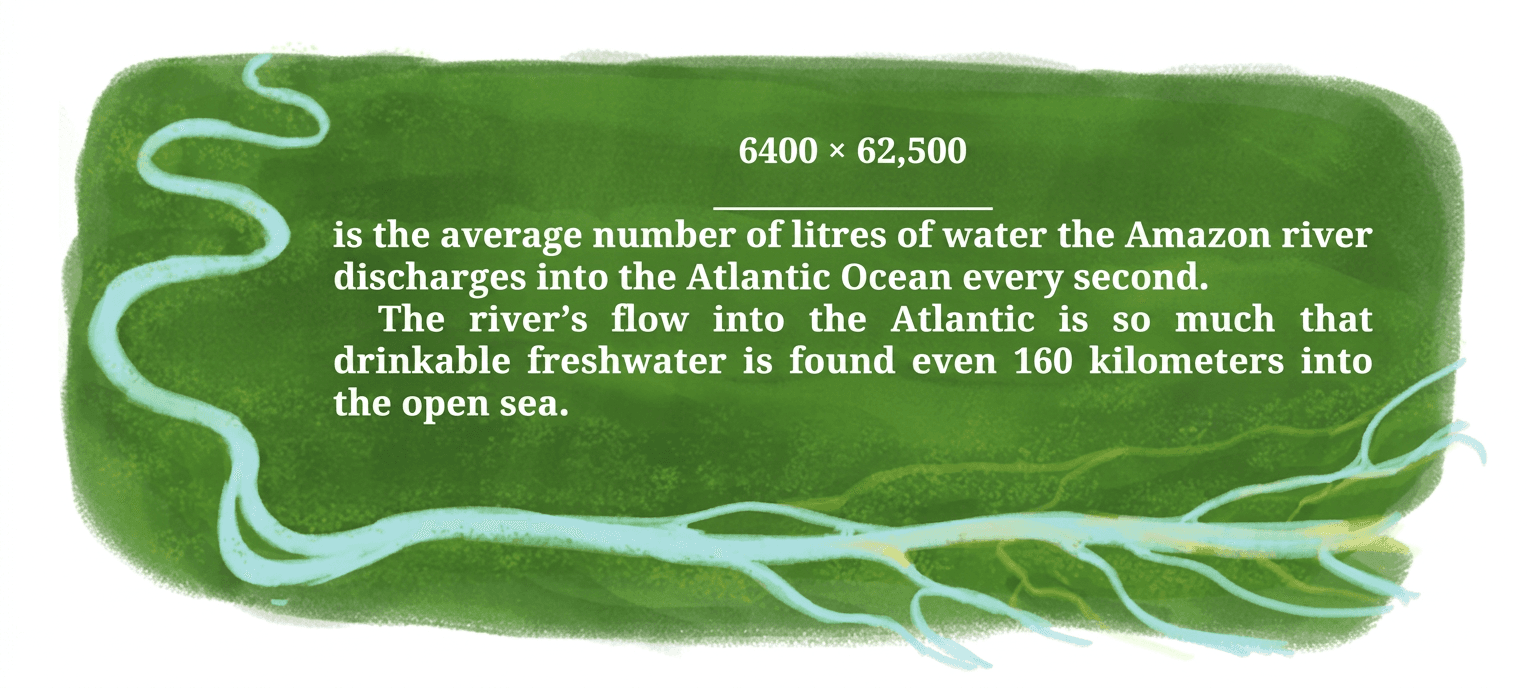
- To multiply large numbers ending in zeros, separate the non-zero parts from powers of , multiply the base numbers, and then append the total count of zeros.
- Indian Naming System: Commas are placed after the first digits from the right (hundreds), and then after every digits (thousands, lakhs, crores).
- American (International) System: Commas are placed after every digits from the right (thousands, millions, billions).
Step 1 · Calculate the Product
Given expression
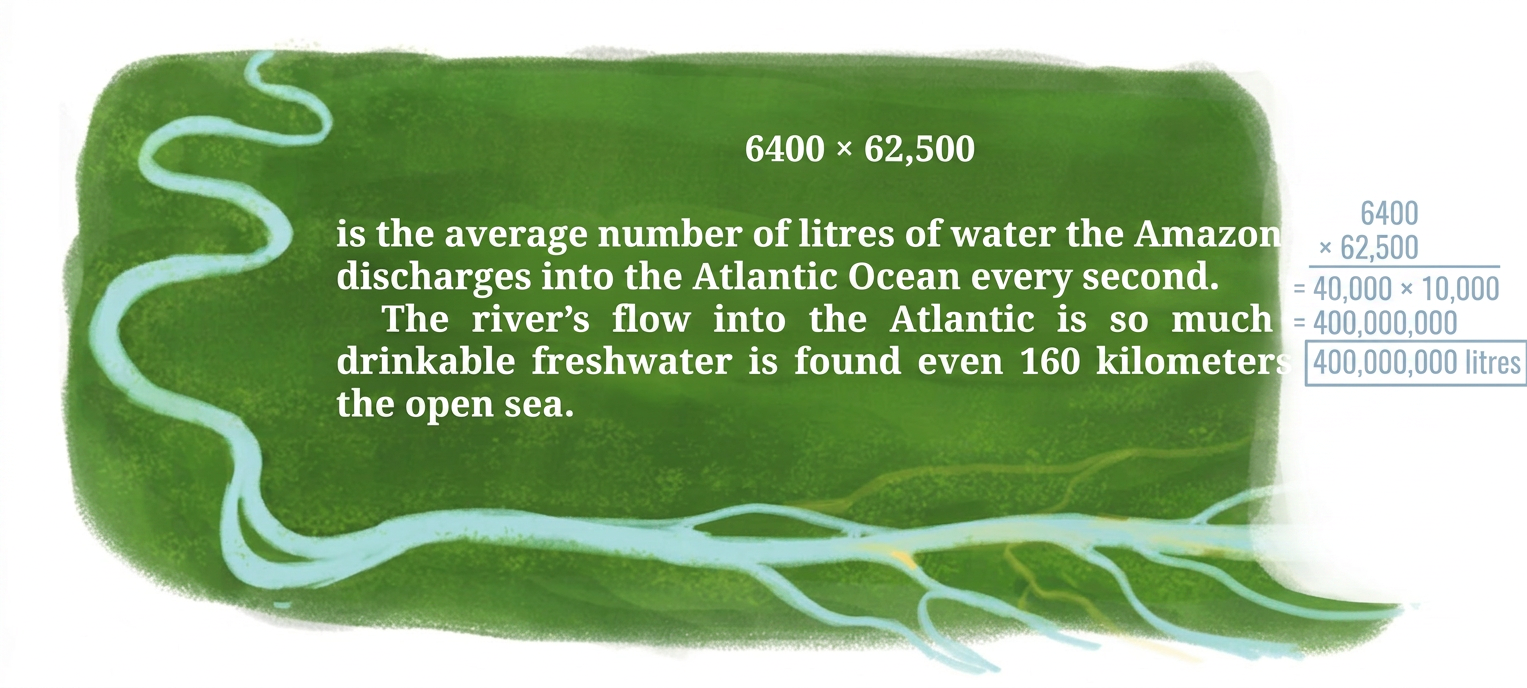
Rewrite by factoring out powers of
Step 2 · Read in the Indian System
In the Indian numbering system, group digits in periods of , then , , and so on from the right
In words
Step 3 · Read in the American System
In the American (International) numbering system, group digits in periods of from the right
In words
Step 4 · Reflect on the Fact
The Amazon river discharges of water every second. This enormous freshwater flow pushes far into the Atlantic Ocean, illustrating the massive scale of the river's drainage basin.
- Product:
- Indian System: Forty Crore ()
- American System: Four Hundred Million ()
- Zero Counting Error: Forgetting the zero generated by the product , which gives zeros before multiplying by (total zeros, yielding ).
- Period Grouping: Confusing the Indian grouping () with the American grouping ().
More questions in A
Calculate the product to uncover the fact. Once you find the product, read the number in both Indian and American naming systems. Share your thoughts and questions about the fact with the class after you discover each number.
As you did before, divide the given numbers to uncover interesting facts about division. Share your thoughts and questions with the class after you uncover each number.
Share such large-number facts you know / come across with your class.
To make the digit 7, three sticks are needed.
Write or make the number 5108. How many sticks are required?
-
Make or write the number 42,019. It would require exactly 23 sticks.
-
Starting with 42,019, add or write two more sticks, and make a bigger number. One example is 42,078. What other numbers bigger than 42,019 can you make in this way?
-
Preetham wants to insert the digit '1' somewhere among the digits '4', '2', '0', '1' and '9'. Where should he place the digit '1' to get the biggest possible number?
-
What other numbers can he make by placing the digit '1'?
-
Make or write the number 63,890.
-
Starting with 63,890, rearrange exactly four sticks and make a bigger number. One example is 88,078. What other numbers bigger than 63,890 can you make in this way?
-
Make any number using exactly 24 sticks or lines.
-
What is the biggest number that can be made using 24 sticks or lines?
-
What is the smallest number that can be made using 24 sticks or lines?