Question 2
As you did before, divide the given numbers to uncover interesting facts about division. Share your thoughts and questions with the class after you uncover each number.
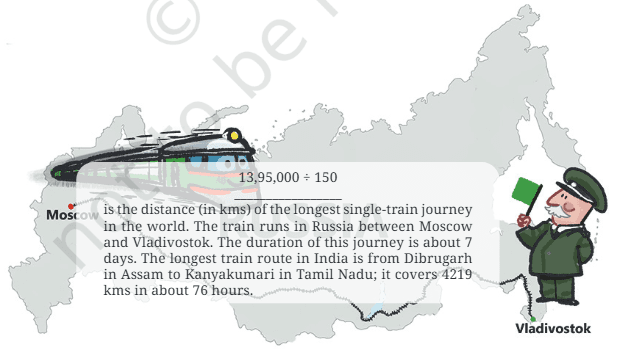
- To uncover the fact, divide the large numbers given in the problem: .
- Simplify the division by canceling common factors of , perform long division, and attach the remaining zeros to find the total distance.
Step 1 · Calculate the Journey Distance
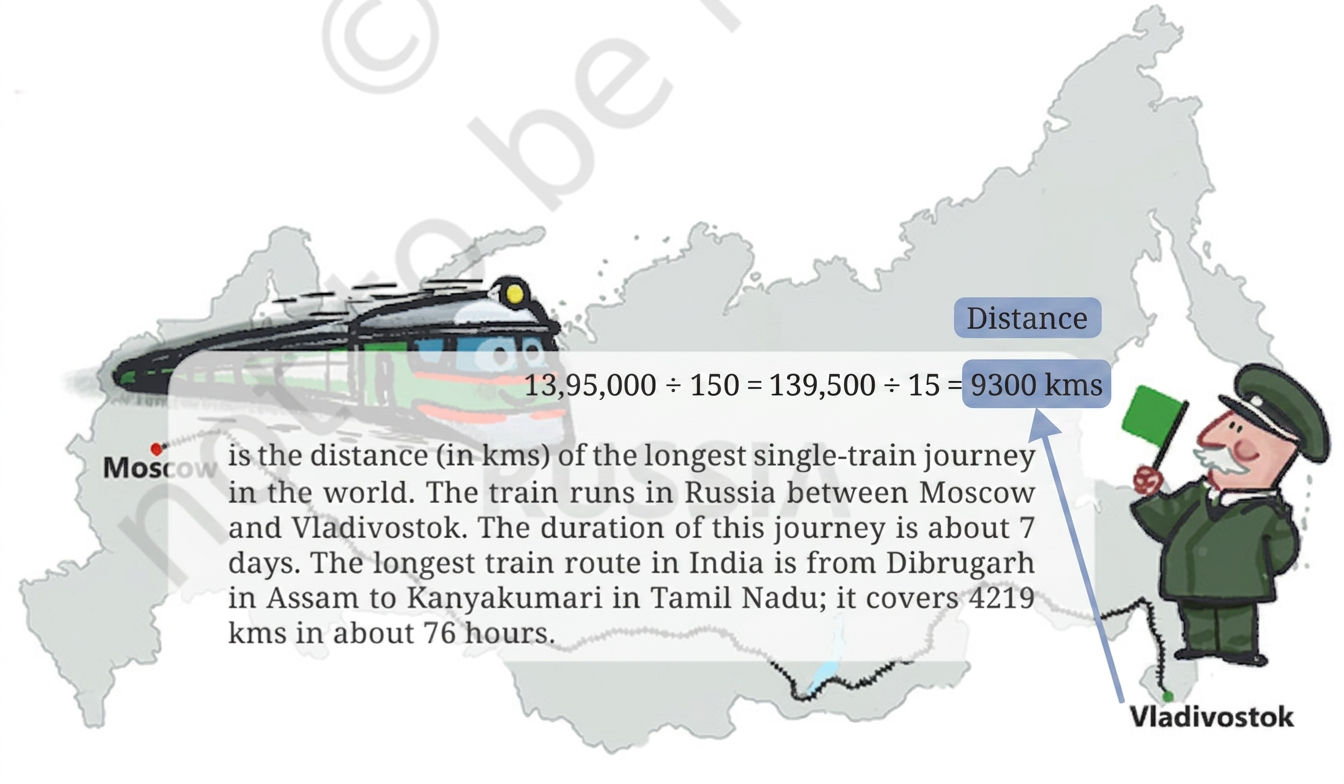
Simplify the division by dividing both numbers by
Dividing by
So, .
Attaching the two remaining zeros from
Step 2 · Interpret the Result
- The distance of the longest single-train journey in the world (Moscow to Vladivostok) is , taking about days.
- For comparison, India's longest train route (Dibrugarh to Kanyakumari) is (takes about hours).
The distance of the longest single-train journey in the world is .
- Zero Omission: Forgetting to add back the remaining two zeros to after dividing , leading to an answer of instead of .
- Simplification Error: Incorrectly canceling zeros (e.g., canceling two zeros from the dividend when the divisor only has one zero).
More questions in A
Calculate the product to uncover the fact. Once you find the product, read the number in both Indian and American naming systems. Share your thoughts and questions about the fact with the class after you discover each number.
As you did before, divide the given numbers to uncover interesting facts about division. Share your thoughts and questions with the class after you uncover each number.
Share such large-number facts you know / come across with your class.
To make the digit 7, three sticks are needed.
Write or make the number 5108. How many sticks are required?
-
Make or write the number 42,019. It would require exactly 23 sticks.
-
Starting with 42,019, add or write two more sticks, and make a bigger number. One example is 42,078. What other numbers bigger than 42,019 can you make in this way?
-
Preetham wants to insert the digit '1' somewhere among the digits '4', '2', '0', '1' and '9'. Where should he place the digit '1' to get the biggest possible number?
-
What other numbers can he make by placing the digit '1'?
-
Make or write the number 63,890.
-
Starting with 63,890, rearrange exactly four sticks and make a bigger number. One example is 88,078. What other numbers bigger than 63,890 can you make in this way?
-
Make any number using exactly 24 sticks or lines.
-
What is the biggest number that can be made using 24 sticks or lines?
-
What is the smallest number that can be made using 24 sticks or lines?