Question 3
Use thin rectangular coloured paper. Fold it several times and create some intricate patterns by cutting the paper, like the one shown here. Identify the lines of symmetry in the repeating design.
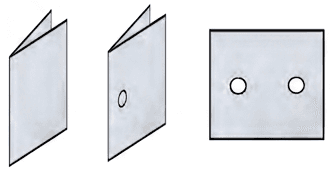
- When paper is folded and cut, unfolding it creates identical, repeating reflections across the fold lines.
- A line of symmetry is a line along which a figure can be folded so that the two halves match each other completely.
- For the unfolded design with two symmetric cutouts, we examine both vertical and horizontal axes of reflection.
Step 1 · Create the Cutout Pattern
Fold a rectangular sheet in half vertically and cut a shape (such as an oval) along the fold.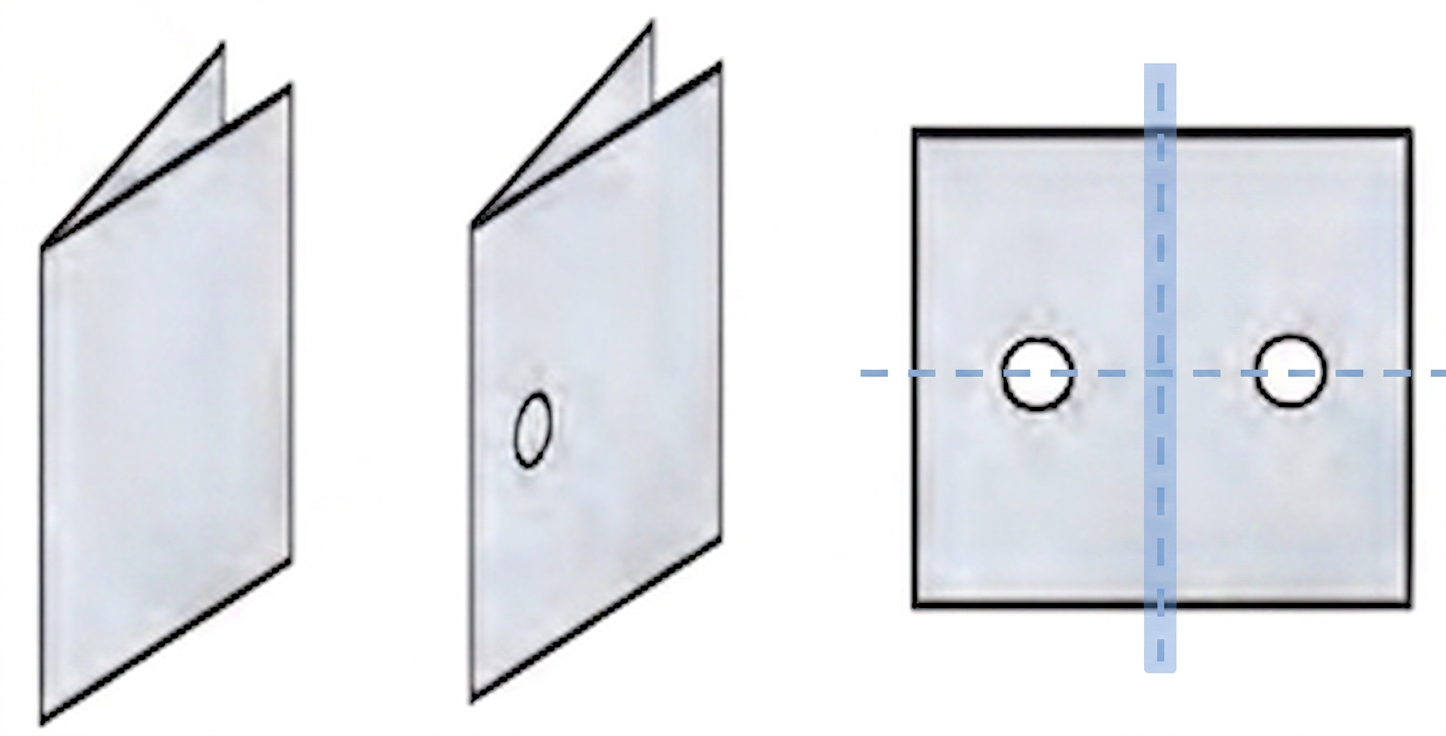
Unfolding the paper reveals two identical cutouts placed symmetrically on either side of the vertical fold line.
Step 2 · Identify the Vertical Line of Symmetry
A vertical line passing straight down the middle between the two oval cutouts divides the design into two matching halves.
Folding along this line places the left half exactly over the right half. Thus, the vertical line is a line of symmetry.
Step 3 · Identify the Horizontal Line of Symmetry
A horizontal line passing straight across the middle through the centers of both cutouts divides the design into two matching halves.
Folding along this line places the top half exactly over the bottom half. Thus, the horizontal line is also a line of symmetry.
The design has lines of symmetry:
- One vertical line of symmetry passing between the two oval cutouts.
- One horizontal line of symmetry passing through the centers of both oval cutouts.
- Missing the Horizontal Axis: Assuming only the original vertical crease is a line of symmetry, while missing the horizontal symmetry created if the cutout itself is symmetric.
- Diagonal Lines of Symmetry: Assuming diagonal lines are lines of symmetry for a rectangular sheet; rectangles only have vertical and horizontal lines of symmetry connecting the midpoints of opposite sides.
More questions in A
Does a square have only one line of symmetry? Take a square piece of paper. By folding, find all its lines of symmetry.
Ink Blot Devils
Take a piece of paper. Fold it in half. Open the paper and spill a few drops of ink (or paint) on one half.
Now press the halves together and then open the paper again.
- What do you see?
- Is the resulting figure symmetric?
- If yes, where is the line of symmetry?
- Is there any other line along which it can be folded to produce two identical parts?
- Try making more such patterns.
Use thin rectangular coloured paper. Fold it several times and create some intricate patterns by cutting the paper, like the one shown here. Identify the lines of symmetry in the repeating design.
Trace and cut out a copy of this figure. By rotating the cutout over this figure determine its angles of rotation.
Game
Draw a grid. Two players take turns covering two adjacent squares by drawing a line. The line can be placed either way: horizontally or vertically. The lines cannot overlap. The game goes on till a player is not able to place any more lines. The player who is not able to place a line loses.
With what strategy can one play to win this game?