Question 4
Trace and cut out a copy of this figure. By rotating the cutout over this figure determine its angles of rotation.
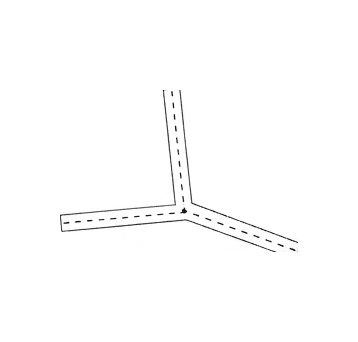
- A figure has rotational symmetry if it looks identical to its original position after a turn of less than around its center.
- The given figure has identical parts (spokes) distributed evenly around the center, which means its order of rotational symmetry is .
- The angles of rotation are obtained by dividing into equal parts and finding its successive multiples.
Step 1 · Find the Smallest Angle of Rotation
The figure consists of identical, equally spaced parts around its central point.
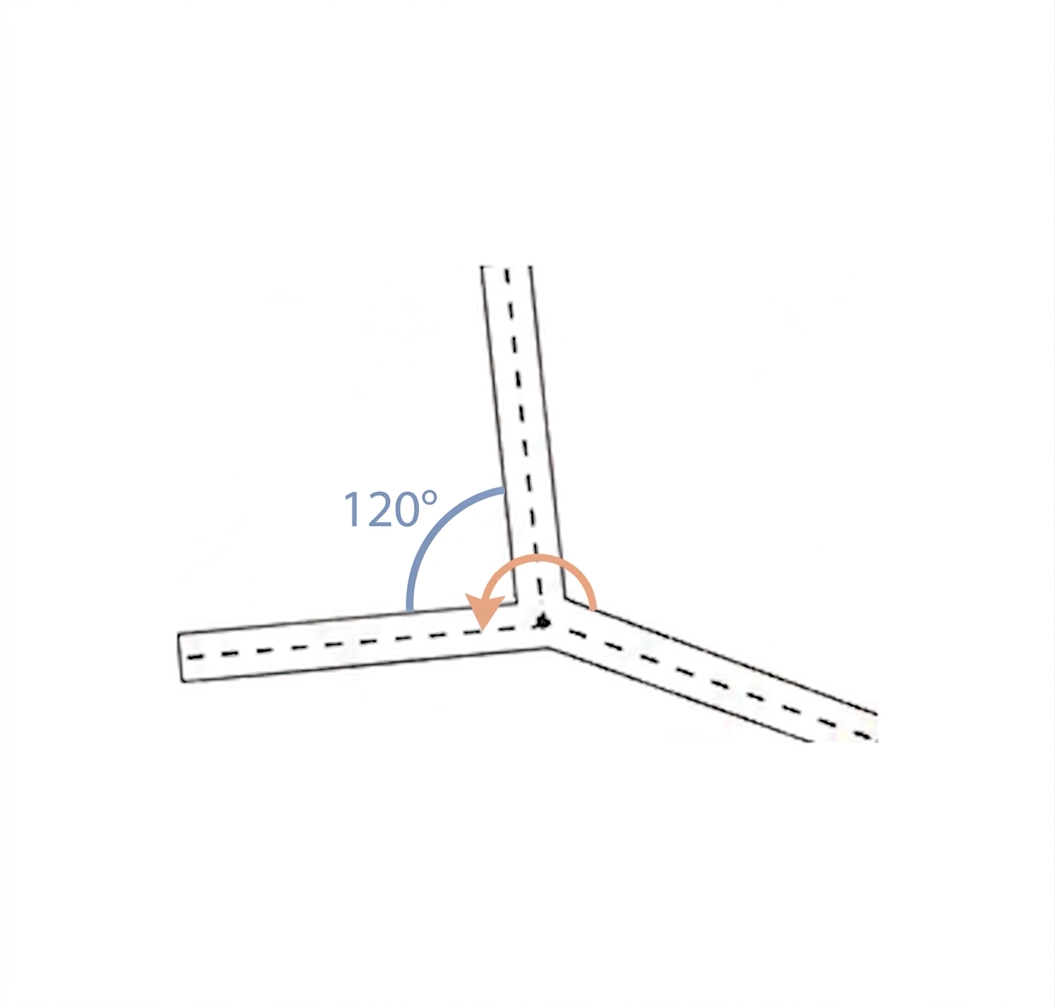
Step 2 · Find Successive Angles of Rotation
Rotating the cutout further by multiples of brings it back into alignment with the original figure:
The angles of rotation are , , and .
- Listing Only the First Angle: Forgetting that all multiples up to () are angles of rotation for the figure.
- Dividing by the Wrong Number: Miscounting the number of identical symmetrical parts/wings in the figure.
More questions in A
Does a square have only one line of symmetry? Take a square piece of paper. By folding, find all its lines of symmetry.
Ink Blot Devils
Take a piece of paper. Fold it in half. Open the paper and spill a few drops of ink (or paint) on one half.
Now press the halves together and then open the paper again.
- What do you see?
- Is the resulting figure symmetric?
- If yes, where is the line of symmetry?
- Is there any other line along which it can be folded to produce two identical parts?
- Try making more such patterns.
Use thin rectangular coloured paper. Fold it several times and create some intricate patterns by cutting the paper, like the one shown here. Identify the lines of symmetry in the repeating design.
Trace and cut out a copy of this figure. By rotating the cutout over this figure determine its angles of rotation.
Game
Draw a grid. Two players take turns covering two adjacent squares by drawing a line. The line can be placed either way: horizontally or vertically. The lines cannot overlap. The game goes on till a player is not able to place any more lines. The player who is not able to place a line loses.
With what strategy can one play to win this game?