Question 2
Ink Blot Devils
Take a piece of paper. Fold it in half. Open the paper and spill a few drops of ink (or paint) on one half.
Now press the halves together and then open the paper again.
- What do you see?
- Is the resulting figure symmetric?
- If yes, where is the line of symmetry?
- Is there any other line along which it can be folded to produce two identical parts?
- Try making more such patterns.
- When paper is folded in half and pressed with wet ink on one side, the ink transfers onto the other half, creating an identical mirror image.
- A figure has line symmetry if it can be folded along a line such that both halves match exactly.
- In this activity, the crease (fold line) acts as the axis (line) of symmetry.
(i) What do you see?
Step 1 · Observe the Ink Pattern
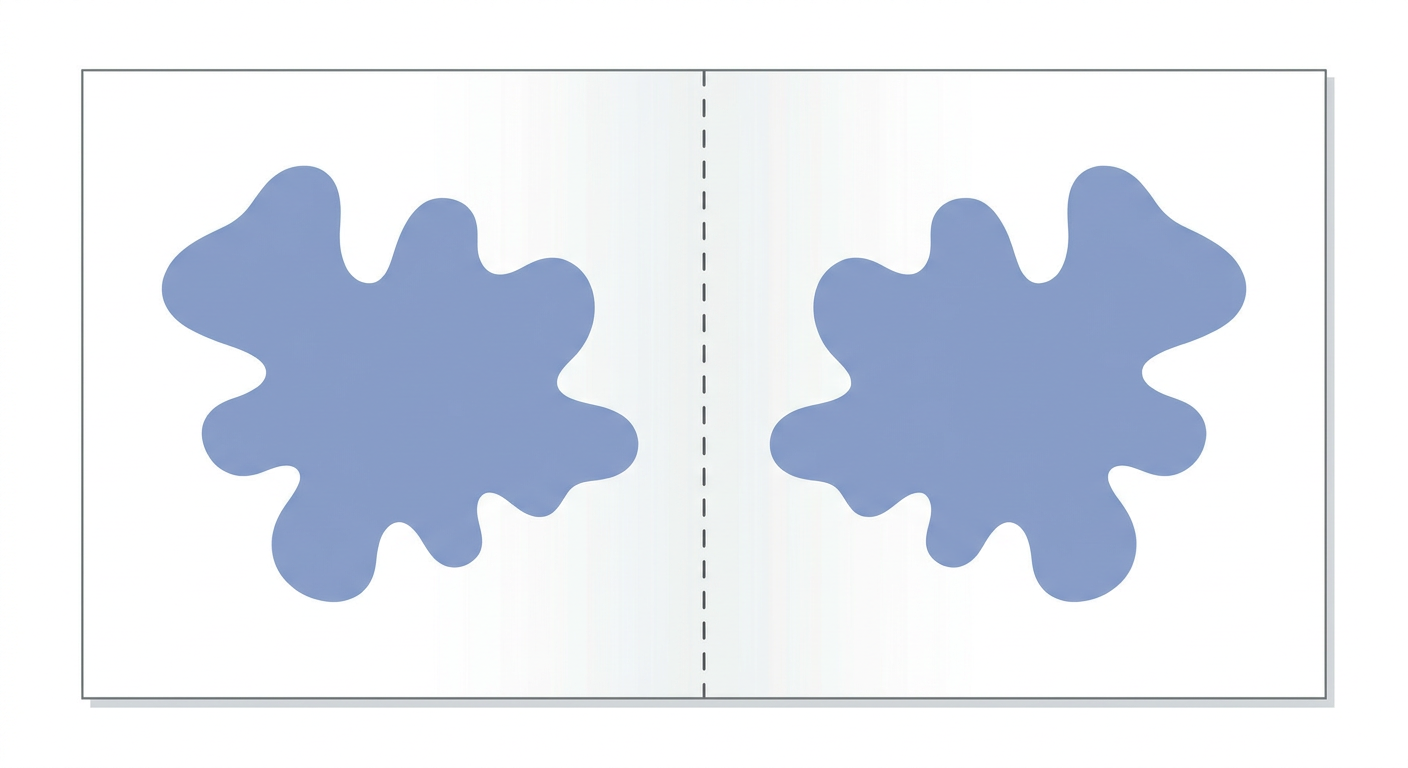
Pressing the folded paper transfers the wet ink to the other half, forming a unique mirror-image pattern (often resembling a butterfly or an abstract shape).
(i) A symmetric, mirror-image pattern on both halves of the paper.
(ii) Is the resulting figure symmetric?
(ii) Yes, the resulting figure is symmetric.
(iii) If yes, where is the line of symmetry?
(iii) The line of symmetry is the original crease (fold line) of the paper.
(iv) Is there any other line along which it can be folded to produce two identical parts?
(iv) No, there is generally no other line of symmetry because the ink was dropped randomly.
(v) Try making more such patterns.
(v) Different unique and symmetric patterns can be created by repeating the process with various colors and drop positions.
- Assuming Multiple Symmetry Lines: Random ink blots only have one line of symmetry—the fold line. They do not possess horizontal or diagonal symmetry unless intentionally constructed that way.
- Misidentifying the Symmetry Line: Believing the symmetry line can be arbitrary, whereas it is strictly the crease where the paper was folded.
More questions in A
Does a square have only one line of symmetry? Take a square piece of paper. By folding, find all its lines of symmetry.
Ink Blot Devils
Take a piece of paper. Fold it in half. Open the paper and spill a few drops of ink (or paint) on one half.
Now press the halves together and then open the paper again.
- What do you see?
- Is the resulting figure symmetric?
- If yes, where is the line of symmetry?
- Is there any other line along which it can be folded to produce two identical parts?
- Try making more such patterns.
Use thin rectangular coloured paper. Fold it several times and create some intricate patterns by cutting the paper, like the one shown here. Identify the lines of symmetry in the repeating design.
Trace and cut out a copy of this figure. By rotating the cutout over this figure determine its angles of rotation.
Game
Draw a grid. Two players take turns covering two adjacent squares by drawing a line. The line can be placed either way: horizontally or vertically. The lines cannot overlap. The game goes on till a player is not able to place any more lines. The player who is not able to place a line loses.
With what strategy can one play to win this game?