Question 7
Q. Solve the prime puzzles by filling the grids with prime numbers only so that the product of each row is the number to the right of the row and the product of each column is the number below the column.
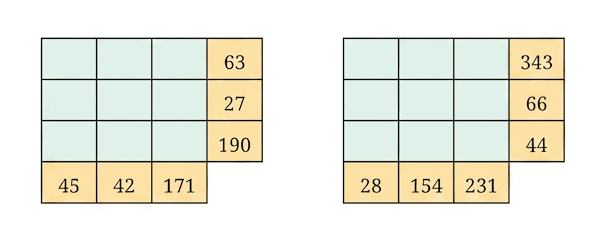
- In a prime puzzle grid, each cell must contain a prime number.
- The product of the numbers in each row equals the target number to the right of that row.
- The product of the numbers in each column equals the target number below that column.
- Approach:
- Find the prime factorisation of each row product and column product.
- For any cell at the intersection of Row and Column , the number in that cell must be a common prime factor of the target product for Row and the target product for Column .
- Use logic and remaining factors to fill in every cell correctly.
(i) Solve the first prime puzzle grid with row products and column products .
Step 1 · Prime Factorisation of Row and Column Products
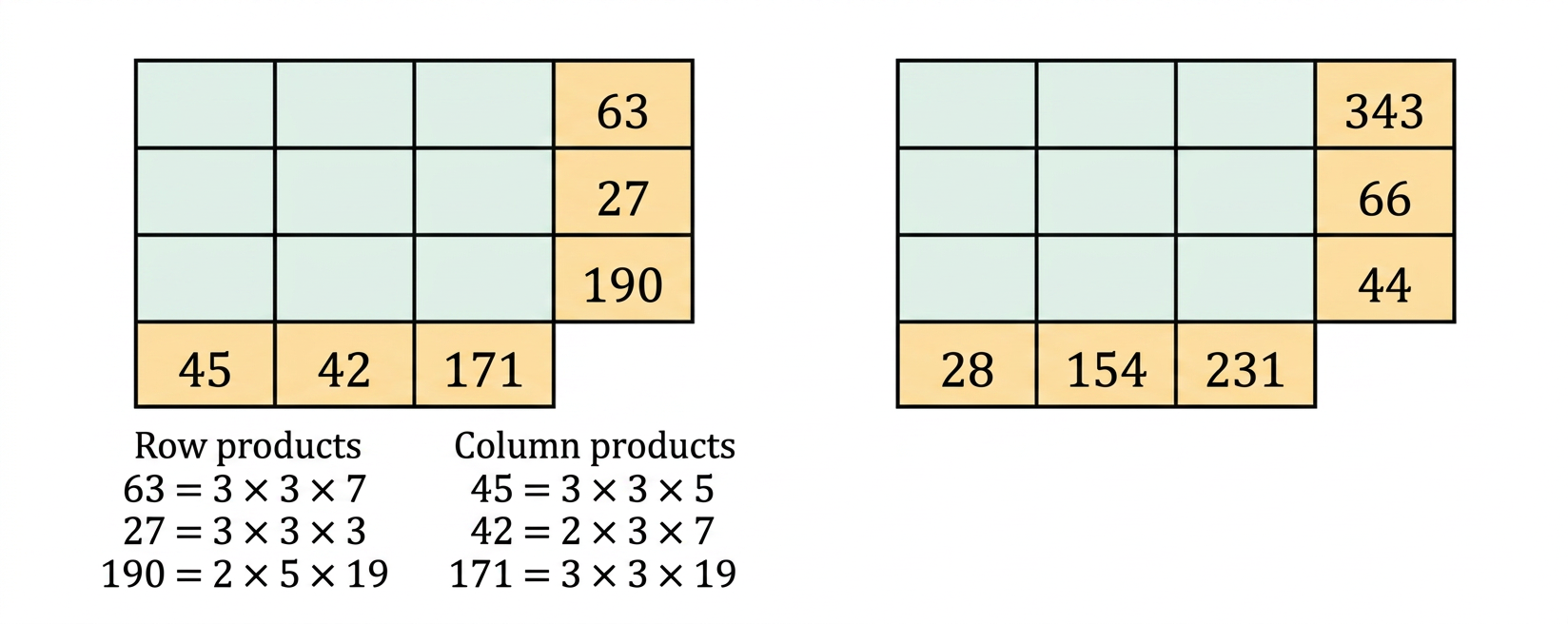
Find the prime factors for each given product:
Step 2 · Fill Grid 1 Cells
- Cell (3, 3): Must be a common prime factor of Row 3 () and Column 3 (). The common factor is .
- Cell (1, 3): Must be a common prime factor of Row 1 () and Column 3 (). We choose .
- Cell (2, 3): Must be a factor of Row 2 () and Column 3 (). The remaining factor for Column 3 is .
Now, fill the remaining cells in each row:
- Row 1: Remaining product is .
- Row 2: Remaining product is .
- Row 3: Remaining product is .
Match with column products:
- Column 1 product is . Choosing cell (1, 1) , cell (2, 1) , and cell (3, 1) gives .
- This leaves cell (1, 2) , cell (2, 2) , and cell (3, 2) .
Check Column 2 product:
This matches the required product.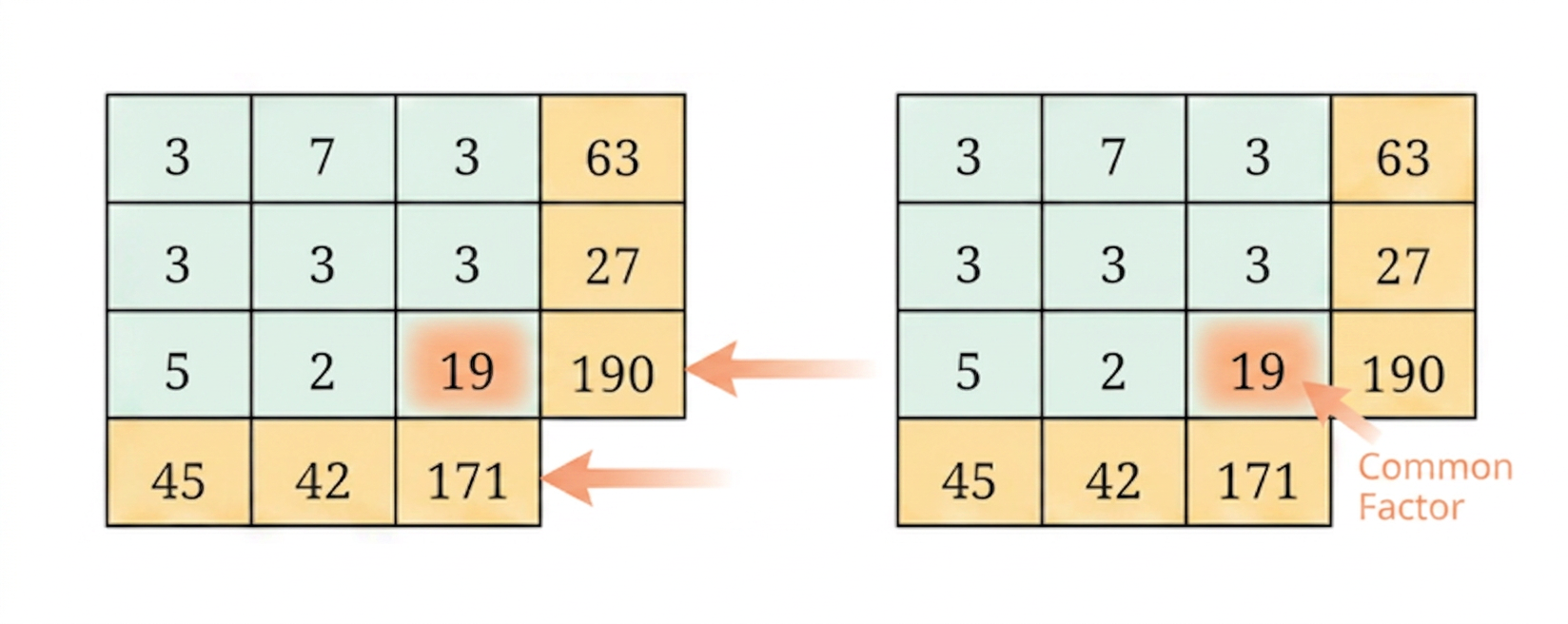
(i)
(ii) Solve the second prime puzzle grid with row products and column products .
Step 1 · Prime Factorisation of Row and Column Products
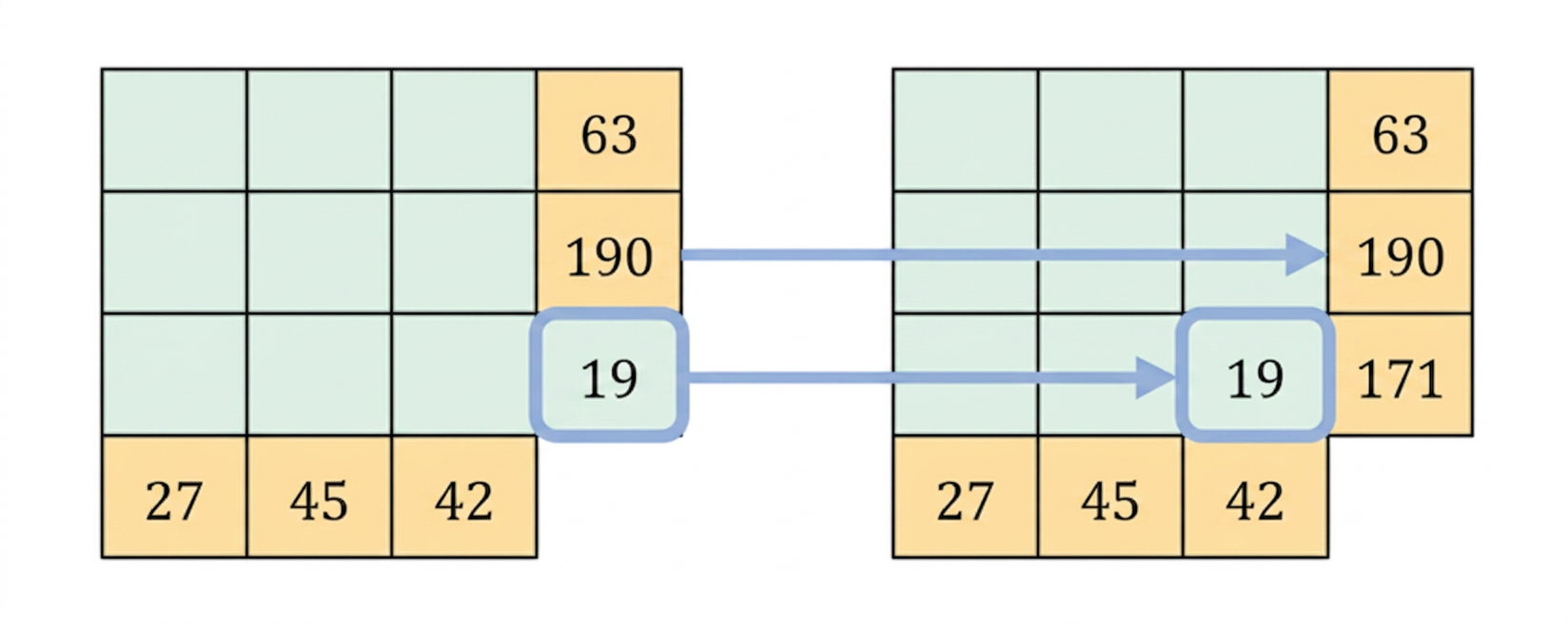
Find the prime factors for each given product:
Step 2 · Fill Grid 2 Cells
- Cell (1, 3): Common prime factor of Row 1 () and Column 3 () is .
- Cell (3, 3): Common prime factor of Row 3 () and Column 3 () is .
- Cell (2, 3): Column 3 product is . The remaining factor is:
Now, fill the remaining cells in each row:
- Row 1: cells (1, 1) and (1, 2) are both .
- Row 2: cells (2, 1) and (2, 2) are and .
- Row 3: cells (3, 1) and (3, 2) are both .
Match with column products:
- Column 1 product is . With cell (1, 1) and cell (3, 1) , cell (2, 1) must be .
- Since cell (2, 1) , cell (2, 2) must be .
- Cell (3, 2) .
Check Column 2 product:
This matches the required product.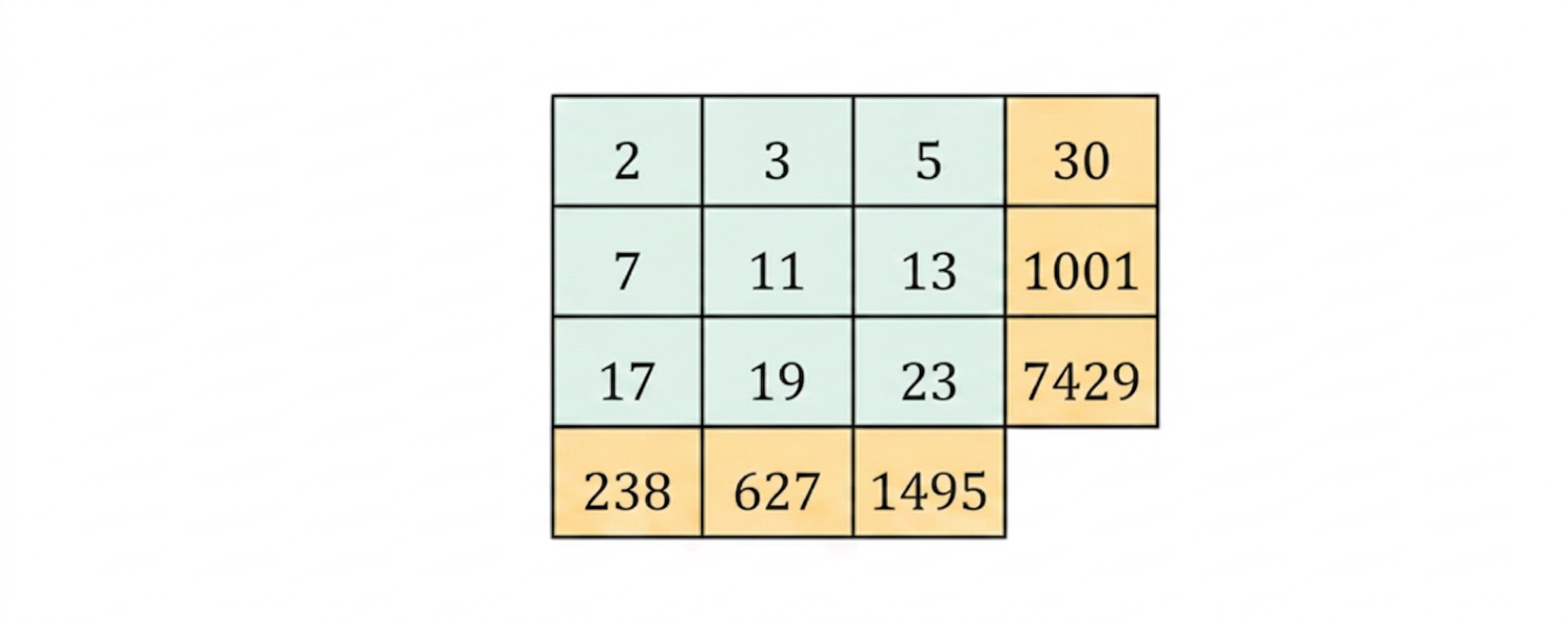
(ii)
- Using Non-Prime Numbers: Placing composite numbers like instead of prime numbers. Only primes are allowed in the grid.
- Not Checking Both Intersections: Selecting a factor that satisfies the row product without verifying if it is also a factor of the corresponding column product.
- Incorrect Prime Factorisation: Forgetting a prime factor (e.g., writing instead of completely breaking it down to ).
More questions in A
Let us now play the 'idli-vada' game with different pairs of numbers:
(a) 2 and 5, (b) 3 and 7, (c) 4 and 6.
We will say 'idli' for multiples of the smaller number, 'vada' for multiples of the larger number and 'idli-vada' for common multiples. Draw a figure similar to Fig. 5.1 if the game is played up to 60.
Co-prime art
Observe the following thread art. The first diagram has 12 pegs and the thread is tied to every fourth peg (we say that the thread-gap is 4). The second diagram has 13 pegs and the thread-gap is 3. What about the other diagrams? Observe these pictures, share and discuss your findings in class.
In some diagrams, the thread is tied to every peg. In some, it is not. Is it related to the two numbers (the number of pegs and the thread-gap) being co-prime?
Make such pictures for the following:
a. 15 pegs, thread-gap of 10
b. 10 pegs, thread-gap of 7
c. 14 pegs, thread-gap of 6
d. 8 pegs, thread-gap of 3
Below are some boxes with four numbers in each box. Within each box try to say how each number is special compared to the rest. Share with your classmates and find out who else gave the same reasons as you did. Did anyone give different reasons that may not have occurred to you?
A prime puzzle
The figure on the left shows the puzzle. The figure on the right shows the solution of the puzzle. Think what the rules can be to solve the puzzle.
Rules
Fill the grid with prime numbers only so that the product of each row is the number to the right of the row and the product of each column is the number below the column.
Q. Solve the prime puzzles by filling the grids with prime numbers only so that the product of each row is the number to the right of the row and the product of each column is the number below the column.