Question 2
Co-prime art
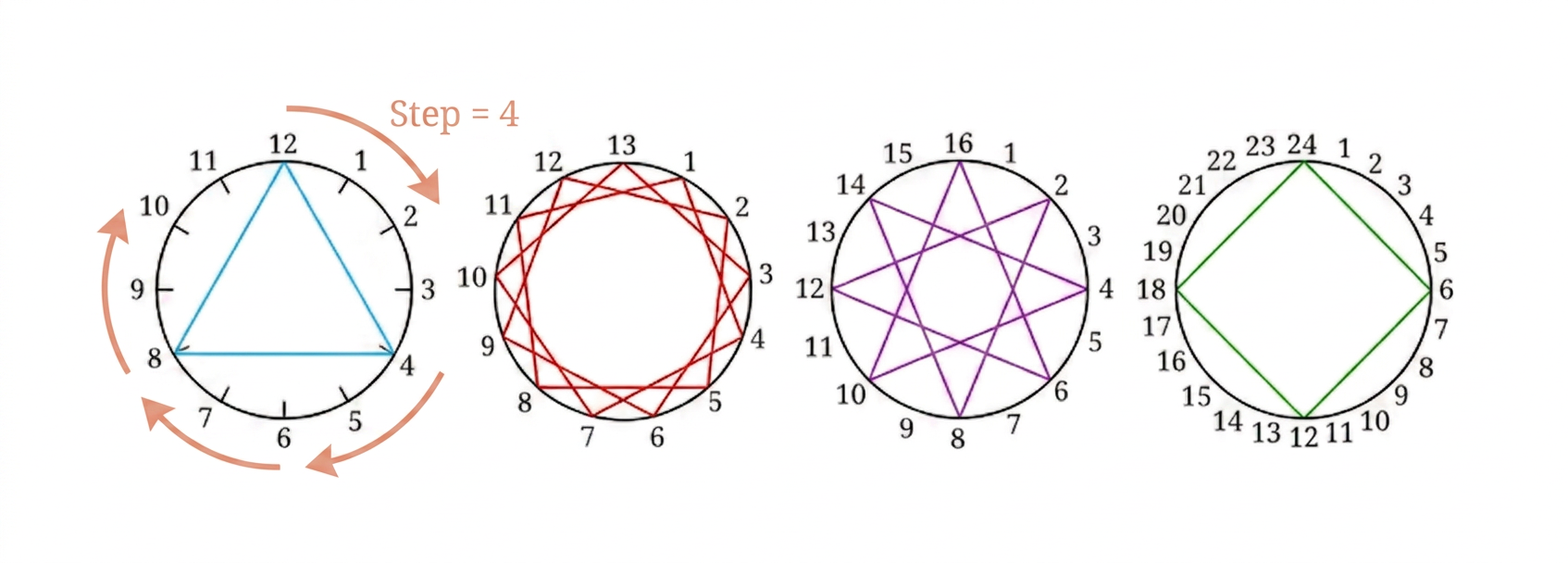
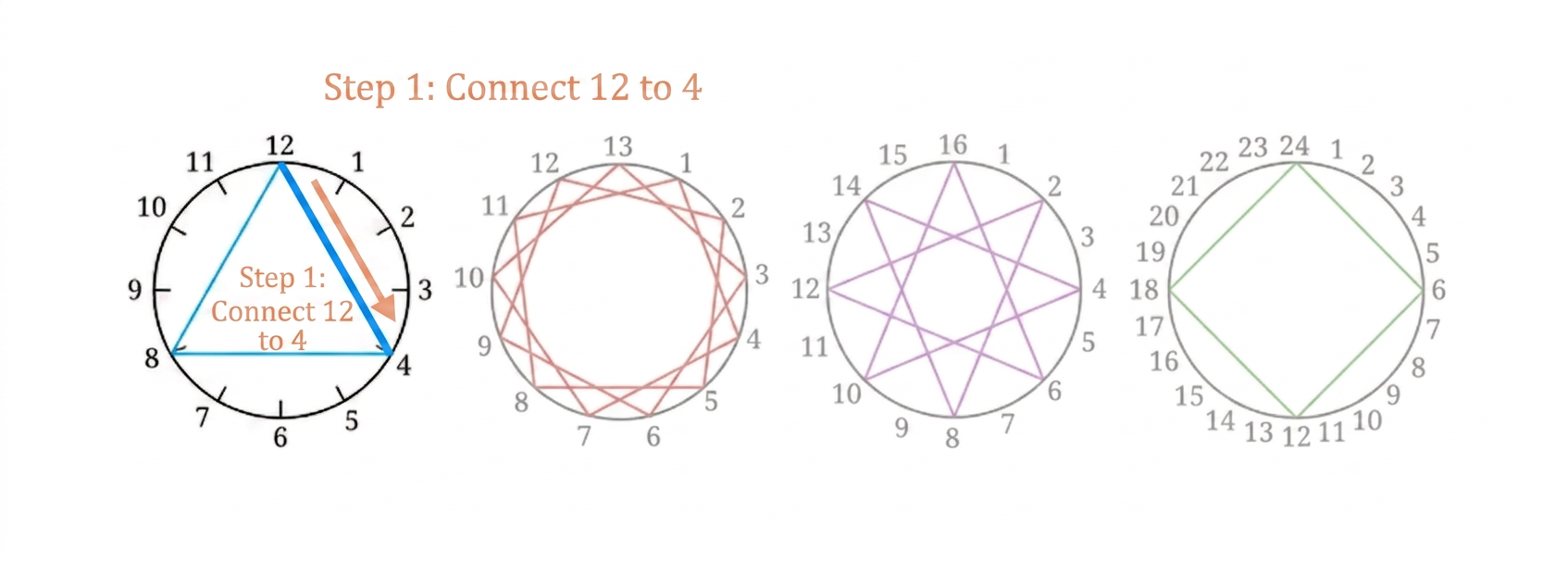
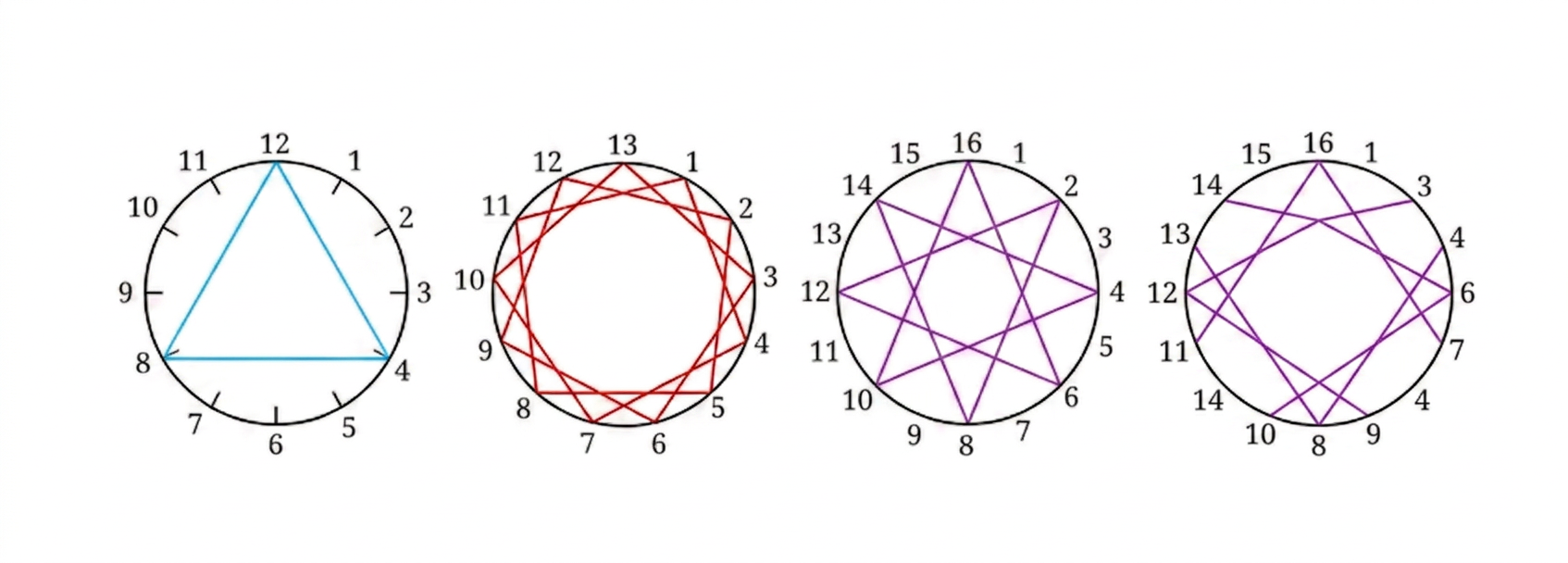
Observe the following thread art. The first diagram has 12 pegs and the thread is tied to every fourth peg (we say that the thread-gap is 4). The second diagram has 13 pegs and the thread-gap is 3. What about the other diagrams? Observe these pictures, share and discuss your findings in class.
In some diagrams, the thread is tied to every peg. In some, it is not. Is it related to the two numbers (the number of pegs and the thread-gap) being co-prime?
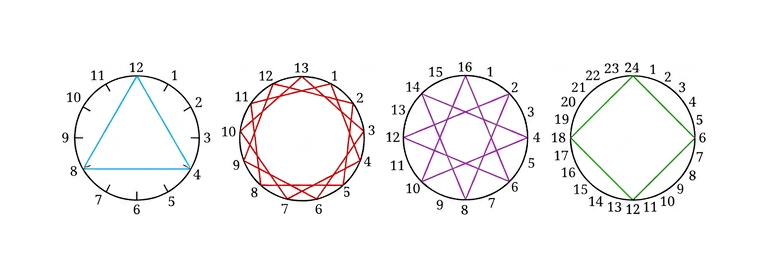
- Thread-gap is the number of steps the thread advances from one peg to the next around the circle.
- Two numbers are co-prime if their Highest Common Factor () is .
- The thread visits every single peg on the circle if and only if the total number of pegs and the thread-gap are co-prime (). If , the thread cycles back to the starting peg without visiting all pegs.
Step 1 · Analyze the First Diagram (12 Pegs, Gap 4)
- Number of pegs:
- Thread-gap: (starts at , jumps steps to , then , then back to )
- Pegs touched: Only pegs and (does not touch every peg)
Finding the common factors:
Step 2 · Analyze the Second Diagram (13 Pegs, Gap 3)
- Number of pegs:
- Thread-gap: (starts at , jumps steps to , then )
- Pegs touched: Touches every peg
Finding the common factors:
Step 3 · Analyze the Third Diagram (16 Pegs, Gap 6)
- Number of pegs:
- Thread-gap: (starts at , jumps steps to , then )
- Pegs touched: Misses odd pegs like (does not touch every peg)
Finding the common factors:
Step 4 · Analyze the Fourth Diagram (24 Pegs, Gap 6)
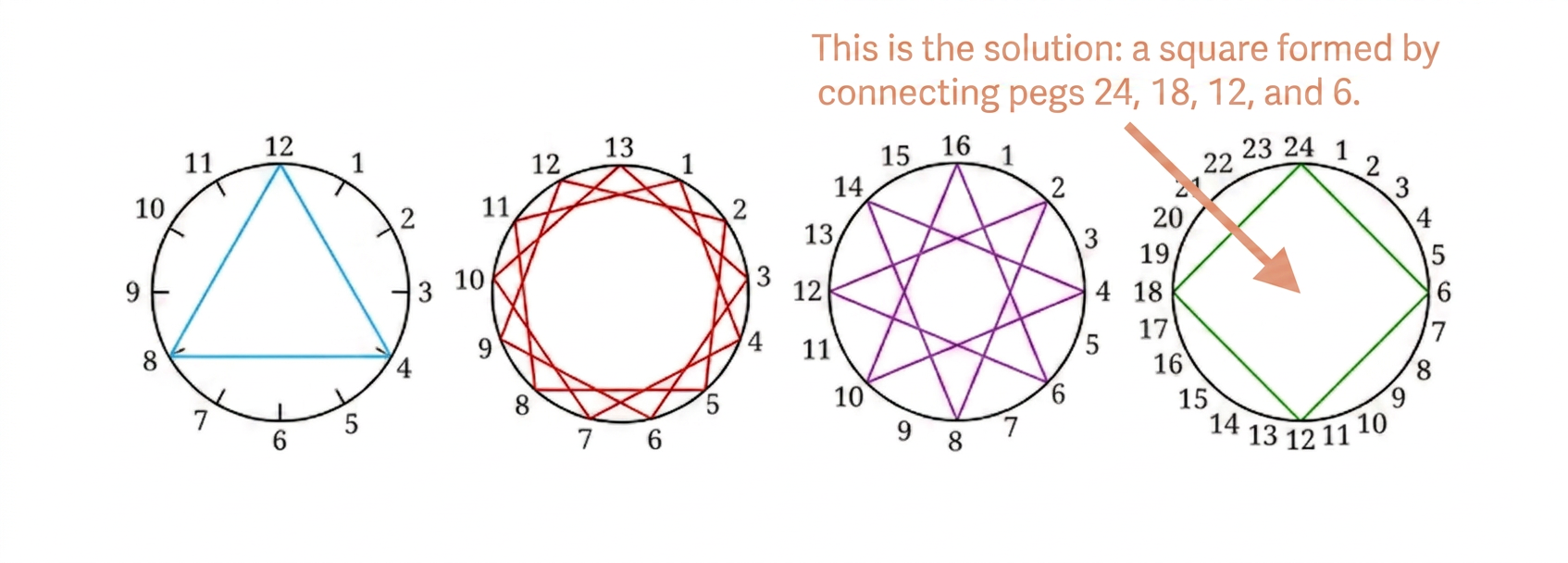
- Number of pegs:
- Thread-gap: (starts at , jumps steps to , then and )
- Pegs touched: Only pegs and (does not touch every peg)
Finding the common factors:
Step 5 · Determine the Co-prime Relationship
Comparing the four diagrams:
- When (i.e. they are co-prime), the thread visits every peg.
- When (not co-prime), the thread forms a smaller closed loop and does not touch every peg.
- The third diagram has 16 pegs with a thread-gap of 6.
- The fourth diagram has 24 pegs with a thread-gap of 6.
- Yes, the thread is tied to every peg if and only if the number of pegs and the thread-gap are co-prime.
- Confusing Prime with Co-prime: The number of pegs does not need to be a prime number itself (e.g. pegs with gap will visit all pegs because ). They only need to be co-prime to each other.
- Miscounting the Thread-gap: Counting the gap starting from instead of counting the number of step intervals from the starting peg.
More questions in A
Let us now play the 'idli-vada' game with different pairs of numbers:
(a) 2 and 5, (b) 3 and 7, (c) 4 and 6.
We will say 'idli' for multiples of the smaller number, 'vada' for multiples of the larger number and 'idli-vada' for common multiples. Draw a figure similar to Fig. 5.1 if the game is played up to 60.
Co-prime art
Observe the following thread art. The first diagram has 12 pegs and the thread is tied to every fourth peg (we say that the thread-gap is 4). The second diagram has 13 pegs and the thread-gap is 3. What about the other diagrams? Observe these pictures, share and discuss your findings in class.
In some diagrams, the thread is tied to every peg. In some, it is not. Is it related to the two numbers (the number of pegs and the thread-gap) being co-prime?
Make such pictures for the following:
a. 15 pegs, thread-gap of 10
b. 10 pegs, thread-gap of 7
c. 14 pegs, thread-gap of 6
d. 8 pegs, thread-gap of 3
Below are some boxes with four numbers in each box. Within each box try to say how each number is special compared to the rest. Share with your classmates and find out who else gave the same reasons as you did. Did anyone give different reasons that may not have occurred to you?
A prime puzzle
The figure on the left shows the puzzle. The figure on the right shows the solution of the puzzle. Think what the rules can be to solve the puzzle.
Rules
Fill the grid with prime numbers only so that the product of each row is the number to the right of the row and the product of each column is the number below the column.
Q. Solve the prime puzzles by filling the grids with prime numbers only so that the product of each row is the number to the right of the row and the product of each column is the number below the column.