Question 4
Explore
Carry out these same steps with a few 3-digit numbers. What number will start repeating?
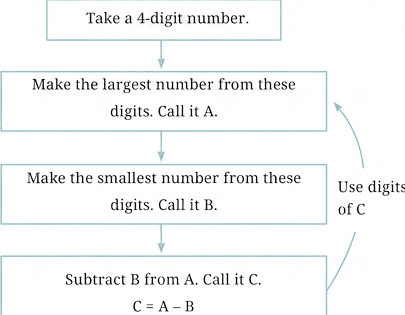
- To perform the routine on any 3-digit number (with not all digits the same):
- Arrange the digits in descending order to form the largest number ().
- Arrange the digits in ascending order to form the smallest number ().
- Subtract the smallest from the largest ().
- Repeat the process with the digits of the resulting difference.
- Continuing this process always leads to a single repeating number known as Kaprekar's constant for 3-digit numbers.
Step 1 · First Iteration
Choose the 3-digit number 123 with digits 1, 2, and 3.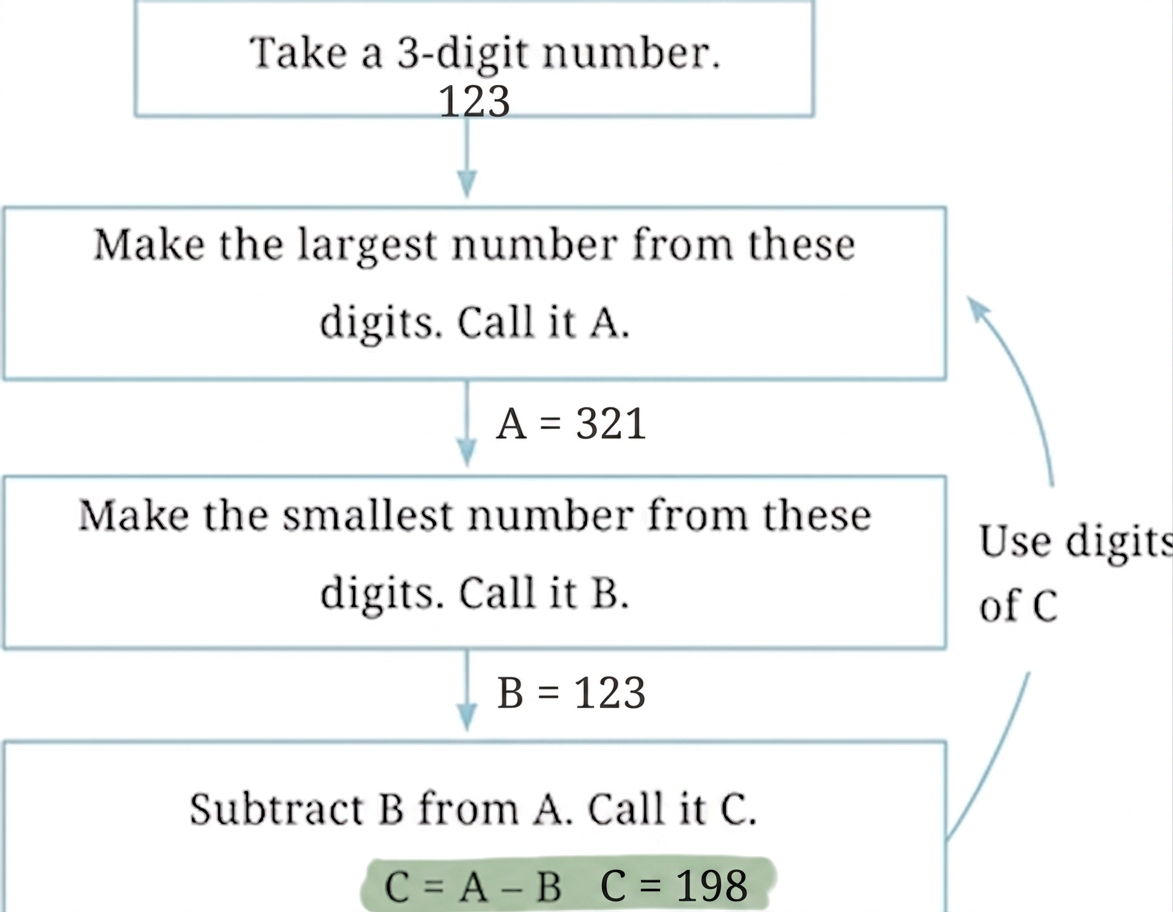
Form the largest and smallest numbers
Subtract from
Step 2 · Second Iteration
Using the digits of 198 (1, 9, and 8)
Subtract from
Step 3 · Third Iteration
Using the digits of 792 (7, 9, and 2)
Subtract from
Step 4 · Fourth Iteration
Using the digits of 693 (6, 9, and 3)
Subtract from
Step 5 · Fifth Iteration
Using the digits of 594 (5, 9, and 4)
Subtract from
Step 6 · Sixth Iteration
Using the digits of 495 (4, 9, and 5)
Subtract from
The operation now continuously produces 495.
495
- Identical Digits Exception: If all three digits are the same (like or ), the difference is , so the rule only applies to numbers with at least two distinct digits.
- Leading Zeroes: When a difference results in a 2-digit number (e.g., ), make sure to include the leading zero as one of the three digits in the next step.
More questions in A
Complete Table 2 with 5-digit numbers whose digits are ‘1’, ‘0’, ‘6’, ‘3’, and ‘9’ in some order. Only a coloured cell should have a number greater than all its neighbours.
The biggest number in the table is _________ . The smallest even number in the table is _________ . The smallest number greater than in the table is _________ . Once you have filled the table above, put commas appropriately after the thousands digit.
Will reversing and adding numbers repeatedly, starting with a 2-digit number, always give a palindrome? Explore and find out.*
Explore
Take different 4-digit numbers and try carrying out these steps. Find out what happens. Check with your friends what they got.
Explore
Carry out these same steps with a few 3-digit numbers. What number will start repeating?
Make some more Collatz sequences like those above, starting with your favourite whole numbers. Do you always reach ?
Do you believe the conjecture of Collatz that all such sequences will eventually reach ? Why or why not?
The first player says 1, 2 or 3. Then the two players take turns adding 1, 2, or 3 to the previous number said. The first player to reach 21 wins!
Play this game several times with your classmate. Are you starting to see the winning strategy? Which player can always win if they play correctly? What is the pattern of numbers that the winning player should say?
The first player says a number between 1 and 10. Then the two players take turns adding a number between 1 and 10 to the previous number said. The first player to reach 99 wins!
Play this game several times with your classmate. See if you can figure out the corresponding winning strategy in this case! Which player can always win? What is the pattern of numbers that the winning player should say this time?