Question 1
Complete Table 2 with 5-digit numbers whose digits are ‘1’, ‘0’, ‘6’, ‘3’, and ‘9’ in some order. Only a coloured cell should have a number greater than all its neighbours.
The biggest number in the table is _________ . The smallest even number in the table is _________ . The smallest number greater than in the table is _________ . Once you have filled the table above, put commas appropriately after the thousands digit.
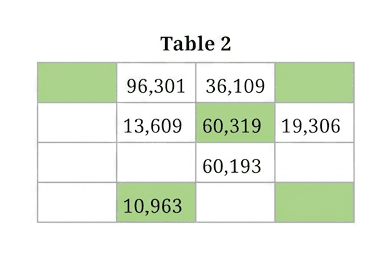
- We need to form 5-digit numbers using the digits and without repetition. The first digit cannot be .
- Rule: A cell is greater than all its adjacent neighbours (top, bottom, left, right) if and only if it is a coloured cell. A non-coloured cell cannot be greater than all of its neighbours.
- Once the table is completed, we determine:
- The biggest number in the table.
- The smallest even number (units digit must be or ).
- The smallest number strictly greater than .
Step 1 · Find the Largest Possible Number
To form the largest 5-digit number from digits , arrange them in descending order:
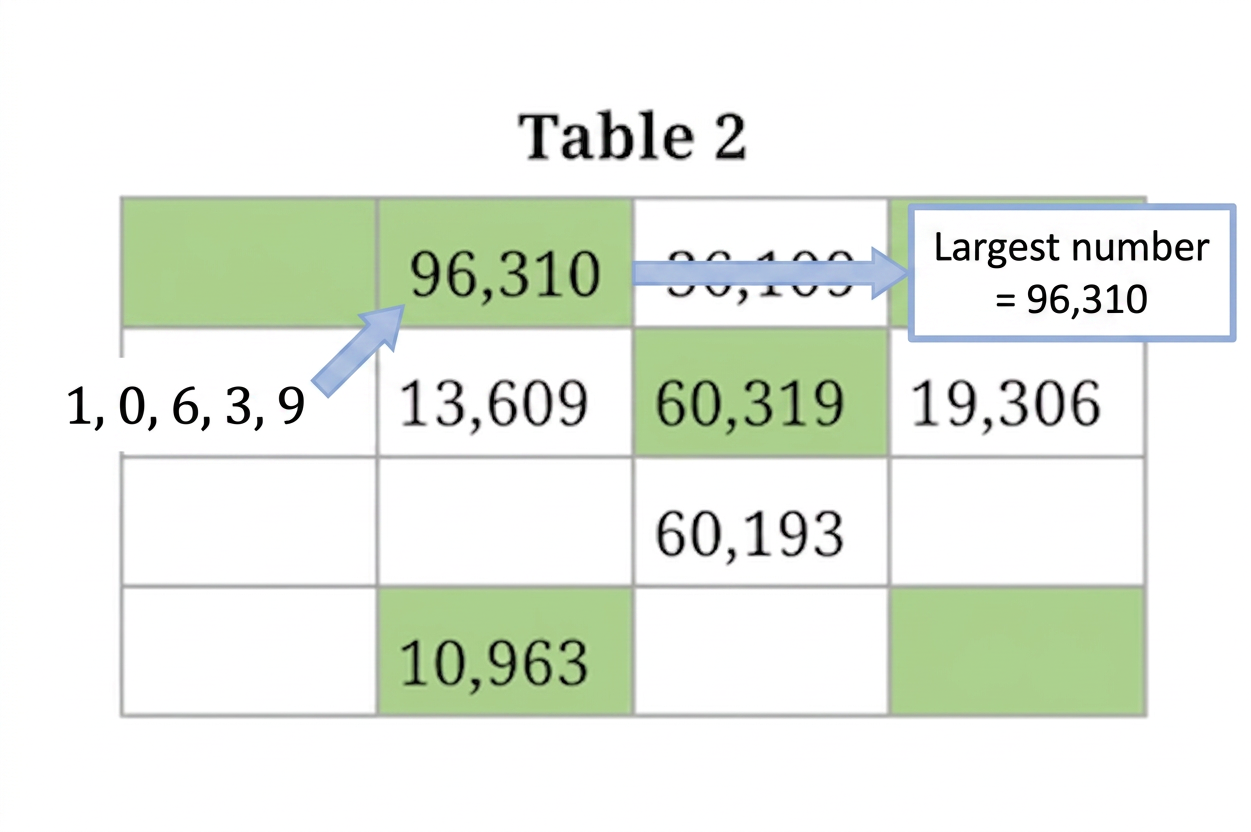
Step 2 · Fill the Top-Left Coloured Cell
Cell contains and is not coloured, so it cannot be greater than all its neighbours (, , and ).
Since and , cell must be greater than .
Since is a coloured cell, assign the largest possible number:
Step 3 · Fill Cells Adjacent to C(4,2)
Cell is a coloured cell, so all its neighbours (, , ) must be smaller than .
Possible unused 5-digit numbers smaller than are , , , , and .
Assigning valid values:
Step 4 · Fill the Top-Right Coloured Cell
Cell is coloured and adjacent to and .
Therefore, must be greater than both and .
Choosing the unused number :
Step 5 · Fill the Bottom-Right Coloured Cell
Cell is coloured and adjacent to and .
Therefore, must be greater than both neighbours.
Choosing the unused number :
Step 6 · Fill Remaining Cells and Complete Table
The remaining empty cells are , , and , with remaining numbers , , and .
Assigning:
Completed Table:
- The biggest number in the table is 96,310.
- The smallest even number in the table is 10,936.
- The smallest number greater than in the table is 60,193.
- Leading Zero Error: Writing numbers like , which has only digits instead of .
- Neighbour Rule Violation: Making an uncoloured cell larger than all surrounding neighbours; uncoloured cells must be strictly smaller than at least one neighbour.
- Even Number Misidentification: Choosing as the smallest number instead of checking the even units digit ( or ), where is the smallest even number in the table.
More questions in A
Complete Table 2 with 5-digit numbers whose digits are ‘1’, ‘0’, ‘6’, ‘3’, and ‘9’ in some order. Only a coloured cell should have a number greater than all its neighbours.
The biggest number in the table is _________ . The smallest even number in the table is _________ . The smallest number greater than in the table is _________ . Once you have filled the table above, put commas appropriately after the thousands digit.
Will reversing and adding numbers repeatedly, starting with a 2-digit number, always give a palindrome? Explore and find out.*
Explore
Take different 4-digit numbers and try carrying out these steps. Find out what happens. Check with your friends what they got.
Explore
Carry out these same steps with a few 3-digit numbers. What number will start repeating?
Make some more Collatz sequences like those above, starting with your favourite whole numbers. Do you always reach ?
Do you believe the conjecture of Collatz that all such sequences will eventually reach ? Why or why not?
The first player says 1, 2 or 3. Then the two players take turns adding 1, 2, or 3 to the previous number said. The first player to reach 21 wins!
Play this game several times with your classmate. Are you starting to see the winning strategy? Which player can always win if they play correctly? What is the pattern of numbers that the winning player should say?
The first player says a number between 1 and 10. Then the two players take turns adding a number between 1 and 10 to the previous number said. The first player to reach 99 wins!
Play this game several times with your classmate. See if you can figure out the corresponding winning strategy in this case! Which player can always win? What is the pattern of numbers that the winning player should say this time?