Question 3
State whether the following quadrilaterals are similar or not:
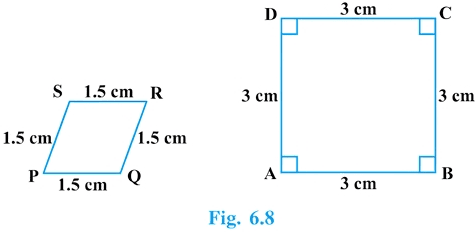
- Two polygons of the same number of sides are similar if and only if both conditions are satisfied:
- Their corresponding angles are equal.
- Their corresponding sides are in the same ratio (proportional).
- Both conditions must hold simultaneously; if either condition fails, the figures are not similar.
Step 1 · Check Ratio of Corresponding Sides
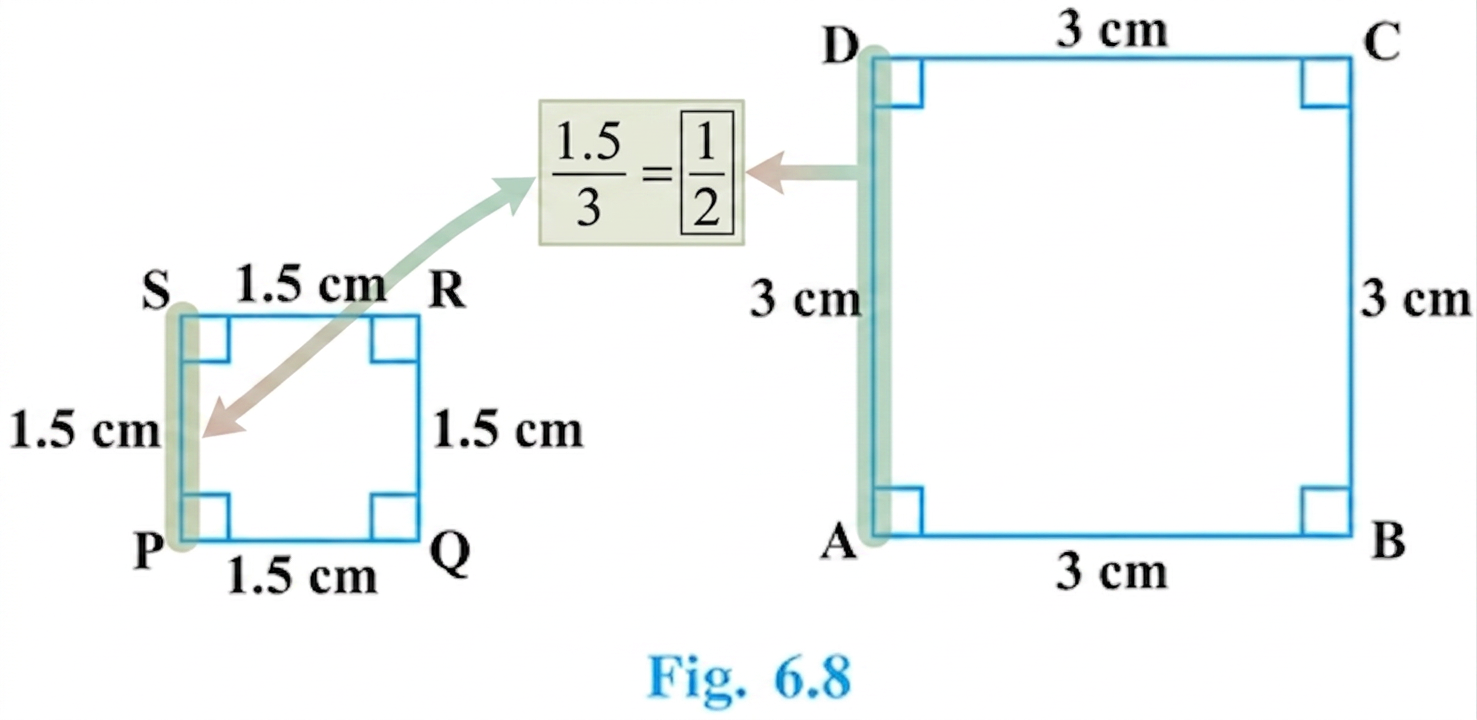
Ratio of the corresponding sides:
The corresponding sides are in the same ratio (proportional).
Step 2 · Check Corresponding Angles
For quadrilateral (square):
For quadrilateral (rhombus): The angles are not ( and are acute, while and are obtuse).
Since the corresponding angles are not equal:
Therefore, the two quadrilaterals are not similar.
The two quadrilaterals are not similar.
- Assuming Proportional Sides Are Sufficient: In triangles, side proportionality guarantees similarity (SSS), but in quadrilaterals and higher polygons, both proportional sides and equal corresponding angles are required.
- Confusing Rhombus and Square: Both figures have equal side lengths, but a square has angles whereas a general rhombus does not.
More questions in Exercise 6.1
Fill in the blanks using the correct word given in brackets :
(i) All circles are __________ . (congruent, similar)
(ii) All squares are __________ . (similar, congruent)
(iii) All __________ triangles are similar. (isosceles, equilateral)
(iv) Two polygons of the same number of sides are similar, if (a) their corresponding angles are __________ and (b) their corresponding sides are __________ . (equal, proportional)
Give two different examples of pair of
(i) similar figures. (ii) non-similar figures.
State whether the following quadrilaterals are similar or not: