Triangles | Exercise 6.2

Question 4

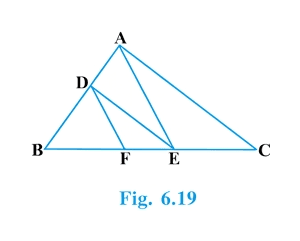
In Fig. 6.19, DEACDE \parallel AC and DFAEDF \parallel AE. Prove that

BFFE=BEEC\dfrac{\text{BF}}{\text{FE}} = \dfrac{\text{BE}}{\text{EC}}

Question diagram 1
Check your answer with HomiSolve it yourself, then let Homi check your steps and spot mistakes.
Solution
Understand the Question
  • Basic Proportionality Theorem (BPT): If a line is drawn parallel to one side of a triangle intersecting the other two sides, it divides the two sides in the same ratio.
  • We apply BPT in two different triangles sharing side ABAB:
    1. In ΔABC\Delta ABC, since DEACDE \parallel AC, it divides sides ABAB and BCBC in equal ratio.
    2. In ΔABE\Delta ABE, since DFAEDF \parallel AE, it divides sides ABAB and BEBE in equal ratio.
  • By equating the common ratio BDDA\dfrac{\text{BD}}{\text{DA}}, we arrive at the required proof.

Step 1 · Apply BPT in ΔABC\Delta ABC

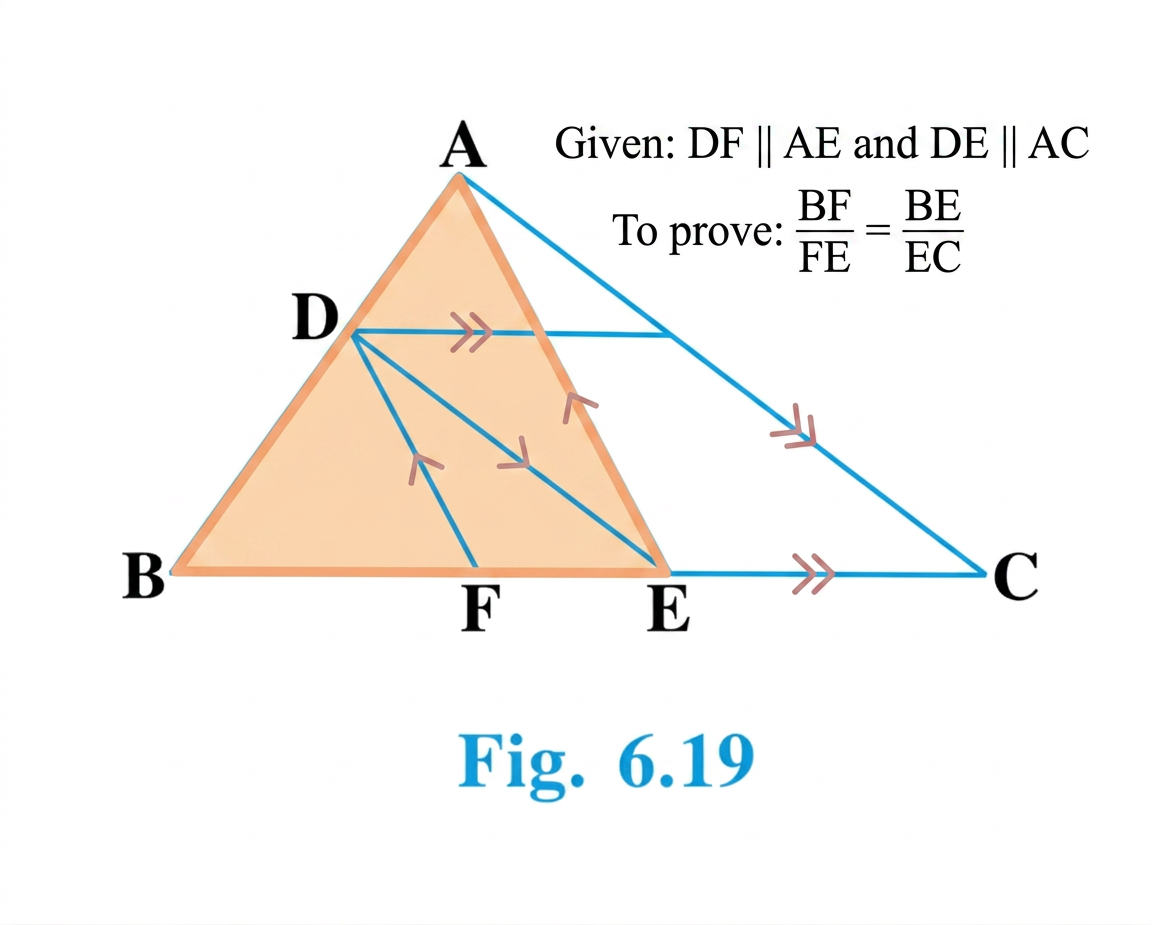
In ΔABC\Delta ABC, we are given DEACDE \parallel AC.Diagram 1

By the Basic Proportionality Theorem (BPT) BDDA=BEEC(1)\dfrac{\text{BD}}{\text{DA}} = \dfrac{\text{BE}}{\text{EC}} \quad \dots (1)

Step 2 · Apply BPT in ΔBAE\Delta BAE

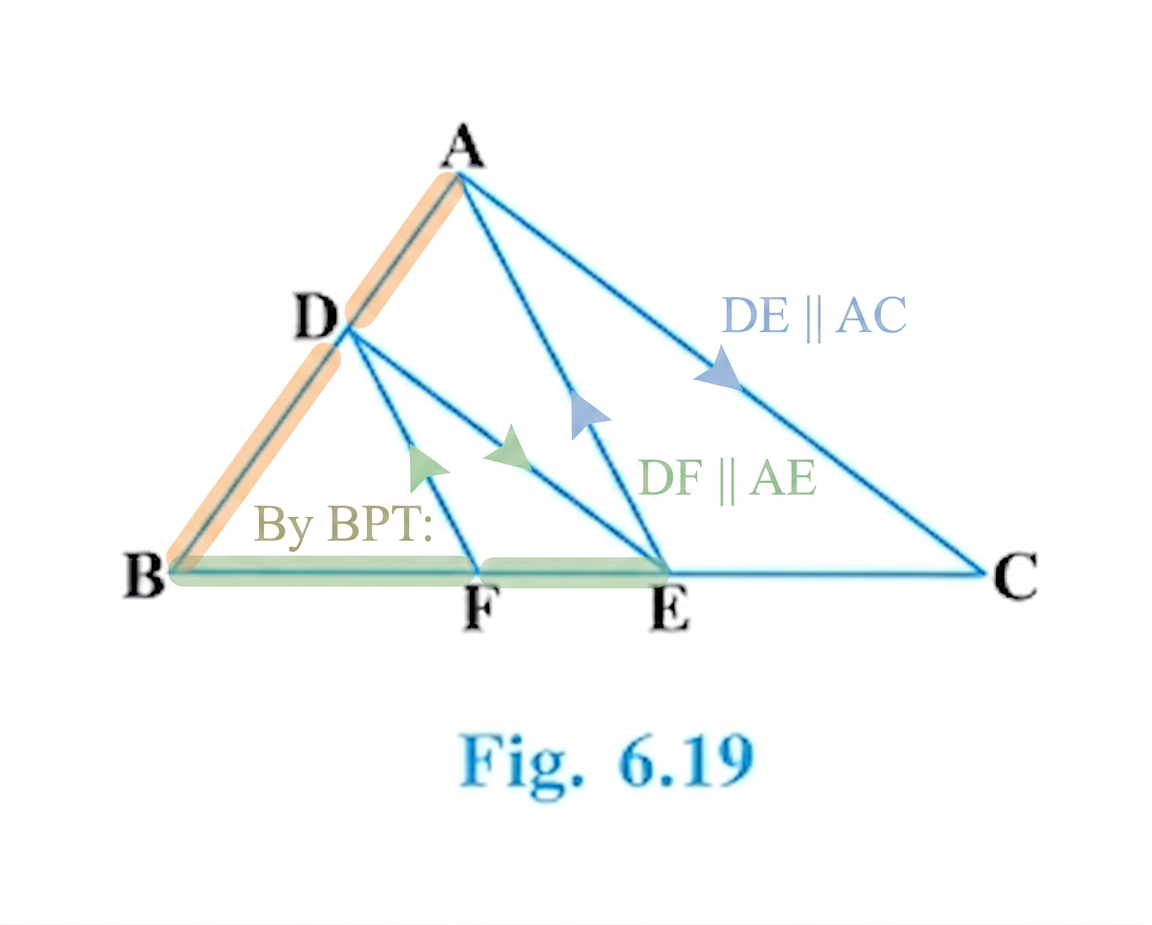
In ΔBAE\Delta BAE, we are given DFAEDF \parallel AE.Diagram 2

By the Basic Proportionality Theorem (BPT) BDDA=BFFE(2)\dfrac{\text{BD}}{\text{DA}} = \dfrac{\text{BF}}{\text{FE}} \quad \dots (2)

Step 3 · Equate the Ratios

From equations (1)(1) and (2)(2), since both equal BDDA\dfrac{\text{BD}}{\text{DA}}

BFFE=BEEC\dfrac{\text{BF}}{\text{FE}} = \dfrac{\text{BE}}{\text{EC}}

Answer

Hence proved, BFFE=BEEC\dfrac{\text{BF}}{\text{FE}} = \dfrac{\text{BE}}{\text{EC}}

Common Mistakes
  • Choosing the Wrong Triangle: Applying DFAEDF \parallel AE to the entire ΔABC\Delta ABC instead of the smaller triangle ΔABE\Delta ABE.
  • Inconsistent Ratio Direction: Writing BDDA\dfrac{\text{BD}}{\text{DA}} on one side and ECBE\dfrac{\text{EC}}{\text{BE}} on the other. Always trace segments consistently starting from vertex BB.

More questions in Exercise 6.2

Q1

In Fig. 6.17, (i) and (ii), DEBCDE \parallel BC. Find ECEC in (i) and ADAD in (ii).

Q2

EE and FF are points on the sides PQPQ and PRPR respectively of a ΔPQR\Delta PQR. For each of the following cases, state whether EFQREF \parallel QR :

(i) PE=3.9 cmPE = 3.9\text{ cm}, EQ=3 cmEQ = 3\text{ cm}, PF=3.6 cmPF = 3.6\text{ cm}, and FR=2.4 cmFR = 2.4\text{ cm}

(ii) PE=4 cmPE = 4\text{ cm}, QE=4.5 cmQE = 4.5\text{ cm}, PF=8 cmPF = 8\text{ cm}, and RF=9 cmRF = 9\text{ cm}

(iii) PQ=1.28 cmPQ = 1.28\text{ cm}, PR=2.56 cmPR = 2.56\text{ cm}, PE=0.18 cmPE = 0.18\text{ cm}, and PF=0.36 cmPF = 0.36\text{ cm}

Q3

In Fig. 6.18, if LMCB\text{LM} \parallel \text{CB} and LNCD\text{LN} \parallel \text{CD}, prove that

AMAB=ANAD\dfrac{\text{AM}}{\text{AB}} = \dfrac{\text{AN}}{\text{AD}}

Q4

In Fig. 6.19, DEACDE \parallel AC and DFAEDF \parallel AE. Prove that

BFFE=BEEC\dfrac{\text{BF}}{\text{FE}} = \dfrac{\text{BE}}{\text{EC}}

← Back to Triangles