Triangles | Exercise 6.2

Question 1

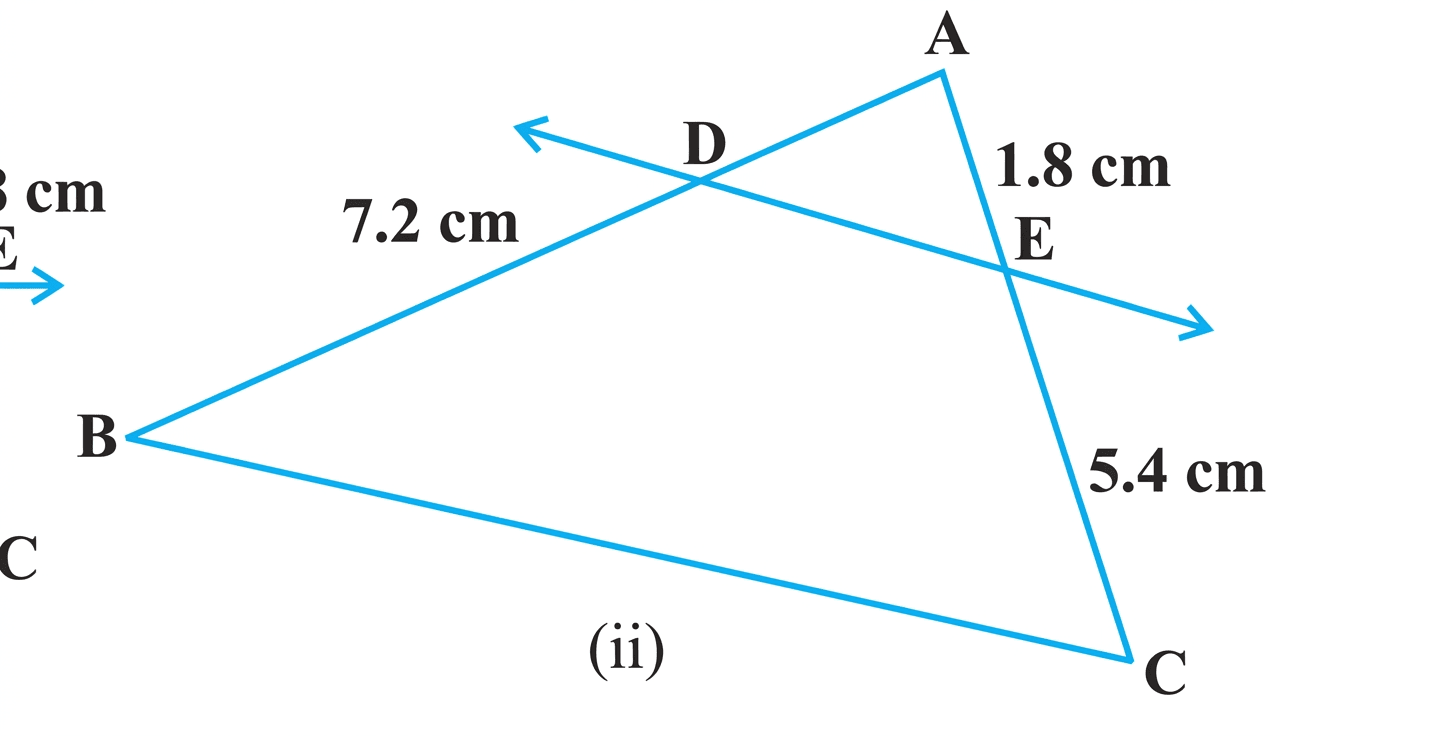
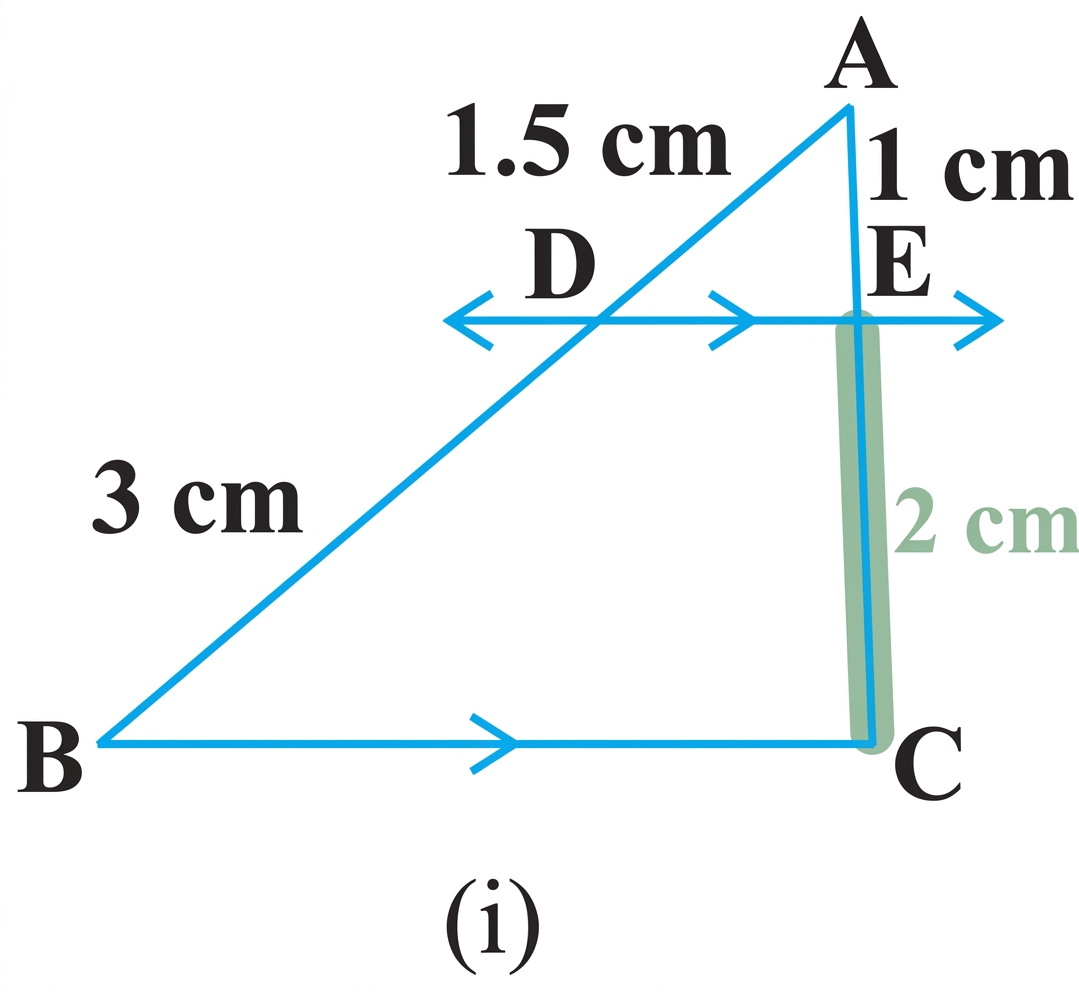
In Fig. 6.17, (i) and (ii), DEBCDE \parallel BC. Find ECEC in (i) and ADAD in (ii).

Question diagram 1Question diagram 2
Check your answer with HomiSolve it yourself, then let Homi check your steps and spot mistakes.
Solution
Understand the Question
  • Basic Proportionality Theorem (Thales's Theorem): If a line is drawn parallel to one side of a triangle intersecting the other two sides in distinct points, then it divides the two sides in the same ratio.
  • In ΔABC\Delta ABC, since DEBCDE \parallel BC, by Basic Proportionality Theorem: ADDB=AEEC\dfrac{AD}{DB} = \dfrac{AE}{EC}
  • We substitute the given lengths into this proportion to find the unknown segment in each part.

(i) Find ECEC in (i)

Step 1 · Calculate the length of ECEC

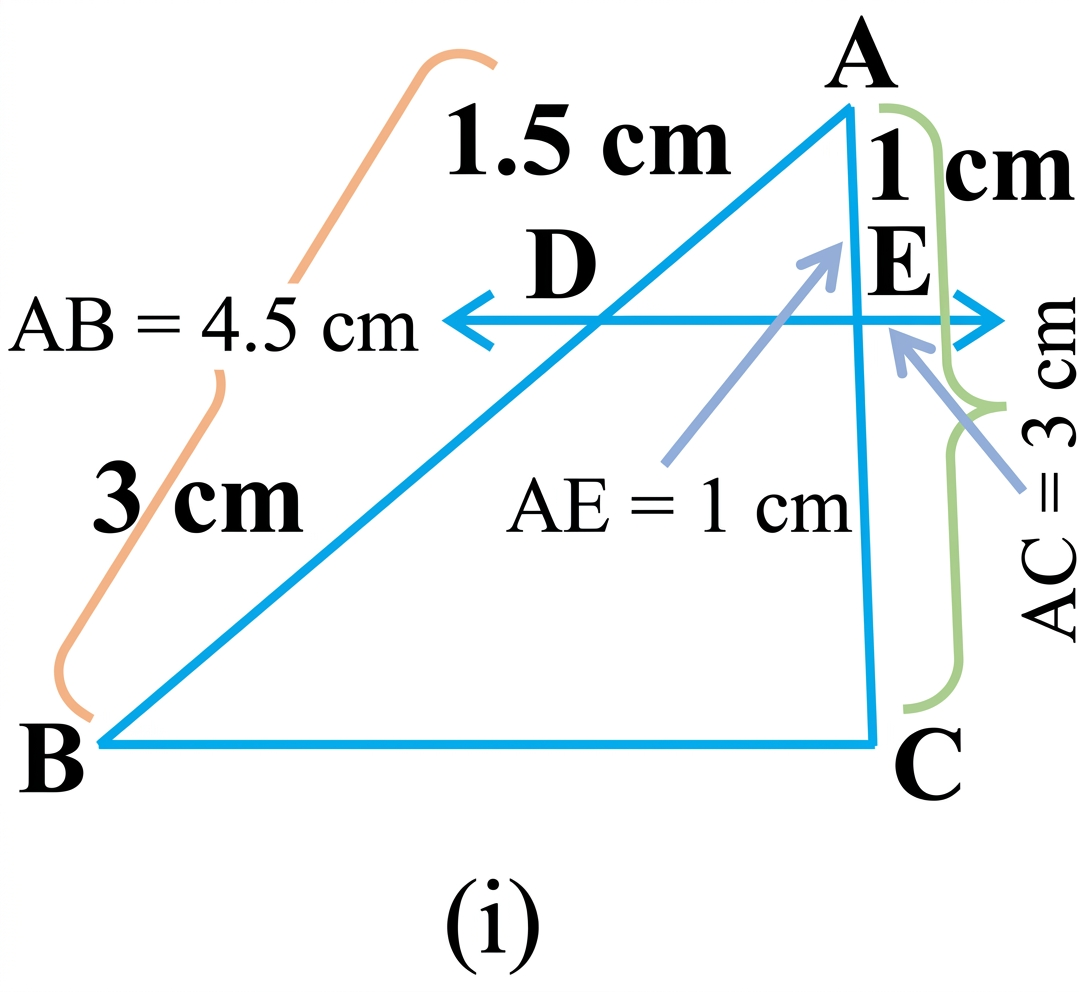
Given AD=1.5 cmAD = 1.5\text{ cm}, DB=3 cmDB = 3\text{ cm}, and AE=1 cmAE = 1\text{ cm}.Diagram 1

In ΔABC\Delta ABC, since DEBCDE \parallel BC, by Basic Proportionality Theorem (BPT) ADDB=AEEC\dfrac{AD}{DB} = \dfrac{AE}{EC}

Let EC=xEC = x. Substituting the given values 1.53=1x\dfrac{1.5}{3} = \dfrac{1}{x}

1.5×x=3×11.5x=3x=31.5x=2\begin{aligned} 1.5 \times x &= 3 \times 1 \\[0.6em] 1.5x &= 3 \\[0.6em] x &= \dfrac{3}{1.5} \\[0.6em] x &= 2 \end{aligned}

Therefore, EC=2 cmEC = 2\text{ cm}.

Answer

(i) EC=2 cmEC = 2 \text{ cm}

(ii) Find ADAD in (ii)

Step 1 · Calculate the length of ADAD

Given DB=7.2 cmDB = 7.2\text{ cm}, AE=1.8 cmAE = 1.8\text{ cm}, and EC=5.4 cmEC = 5.4\text{ cm}.Diagram 2

In ΔABC\Delta ABC, since DEBCDE \parallel BC, by Basic Proportionality Theorem (BPT) ADDB=AEEC\dfrac{AD}{DB} = \dfrac{AE}{EC}

Let AD=xAD = x. Substituting the given values x7.2=1.85.4\dfrac{x}{7.2} = \dfrac{1.8}{5.4}

x=1.8×7.25.4x = \dfrac{1.8 \times 7.2}{5.4}

Simplifying 1.85.4\dfrac{1.8}{5.4}

1.85.4=1854=13\begin{aligned} \dfrac{1.8}{5.4} &= \dfrac{18}{54} \\[0.6em] &= \dfrac{1}{3} \end{aligned}

Substituting back

x=13×7.2=7.23=2.4\begin{aligned} x &= \dfrac{1}{3} \times 7.2 \\[0.6em] &= \dfrac{7.2}{3} \\[0.6em] &= 2.4 \end{aligned}

Therefore, AD=2.4 cmAD = 2.4\text{ cm}.

Answer

(ii) AD=2.4 cmAD = 2.4 \text{ cm}

Common Mistakes
  • Ratio Mismatch: Setting up incorrect ratios such as ADAB=AEEC\dfrac{AD}{AB} = \dfrac{AE}{EC} instead of using the corresponding parts ADDB=AEEC\dfrac{AD}{DB} = \dfrac{AE}{EC}.
  • Decimal Calculation Slip: Making errors when simplifying fractions involving decimals like 1.85.4\dfrac{1.8}{5.4} or 31.5\dfrac{3}{1.5}. Convert them into whole-number fractions (e.g., 1854=13\dfrac{18}{54} = \dfrac{1}{3}) to avoid arithmetic mistakes.

More questions in Exercise 6.2

Q1

In Fig. 6.17, (i) and (ii), DEBCDE \parallel BC. Find ECEC in (i) and ADAD in (ii).

Q2

EE and FF are points on the sides PQPQ and PRPR respectively of a ΔPQR\Delta PQR. For each of the following cases, state whether EFQREF \parallel QR :

(i) PE=3.9 cmPE = 3.9\text{ cm}, EQ=3 cmEQ = 3\text{ cm}, PF=3.6 cmPF = 3.6\text{ cm}, and FR=2.4 cmFR = 2.4\text{ cm}

(ii) PE=4 cmPE = 4\text{ cm}, QE=4.5 cmQE = 4.5\text{ cm}, PF=8 cmPF = 8\text{ cm}, and RF=9 cmRF = 9\text{ cm}

(iii) PQ=1.28 cmPQ = 1.28\text{ cm}, PR=2.56 cmPR = 2.56\text{ cm}, PE=0.18 cmPE = 0.18\text{ cm}, and PF=0.36 cmPF = 0.36\text{ cm}

Q3

In Fig. 6.18, if LMCB\text{LM} \parallel \text{CB} and LNCD\text{LN} \parallel \text{CD}, prove that

AMAB=ANAD\dfrac{\text{AM}}{\text{AB}} = \dfrac{\text{AN}}{\text{AD}}

Q4

In Fig. 6.19, DEACDE \parallel AC and DFAEDF \parallel AE. Prove that

BFFE=BEEC\dfrac{\text{BF}}{\text{FE}} = \dfrac{\text{BE}}{\text{EC}}

← Back to Triangles