Triangles | Exercise 6.2

Question 3

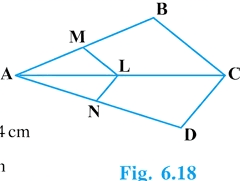
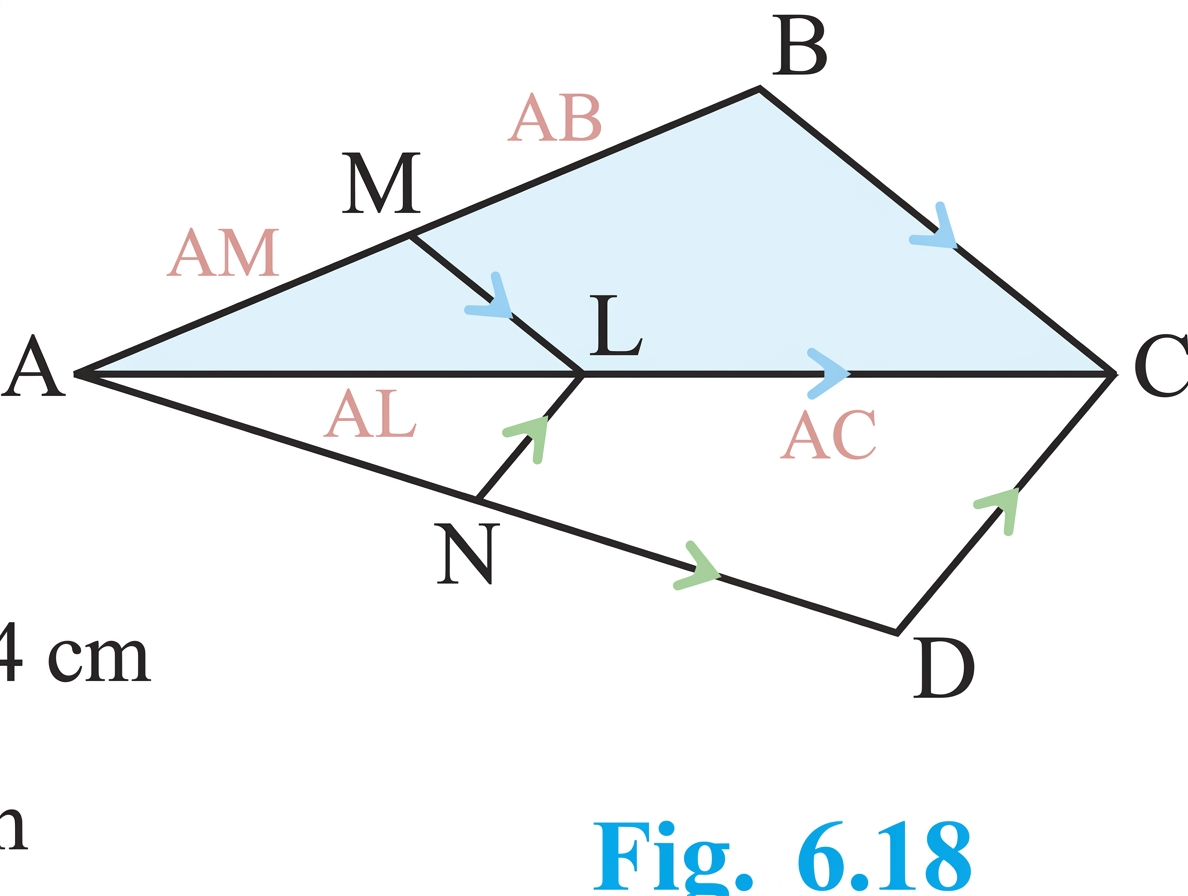
In Fig. 6.18, if LMCB\text{LM} \parallel \text{CB} and LNCD\text{LN} \parallel \text{CD}, prove that

AMAB=ANAD\dfrac{\text{AM}}{\text{AB}} = \dfrac{\text{AN}}{\text{AD}}

Question diagram 1
Check your answer with HomiSolve it yourself, then let Homi check your steps and spot mistakes.
Solution
Understand the Question
  • We are given a figure with quadrilateral ABCD\text{ABCD} divided by diagonal AC\text{AC} into two triangles: ΔABC\Delta \text{ABC} and ΔADC\Delta \text{ADC}.
  • In ΔABC\Delta \text{ABC}, line LMCB\text{LM} \parallel \text{CB}, and in ΔADC\Delta \text{ADC}, line LNCD\text{LN} \parallel \text{CD}.
  • According to the Basic Proportionality Theorem (BPT), a line drawn parallel to one side of a triangle divides the other two sides in the same ratio.
  • We apply BPT to both triangles with respect to the common side AC\text{AC} and equate the resulting ratios.

Step 1 · Apply BPT in ΔABC\Delta \text{ABC}

In ΔABC\Delta \text{ABC}, we are given LMCB\text{LM} \parallel \text{CB}.Diagram 1

By Basic Proportionality Theorem (BPT) AMAB=ALAC(1)\dfrac{\text{AM}}{\text{AB}} = \dfrac{\text{AL}}{\text{AC}} \quad \dots (1)

Step 2 · Apply BPT in ΔADC\Delta \text{ADC}

In ΔADC\Delta \text{ADC}, we are given LNCD\text{LN} \parallel \text{CD}.

By Basic Proportionality Theorem (BPT) ANAD=ALAC(2)\dfrac{\text{AN}}{\text{AD}} = \dfrac{\text{AL}}{\text{AC}} \quad \dots (2)

Step 3 · Compare Equations

From equations (1)(1) and (2)(2), both ratios are equal to ALAC\dfrac{\text{AL}}{\text{AC}} AMAB=ANAD\dfrac{\text{AM}}{\text{AB}} = \dfrac{\text{AN}}{\text{AD}}

Answer

Hence proved,

AMAB=ANAD\dfrac{\text{AM}}{\text{AB}} = \dfrac{\text{AN}}{\text{AD}}

Common Mistakes
  • Ratio Form Confusion: Standard BPT gives AMMB=ALLC\dfrac{\text{AM}}{\text{MB}} = \dfrac{\text{AL}}{\text{LC}}. Adding 11 to both sides or taking reciprocals gives the whole-length form AMAB=ALAC\dfrac{\text{AM}}{\text{AB}} = \dfrac{\text{AL}}{\text{AC}}, which directly matches what needs to be proved.
  • Incorrect Triangle Association: Mixing up the vertices — ensure LMCB\text{LM} \parallel \text{CB} is applied strictly to ΔABC\Delta \text{ABC} and LNCD\text{LN} \parallel \text{CD} to ΔADC\Delta \text{ADC} with common side AC\text{AC}.

More questions in Exercise 6.2

Q1

In Fig. 6.17, (i) and (ii), DEBCDE \parallel BC. Find ECEC in (i) and ADAD in (ii).

Q2

EE and FF are points on the sides PQPQ and PRPR respectively of a ΔPQR\Delta PQR. For each of the following cases, state whether EFQREF \parallel QR :

(i) PE=3.9 cmPE = 3.9\text{ cm}, EQ=3 cmEQ = 3\text{ cm}, PF=3.6 cmPF = 3.6\text{ cm}, and FR=2.4 cmFR = 2.4\text{ cm}

(ii) PE=4 cmPE = 4\text{ cm}, QE=4.5 cmQE = 4.5\text{ cm}, PF=8 cmPF = 8\text{ cm}, and RF=9 cmRF = 9\text{ cm}

(iii) PQ=1.28 cmPQ = 1.28\text{ cm}, PR=2.56 cmPR = 2.56\text{ cm}, PE=0.18 cmPE = 0.18\text{ cm}, and PF=0.36 cmPF = 0.36\text{ cm}

Q3

In Fig. 6.18, if LMCB\text{LM} \parallel \text{CB} and LNCD\text{LN} \parallel \text{CD}, prove that

AMAB=ANAD\dfrac{\text{AM}}{\text{AB}} = \dfrac{\text{AN}}{\text{AD}}

Q4

In Fig. 6.19, DEACDE \parallel AC and DFAEDF \parallel AE. Prove that

BFFE=BEEC\dfrac{\text{BF}}{\text{FE}} = \dfrac{\text{BE}}{\text{EC}}

← Back to Triangles