Question 8
From a solid cylinder whose height is 2.4 cm and diameter 1.4 cm, a conical cavity of the same height and same diameter is hollowed out. Find the total surface area of the remaining solid to the nearest cm².
We need to find the total surface area of the remaining solid after hollowing out a cone from a cylinder.
Step 1 — Find the dimensions
Let's write down the given dimensions for the cylinder. The height of the cylinder is . The diameter of the cylinder is . So, the radius of the cylinder is half of the diameter.
The conical cavity has the same height and diameter. So, for the cone, its height is and its radius is .
We need to find the slant height () of the cone. The radius, the height, and the slant height form a right-angled triangle, where the slant height is the hypotenuse. So by the Pythagoras theorem:
Taking the square root on both sides:
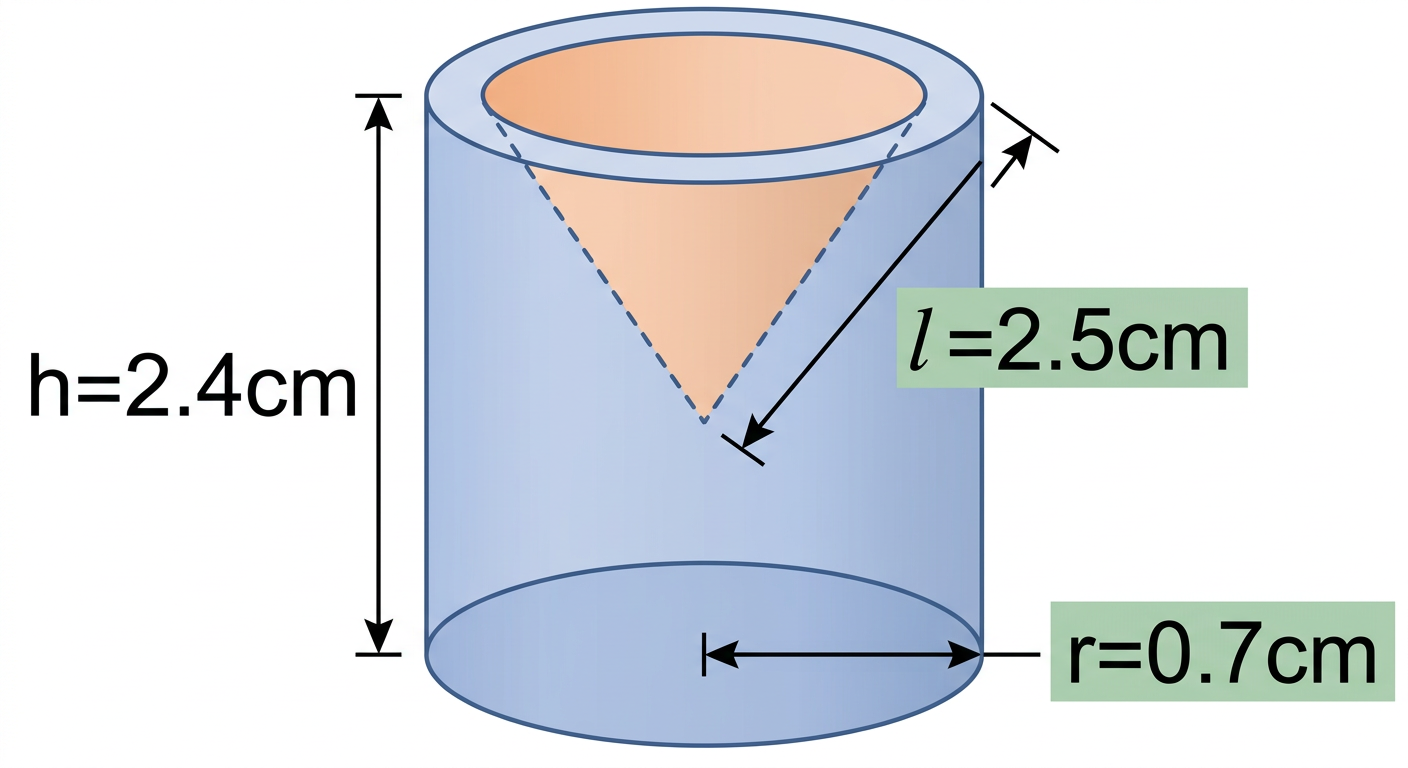
Step 2 — Calculate the total surface area
The total surface area of the remaining solid is made of three parts:
- the curved surface of the cylinder (the outer wall)
- the curved surface of the conical cavity (the sloping inner surface of the scooped-out cone)
- the base of the cylinder (the flat circle at the bottom)
We use these formulas:
- CSA of a cylinder
- CSA of a cone
- Area of a circular base
Adding them gives the total surface area (TSA):
Now we substitute the values , , and , using :
Here , which makes each term simpler:
We need to round this to the nearest cm². The digit after the decimal point is , which is greater than . So, we round up the whole number part.
Answer
The total surface area of the remaining solid is .
More questions in Exercise 12.1
Unless stated otherwise, take .
2 cubes each of volume are joined end to end. Find the surface area of the resulting cuboid.
A vessel is in the form of a hollow hemisphere mounted by a hollow cylinder. The diameter of the hemisphere is and the total height of the vessel is . Find the inner surface area of the vessel.
A toy is in the form of a cone of radius mounted on a hemisphere of same radius. The total height of the toy is . Find the total surface area of the toy.
A cubical block of side is surmounted by a hemisphere. What is the greatest diameter the hemisphere can have? Find the surface area of the solid.
A hemispherical depression is cut out from one face of a cubical wooden block such that the diameter of the hemisphere is equal to the edge of the cube. Determine the surface area of the remaining solid.
A medicine capsule is in the shape of a cylinder with two hemispheres stuck to each of its ends (see Fig. 12.10). The length of the entire capsule is and the diameter of the capsule is . Find its surface area.
A tent is in the shape of a cylinder surmounted by a conical top. If the height and diameter of the cylindrical part are 2.1 m and 4 m respectively, and the slant height of the top is 2.8 m, find the area of the canvas used for making the tent. Also, find the cost of the canvas of the tent at the rate of ₹500 per m². (Note that the base of the tent will not be covered with canvas.)
From a solid cylinder whose height is 2.4 cm and diameter 1.4 cm, a conical cavity of the same height and same diameter is hollowed out. Find the total surface area of the remaining solid to the nearest cm².
A wooden article was made by scooping out a hemisphere from each end of a solid cylinder, as shown in Fig. 12.11. If the height of the cylinder is 10 cm, and its base is of radius 3.5 cm, find the total surface area of the article.