Question 6
A medicine capsule is in the shape of a cylinder with two hemispheres stuck to each of its ends (see Fig. 12.10). The length of the entire capsule is and the diameter of the capsule is . Find its surface area.
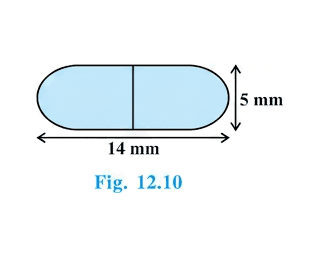
- A medicine capsule consists of a central cylindrical section with a hemisphere attached at each of its two ends.
- The total surface area of the capsule is the sum of the curved surface area (CSA) of the cylinder and the curved surface areas of the two hemispheres:
- Note that the circular bases of the cylinder and hemispheres are joined internally and are not part of the outer surface.
Step 1 · Find Dimensions of the Cylinder and Hemispheres
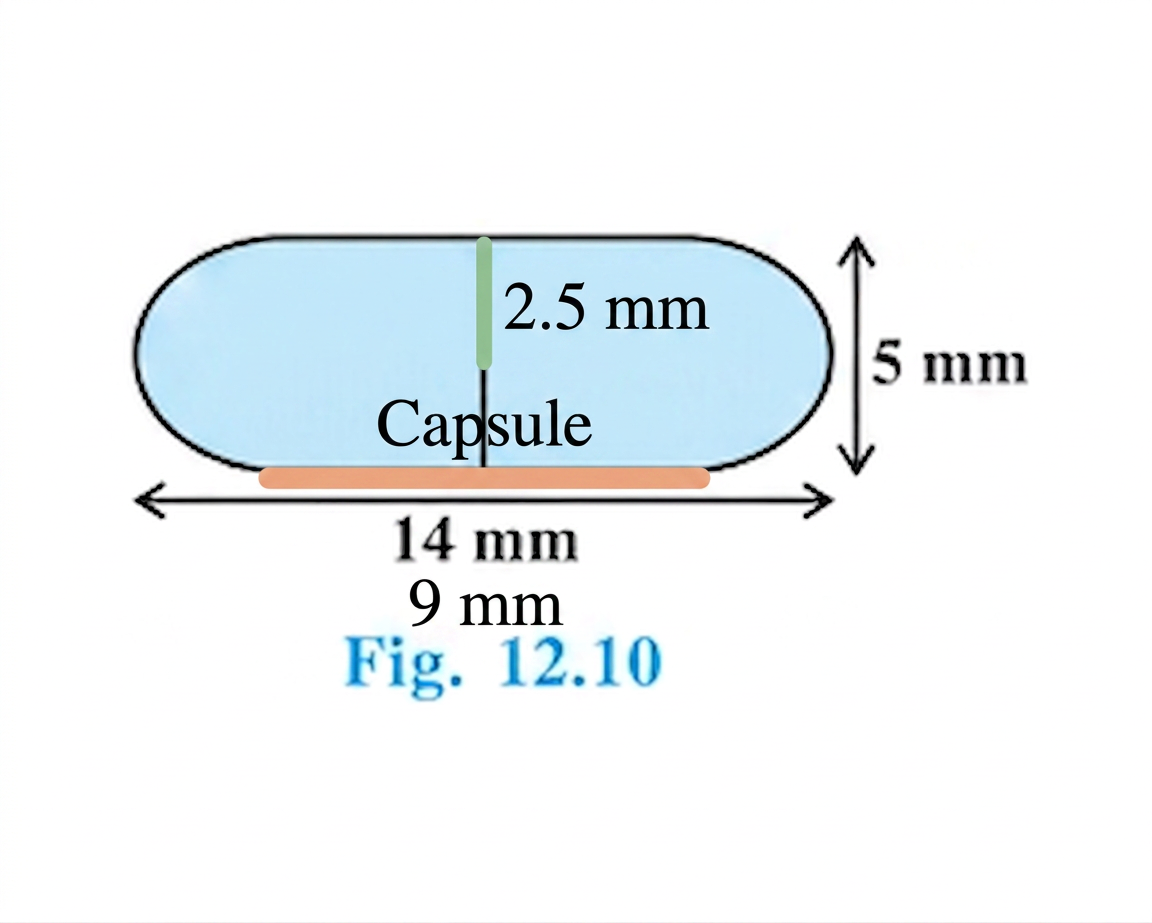
Given the diameter of the capsule is , the radius of both the cylinder and the hemispheres is:
The height (length) of the cylindrical part is found by subtracting the radius of both hemispherical ends from the total length:
Step 2 · Calculate the Surface Area of the Capsule
The surface area of the capsule is the sum of the curved surface areas:
Substitute and :
Using :
- Adding Total Surface Areas: Adding the total surface area (TSA) of the cylinder and hemispheres instead of their curved surface areas (CSA). The circular faces are joined together inside and are not exposed.
- Height of the Cylinder: Forgetting to subtract the radius of both hemispheres () from the total length, erroneously taking instead of .
More questions in Exercise 12.1
Unless stated otherwise, take .
2 cubes each of volume are joined end to end. Find the surface area of the resulting cuboid.
A vessel is in the form of a hollow hemisphere mounted by a hollow cylinder. The diameter of the hemisphere is and the total height of the vessel is . Find the inner surface area of the vessel.
A toy is in the form of a cone of radius mounted on a hemisphere of same radius. The total height of the toy is . Find the total surface area of the toy.
A cubical block of side is surmounted by a hemisphere. What is the greatest diameter the hemisphere can have? Find the surface area of the solid.
A hemispherical depression is cut out from one face of a cubical wooden block such that the diameter of the hemisphere is equal to the edge of the cube. Determine the surface area of the remaining solid.
A medicine capsule is in the shape of a cylinder with two hemispheres stuck to each of its ends (see Fig. 12.10). The length of the entire capsule is and the diameter of the capsule is . Find its surface area.
A tent is in the shape of a cylinder surmounted by a conical top. If the height and diameter of the cylindrical part are and respectively, and the slant height of the top is , find the area of the canvas used for making the tent. Also, find the cost of the canvas of the tent at the rate of ₹ per . (Note that the base of the tent will not be covered with canvas.)
From a solid cylinder whose height is and diameter , a conical cavity of the same height and same diameter is hollowed out. Find the total surface area of the remaining solid to the nearest .
A wooden article was made by scooping out a hemisphere from each end of a solid cylinder, as shown in Fig. 12.11. If the height of the cylinder is , and its base is of radius , find the total surface area of the article.