Question 6
A solid iron pole consists of a cylinder of height 220 cm and base diameter 24 cm, which is surmounted by another cylinder of height 60 cm and radius 8 cm. Find the mass of the pole, given that of iron has approximately mass. (Use )
- The solid iron pole consists of two cylinders, one mounted on top of the other:
- Larger (bottom) cylinder: Height , base diameter .
- Smaller (top) cylinder: Height , radius .
- The total volume of the pole is the sum of the volumes of both cylinders: .
- The total mass is found by multiplying the volume by the density () and converting the result from grams to kilograms ().
Step 1 · Calculate the Total Volume of the Pole
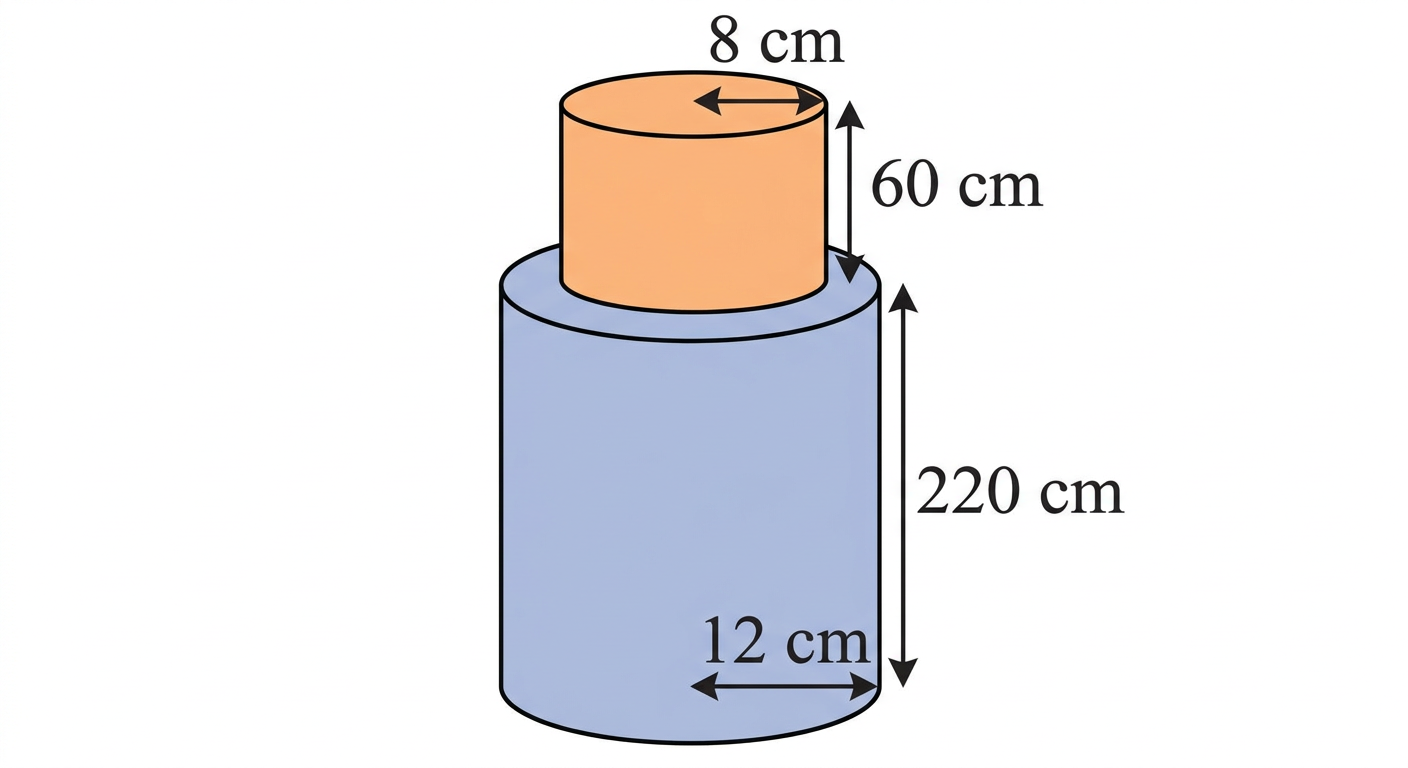
For the larger cylinder:
For the smaller cylinder:
Total volume of the pole:
Using :
Step 2 · Calculate the Mass of the Pole
Given that mass of of iron :
Converting to kilograms ():
- Diameter vs. Radius: Using the diameter directly instead of halving it to get radius .
- Incorrect Value of : Using instead of the explicitly specified .
- Unit Conversion: Forgetting to divide the mass by to convert grams into kilograms.
More questions in Exercise 12.2
Unless stated otherwise, take .
- A solid is in the shape of a cone standing on a hemisphere with both their radii being equal to 1 cm and the height of the cone is equal to its radius. Find the volume of the solid in terms of .
- Rachel, an engineering student, was asked to make a model shaped like a cylinder with two cones attached at its two ends by using a thin aluminium sheet. The diameter of the model is and its length is . If each cone has a height of , find the volume of air contained in the model that Rachel made. (Assume the outer and inner dimensions of the model to be nearly the same.)
A gulab jamun, contains sugar syrup up to about of its volume. Find approximately how much syrup would be found in 45 gulab jamuns, each shaped like a cylinder with two hemispherical ends with length and diameter (see Fig. 12.15).
A pen stand made of wood is in the shape of a cuboid with four conical depressions to hold pens. The dimensions of the cuboid are 15 cm by 10 cm by 3.5 cm. The radius of each of the depressions is 0.5 cm and the depth is 1.4 cm. Find the volume of wood in the entire stand (see Fig. 12.16).
A vessel is in the form of an inverted cone. Its height is and the radius of its top, which is open, is . It is filled with water up to the brim. When lead shots, each of which is a sphere of radius are dropped into the vessel, one-fourth of the water flows out. Find the number of lead shots dropped in the vessel.
A solid iron pole consists of a cylinder of height 220 cm and base diameter 24 cm, which is surmounted by another cylinder of height 60 cm and radius 8 cm. Find the mass of the pole, given that of iron has approximately mass. (Use )
A solid consisting of a right circular cone of height and radius standing on a hemisphere of radius is placed upright in a right circular cylinder full of water such that it touches the bottom. Find the volume of water left in the cylinder, if the radius of the cylinder is and its height is .
A spherical glass vessel has a cylindrical neck 8 cm long, 2 cm in diameter; the diameter of the spherical part is 8.5 cm. By measuring the amount of water it holds, a child finds its volume to be . Check whether she is correct, taking the above as the inside measurements, and .