Question 5
The altitude of a right triangle is 7 cm less than its base. If the hypotenuse is 13 cm, find the other two sides.
- Let the base of the right-angled triangle be .
- The altitude is less than the base, so .
- According to the Pythagoras theorem:
- Substitute the given values to form a quadratic equation, solve for , and reject any negative value since length must be positive.
Step 1 · Form the Quadratic Equation
Let the base of the right-angled triangle be .
Then, and .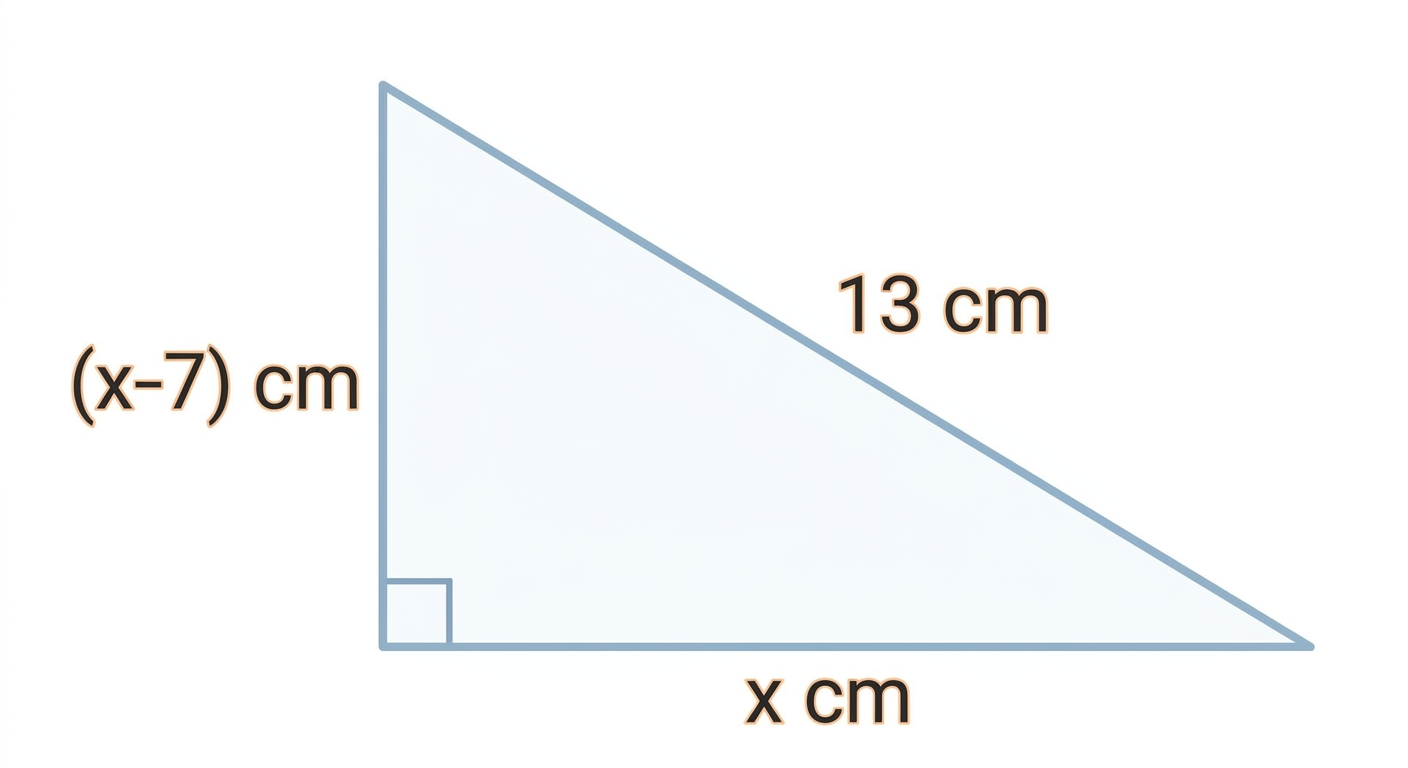
By Pythagoras theorem
Dividing the entire equation by
Step 2 · Solve for the Sides of the Triangle
Factorising the quadratic equation
Since side length cannot be negative, .
Therefore,
and
- Accepting Negative Roots: Side lengths represent physical distances and cannot be negative, so must be discarded.
- Expansion Error: Incorrectly expanding as or instead of using the identity .
More questions in Exercise 4.2
Find the roots of the following quadratic equations by factorisation:
(i)
(ii)
(iii)
(iv)
(v)
Solve the problems given in Example 1.
Find two numbers whose sum is 27 and product is 182.
Find two consecutive positive integers, sum of whose squares is 365.
The altitude of a right triangle is 7 cm less than its base. If the hypotenuse is 13 cm, find the other two sides.
A cottage industry produces a certain number of pottery articles in a day. It was observed on a particular day that the cost of production of each article (in rupees) was 3 more than twice the number of articles produced on that day. If the total cost of production on that day was ₹ 90, find the number of articles produced and the cost of each article.