Quadratic Equations | Exercise 4.2

Question 2

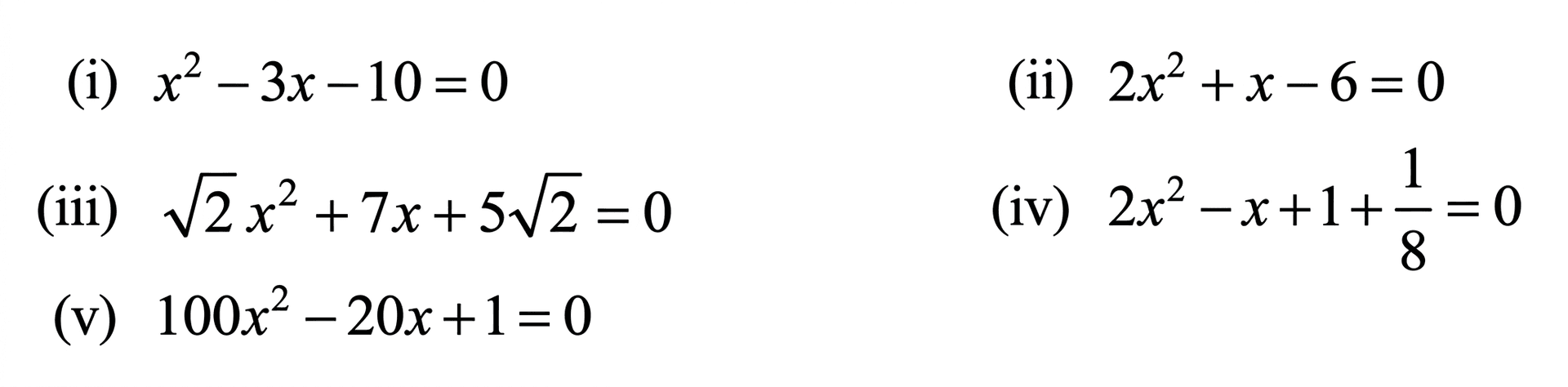
Solve the problems given in Example 1.
Question diagram 1
Check your answer with HomiSolve it yourself, then let Homi check your steps and spot mistakes.
Solution
Understand the Question

To find the roots of a quadratic equation ax2+bx+c=0ax^2 + bx + c = 0, we can use one of the standard methods:

  • Factorisation (Splitting the middle term): Find two numbers whose product is a×ca \times c and whose sum is bb, then factor by grouping.
  • Quadratic Formula: Find the discriminant D=b24acD = b^2 - 4ac. If D0D \ge 0, the roots are given by x=b±D2ax = \dfrac{-b \pm \sqrt{D}}{2a}. If D<0D < 0, the equation has no real roots.
  • Perfect Square Identity: If the expression matches A2±2AB+B2=(A±B)2A^2 \pm 2AB + B^2 = (A \pm B)^2, solve (A±B)=0(A \pm B) = 0.

(i) Solve x23x10=0x^2 - 3x - 10 = 0

Step 1 · Factorise by Splitting the Middle Term

Find two numbers whose product is 10-10 and sum is 3-3. The numbers are 5-5 and 22.

x25x+2x10=0x(x5)+2(x5)=0(x5)(x+2)=0\begin{aligned} x^2 - 5x + 2x - 10 &= 0 \\ x(x - 5) + 2(x - 5) &= 0 \\ (x - 5)(x + 2) &= 0 \end{aligned}

Setting each factor to zero: x5=0    x=5x - 5 = 0 \implies x = 5 x+2=0    x=2x + 2 = 0 \implies x = -2

Answer

(i) x=5x = 5 or x=2x = -2

(ii) Solve 2x2+x6=02x^2 + x - 6 = 0

Step 1 · Factorise by Splitting the Middle Term

Find two numbers whose product is 2×(6)=122 \times (-6) = -12 and sum is 11. The numbers are 44 and 3-3.

2x2+4x3x6=02x(x+2)3(x+2)=0(2x3)(x+2)=0\begin{aligned} 2x^2 + 4x - 3x - 6 &= 0 \\ 2x(x + 2) - 3(x + 2) &= 0 \\ (2x - 3)(x + 2) &= 0 \end{aligned}

Setting each factor to zero: 2x3=0    x=322x - 3 = 0 \implies x = \dfrac{3}{2} x+2=0    x=2x + 2 = 0 \implies x = -2

Answer

(ii) x=32x = \dfrac{3}{2} or x=2x = -2

(iii) Solve 2x2+7x+52=0\sqrt{2}x^2 + 7x + 5\sqrt{2} = 0

Step 1 · Calculate Discriminant and Apply Quadratic Formula

Here, a=2a = \sqrt{2}, b=7b = 7, and c=52c = 5\sqrt{2}.

Calculate the discriminant D=b24acD = b^2 - 4ac:

D=(7)24(2)(52)=494(5×2)=4940=9\begin{aligned} D &= (7)^2 - 4(\sqrt{2})(5\sqrt{2}) \\ &= 49 - 4(5 \times 2) \\ &= 49 - 40 \\ &= 9 \end{aligned}

Using the quadratic formula x=b±D2ax = \dfrac{-b \pm \sqrt{D}}{2a}:

x=7±922=7±322\begin{aligned} x &= \dfrac{-7 \pm \sqrt{9}}{2\sqrt{2}} \\[0.6em] &= \dfrac{-7 \pm 3}{2\sqrt{2}} \end{aligned}

Calculating the two roots:

x1=7+322=422=22=2x2=7322=1022=52=522\begin{aligned} x_1 &= \dfrac{-7 + 3}{2\sqrt{2}} = \dfrac{-4}{2\sqrt{2}} = \dfrac{-2}{\sqrt{2}} = -\sqrt{2} \\[0.6em] x_2 &= \dfrac{-7 - 3}{2\sqrt{2}} = \dfrac{-10}{2\sqrt{2}} = \dfrac{-5}{\sqrt{2}} = \dfrac{-5\sqrt{2}}{2} \end{aligned}
Answer

(iii) x=2x = -\sqrt{2} or x=522x = \dfrac{-5\sqrt{2}}{2}

(iv) Solve 2x2x+1+18=02x^2 - x + 1 + \dfrac{1}{8} = 0

Step 1 · Simplify and Check the Discriminant

Simplify the constant term:

2x2x+88+18=02x2x+98=0\begin{aligned} 2x^2 - x + \dfrac{8}{8} + \dfrac{1}{8} &= 0 \\[0.6em] 2x^2 - x + \dfrac{9}{8} &= 0 \end{aligned}

Multiply the equation by 88:

8(2x2)8(x)+8(98)=016x28x+9=0\begin{aligned} 8(2x^2) - 8(x) + 8\left(\dfrac{9}{8}\right) &= 0 \\[0.6em] 16x^2 - 8x + 9 &= 0 \end{aligned}

For a=16a = 16, b=8b = -8, and c=9c = 9, find the discriminant D=b24acD = b^2 - 4ac:

D=(8)24(16)(9)=64576=512\begin{aligned} D &= (-8)^2 - 4(16)(9) \\ &= 64 - 576 \\ &= -512 \end{aligned}

Since D<0D < 0, the equation has no real roots.

Answer

(iv) No real roots

(v) Solve 100x220x+1=0100x^2 - 20x + 1 = 0

Step 1 · Factorise as a Perfect Square

Express the quadratic as a perfect square (AxB)2=A22AB+B2(Ax - B)^2 = A^2 - 2AB + B^2:

(10x)22(10x)(1)+(1)2=0(10x1)2=0\begin{aligned} (10x)^2 - 2(10x)(1) + (1)^2 &= 0 \\ (10x - 1)^2 &= 0 \end{aligned}

Solve for xx:

10x1=010x=1x=110\begin{aligned} 10x - 1 &= 0 \\ 10x &= 1 \\ x &= \dfrac{1}{10} \end{aligned}
Answer

(v) x=110x = \dfrac{1}{10}

Common Mistakes
  • Sign Errors in Middle-Term Splitting: Choosing numbers with correct magnitude but incorrect signs (e.g., choosing +5,2+5, -2 instead of 5,+2-5, +2 for x23x10=0x^2 - 3x - 10 = 0).
  • Negative Discriminant: Forgetting that if D=b24ac<0D = b^2 - 4ac < 0, the square root D\sqrt{D} is not a real number, meaning no real roots exist.
  • Repeated Roots: For a perfect square like (10x1)2=0(10x - 1)^2 = 0, forgetting that x=110x = \dfrac{1}{10} is a repeated (equal) root occurring twice.

More questions in Exercise 4.2

Q1

Find the roots of the following quadratic equations by factorisation:

(i) x23x10=0x^2 - 3x - 10 = 0

(ii) 2x2+x6=02x^2 + x - 6 = 0

(iii) 2x2+7x+52=0\sqrt{2}x^2 + 7x + 5\sqrt{2} = 0

(iv) 2x2x+18=02x^2 - x + \dfrac{1}{8} = 0

(v) 100x220x+1=0100x^2 - 20x + 1 = 0

Q2

Solve the problems given in Example 1.

Q3

Find two numbers whose sum is 27 and product is 182.

Q4

Find two consecutive positive integers, sum of whose squares is 365.

Q5

The altitude of a right triangle is 7 cm less than its base. If the hypotenuse is 13 cm, find the other two sides.

Q6

A cottage industry produces a certain number of pottery articles in a day. It was observed on a particular day that the cost of production of each article (in rupees) was 3 more than twice the number of articles produced on that day. If the total cost of production on that day was ₹ 90, find the number of articles produced and the cost of each article.

← Back to Quadratic Equations