Question 6
A cottage industry produces a certain number of pottery articles in a day. It was observed on a particular day that the cost of production of each article (in rupees) was 3 more than twice the number of articles produced on that day. If the total cost of production on that day was ₹ 90, find the number of articles produced and the cost of each article.
- Let the number of pottery articles produced on that day be .
- The cost of production of each article is ₹ (3 more than twice the number of articles).
- .
- Setting up this relation gives a quadratic equation in , which we solve to determine the number of articles and the cost per article.
Step 1 · Set up the Quadratic Equation
Let the number of articles produced be .
Then, the cost of production of each article .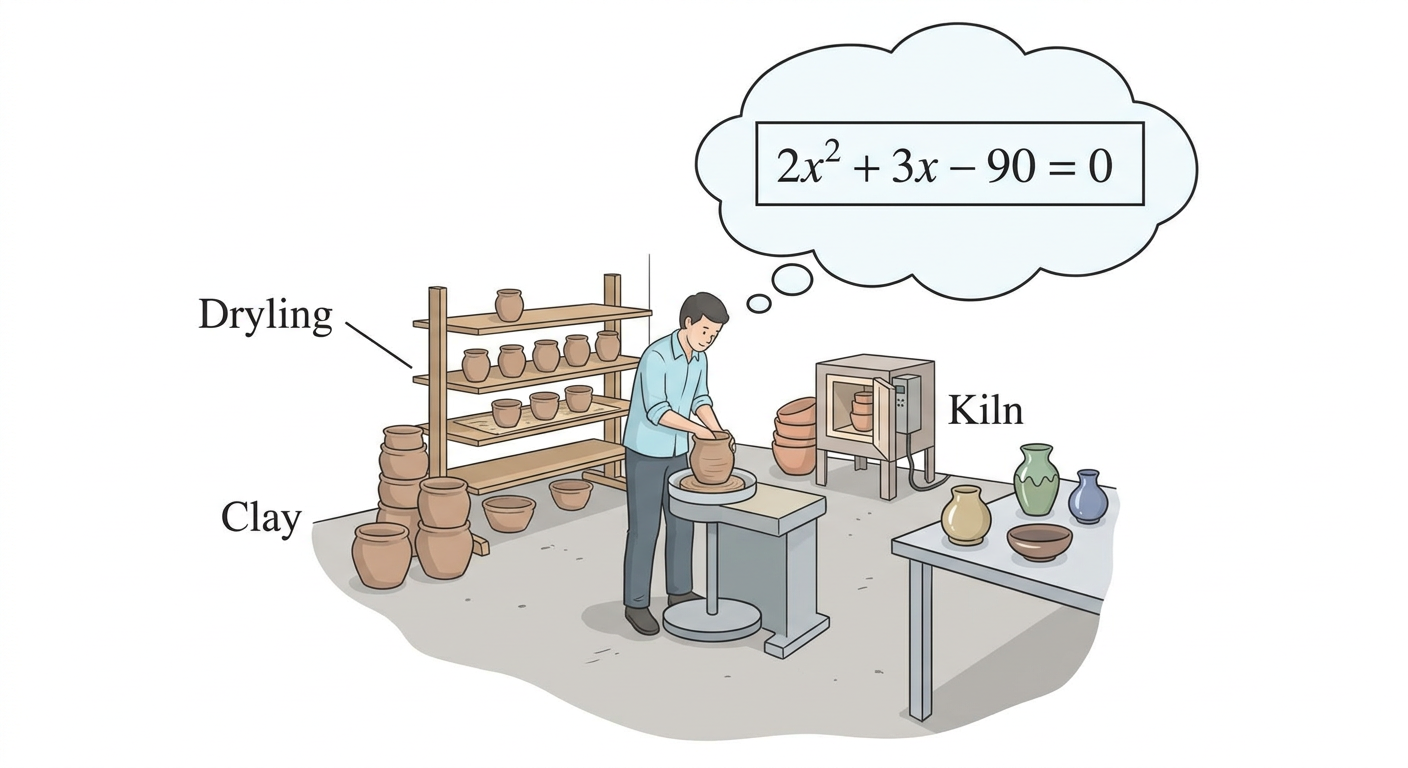
Given that the total cost of production is ₹
Step 2 · Solve for the Number of Articles
Solve by factorisation (splitting the middle term using and )
Setting each factor to zero
Since the number of articles cannot be negative, we reject .
Therefore, the number of articles produced is .
Step 3 · Calculate the Cost of Each Article
Substitute into the cost expression
So, the cost of each article is ₹.
Number of articles produced , and the cost of each article
- Sign Error in Cost Setup: Writing the cost as instead of .
- Not Rejecting Negative Root: Keeping without realizing that physical counts of articles must be positive integers.
- Incomplete Answer: Stopping after finding the number of articles () and forgetting to compute the cost of each article.
More questions in Exercise 4.2
Find the roots of the following quadratic equations by factorisation:
(i)
(ii)
(iii)
(iv)
(v)
Solve the problems given in Example 1.
Find two numbers whose sum is 27 and product is 182.
Find two consecutive positive integers, sum of whose squares is 365.
The altitude of a right triangle is 7 cm less than its base. If the hypotenuse is 13 cm, find the other two sides.
A cottage industry produces a certain number of pottery articles in a day. It was observed on a particular day that the cost of production of each article (in rupees) was 3 more than twice the number of articles produced on that day. If the total cost of production on that day was ₹ 90, find the number of articles produced and the cost of each article.