Question 1
In , right-angled at B, , . Determine :
(i) ,
(ii) ,
- In right triangle with right angle at , we are given and .
- First, find the hypotenuse using the Pythagoras theorem:
- Trigonometric ratios depend on which acute angle is being referenced:
- For , and .
- For , and .
(i) Determine ,
Step 1 · Find Hypotenuse AC
In right , right-angled at :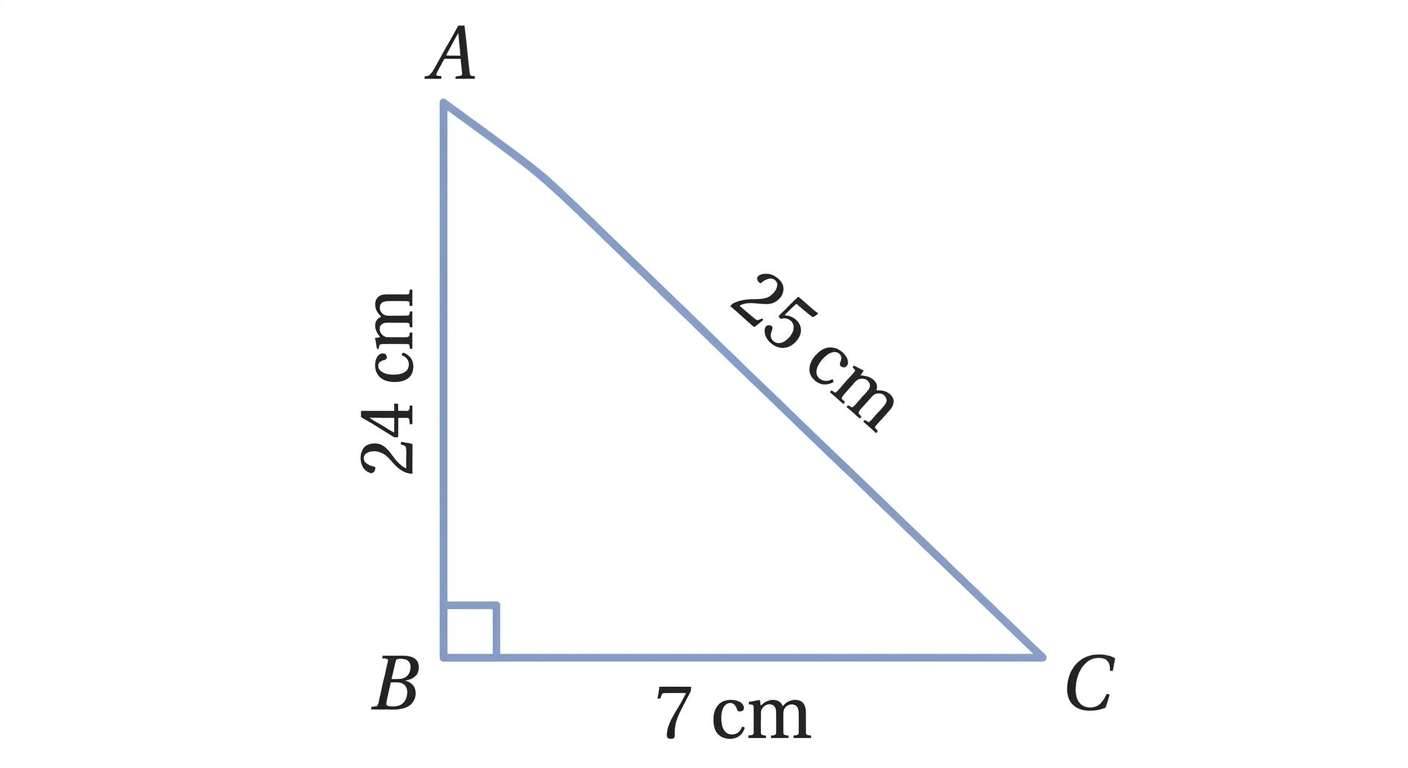
By Pythagoras theorem
Step 2 · Calculate and
For angle :
(i) ,
(ii) Determine ,
Step 1 · Calculate and
For angle :
(ii) ,
- Switching Opposite and Adjacent Sides: The opposite and adjacent sides depend on the angle considered. For , the opposite side is , whereas for , the opposite side is .
- Hypotenuse Identification: The hypotenuse is always the side opposite the angle (here, ), and it remains fixed regardless of whether finding ratios for or .
More questions in Exercise 8.1
In , right-angled at B, , . Determine :
(i) ,
(ii) ,
In Fig. 8.13, find .
If , calculate and .
Given , find and .
Given , calculate all other trigonometric ratios.
If and are acute angles such that , then show that .
If , evaluate :
(i)
(ii)
If , check whether or not.
In triangle ABC, right-angled at B, if , find the value of:
(i)
(ii)
In , right-angled at Q, and . Determine the values of , and .
State whether the following are true or false. Justify your answer.
(i) The value of is always less than 1.
(ii) for some value of angle A.
(iii) is the abbreviation used for the cosecant of angle A.
(iv) is the product of and .
(v) for some angle .