Introduction to Trigonometry | Exercise 8.1

Question 6

If A\angle A and B\angle B are acute angles such that cosA=cosB\cos A = \cos B, then show that A=B\angle A = \angle B.

Check your answer with HomiSolve it yourself, then let Homi check your steps and spot mistakes.
Solution

Acute Angle: An angle strictly between 0° and 90°. In a right-angled triangle, both non-right angles are acute.

Right-Angled Triangle: A triangle with one 90° angle. For any acute angle in it:

cosθ=AdjacentHypotenuse\cos\theta = \frac{\text{Adjacent}}{\text{Hypotenuse}}

Key idea: If cosA=cosB\cos A = \cos B, the ratios of adjacent to hypotenuse are equal in both triangles. This means the triangles are proportional — and by SSS similarity, corresponding angles must be equal, giving A=B\angle A = \angle B.

SSS Similarity: If all three pairs of corresponding sides of two triangles are proportional, the triangles are similar and their corresponding angles are equal.

We will use two right-angled triangles to show the equality of angles.

Step 1 — Constructing Right Triangles

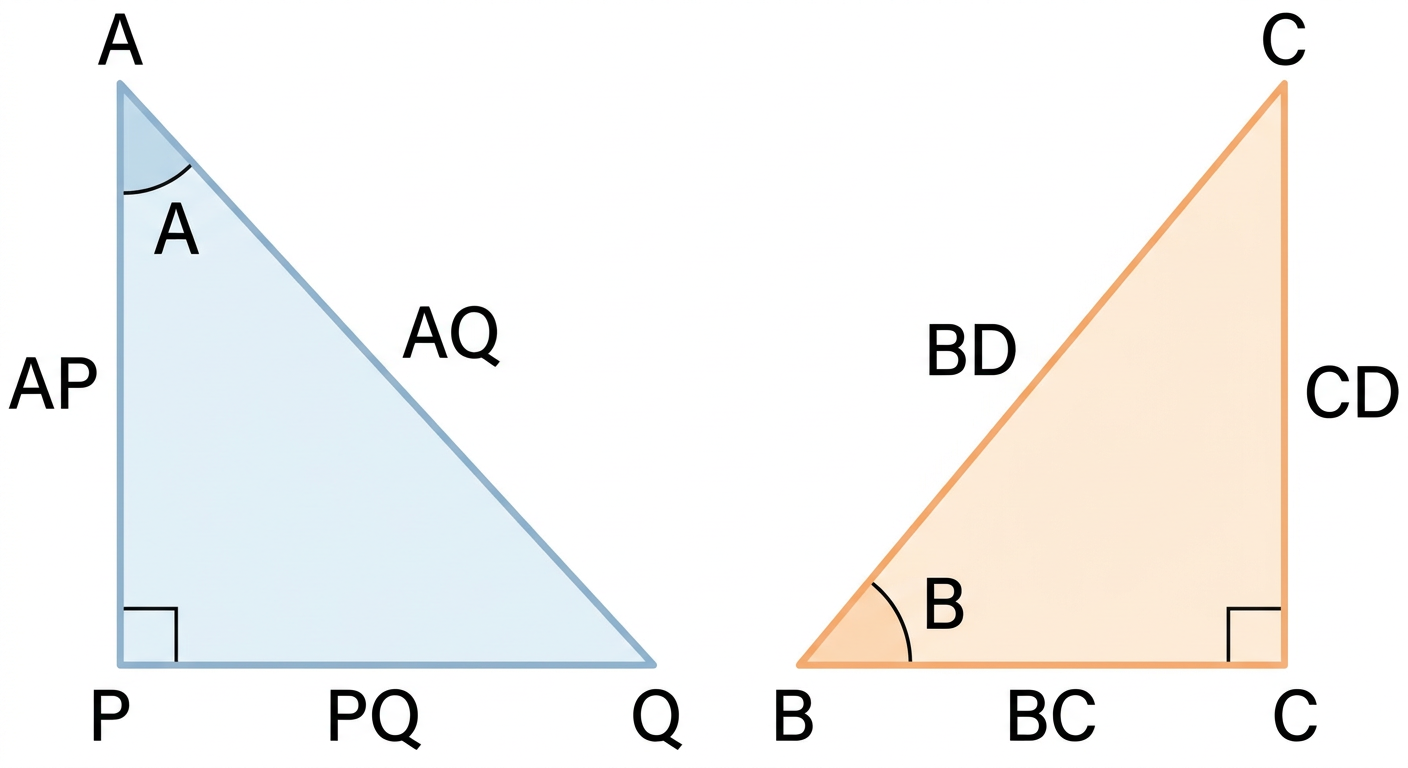
Let's consider two right-angled triangles. Let APQ\triangle APQ be right-angled at PP. Let A\angle A be one of its acute angles. Let BCD\triangle BCD be right-angled at CC. Let B\angle B be one of its acute angles.

Diagram 1

Step 2 — Relating Sides using Cosine

We know the definition of cosine in a right triangle. cosA=Adjacent sideHypotenuse=APAQ\cos A = \frac{\text{Adjacent side}}{\text{Hypotenuse}} = \frac{AP}{AQ}

cosB=Adjacent sideHypotenuse=BCBD\cos B = \frac{\text{Adjacent side}}{\text{Hypotenuse}} = \frac{BC}{BD}

We are given that cosA=cosB\cos A = \cos B. So, we can write: APAQ=BCBD\frac{AP}{AQ} = \frac{BC}{BD}

Let's rearrange this proportion. APBC=AQBD\frac{AP}{BC} = \frac{AQ}{BD}

Let this common ratio be k\mathbf{k}. APBC=AQBD=k\frac{AP}{BC} = \frac{AQ}{BD} = k

From this, we get: AP=kBCAP = k \cdot BC AQ=kBDAQ = k \cdot BD

Step 3 — Proving Triangle Similarity

Now, let's find the third side of each triangle using the Pythagorean theorem. In APQ\triangle APQ: PQ=AQ2AP2PQ = \sqrt{AQ^2 - AP^2}

In BCD\triangle BCD: CD=BD2BC2CD = \sqrt{BD^2 - BC^2}

Let's find the ratio of these third sides. PQCD=AQ2AP2BD2BC2\frac{PQ}{CD} = \frac{\sqrt{AQ^2 - AP^2}}{\sqrt{BD^2 - BC^2}}

Substitute the expressions for AQAQ and APAP in terms of kk. PQCD=(kBD)2(kBC)2BD2BC2\frac{PQ}{CD} = \frac{\sqrt{(k \cdot BD)^2 - (k \cdot BC)^2}}{\sqrt{BD^2 - BC^2}}

=k2BD2k2BC2BD2BC2= \frac{\sqrt{k^2 \cdot BD^2 - k^2 \cdot BC^2}}{\sqrt{BD^2 - BC^2}}

=k2(BD2BC2)BD2BC2= \frac{\sqrt{k^2 (BD^2 - BC^2)}}{\sqrt{BD^2 - BC^2}}

=kBD2BC2BD2BC2= \frac{k \sqrt{BD^2 - BC^2}}{\sqrt{BD^2 - BC^2}}

=k= k

So, we have established that: APBC=AQBD=PQCD=k\frac{AP}{BC} = \frac{AQ}{BD} = \frac{PQ}{CD} = k

This means that the corresponding sides of APQ\triangle APQ and BCD\triangle BCD are proportional. Therefore, APQBCD\triangle APQ \sim \triangle BCD by the SSS (Side-Side-Side) similarity criterion.

Step 4 — Concluding Equality of Angles

Since the two triangles APQ\triangle APQ and BCD\triangle BCD are similar, their corresponding angles must be equal. The angle corresponding to A\angle A in APQ\triangle APQ is B\angle B in BCD\triangle BCD. Hence, we can conclude that:

A=B\boxed{\angle A = \angle B}

More questions in Exercise 8.1

Q1

In ΔABC\Delta \text{ABC}, right-angled at B, AB=24 cm\text{AB} = 24\text{ cm}, BC=7 cm\text{BC} = 7\text{ cm}. Determine :

(i) sinA\sin A, cosA\cos A (ii) sinC\sin C, cosC\cos C

Q2

In Fig. 8.13, find tanPcotR\tan P - \cot R.

Q3

If sinA=34\sin A = \frac{3}{4}, calculate cosA\cos A and tanA\tan A.

Q4

Given 15cotA=815 \cot A = 8, find sinA\sin A and secA\sec A.

Q5

Given secθ=1312\sec \theta = \frac{13}{12}, calculate all other trigonometric ratios.

Q6

If A\angle A and B\angle B are acute angles such that cosA=cosB\cos A = \cos B, then show that A=B\angle A = \angle B.

Q7

If cotθ=78\cot \theta = \frac{7}{8}, evaluate :

(i) (1+sinθ)(1sinθ)(1+cosθ)(1cosθ)\frac{(1 + \sin \theta)(1 - \sin \theta)}{(1 + \cos \theta)(1 - \cos \theta)} (ii) cot2θ\cot^2 \theta

Q8

If 3cotA=43 \cot A = 4, check whether 1tan2A1+tan2A=cos2Asin2A\frac{1 - \tan^2 A}{1 + \tan^2 A} = \cos^2 A - \sin^2 A or not.

Q9

In triangle ABC, right-angled at B, if tanA=13\tan A = \frac{1}{\sqrt{3}}, find the value of:

(i) sinAcosC+cosAsinC\sin A \cos C + \cos A \sin C

(ii) cosAcosCsinAsinC\cos A \cos C - \sin A \sin C

Q10

In ΔPQR\Delta \text{PQR}, right-angled at Q, PR+QR=25 cm\text{PR} + \text{QR} = 25\text{ cm} and PQ=5 cm\text{PQ} = 5\text{ cm}. Determine the values of sinP\sin P, cosP\cos P and tanP\tan P.

Q11

State whether the following are true or false. Justify your answer.

(i) The value of tanA\tan A is always less than 1.

(ii) secA=125\sec A = \frac{12}{5} for some value of angle A.

(iii) cosA\cos A is the abbreviation used for the cosecant of angle A.

(iv) cotA\cot A is the product of cot\cot and AA.

(v) sinθ=43\sin \theta = \frac{4}{3} for some angle θ\theta.

← Back to Introduction to Trigonometry