Introduction to Trigonometry | Exercise 8.1

Question 5

Given secθ=1312\sec \theta = \dfrac{13}{12}, calculate all other trigonometric ratios.

Check your answer with HomiSolve it yourself, then let Homi check your steps and spot mistakes.
Solution
Understand the Question
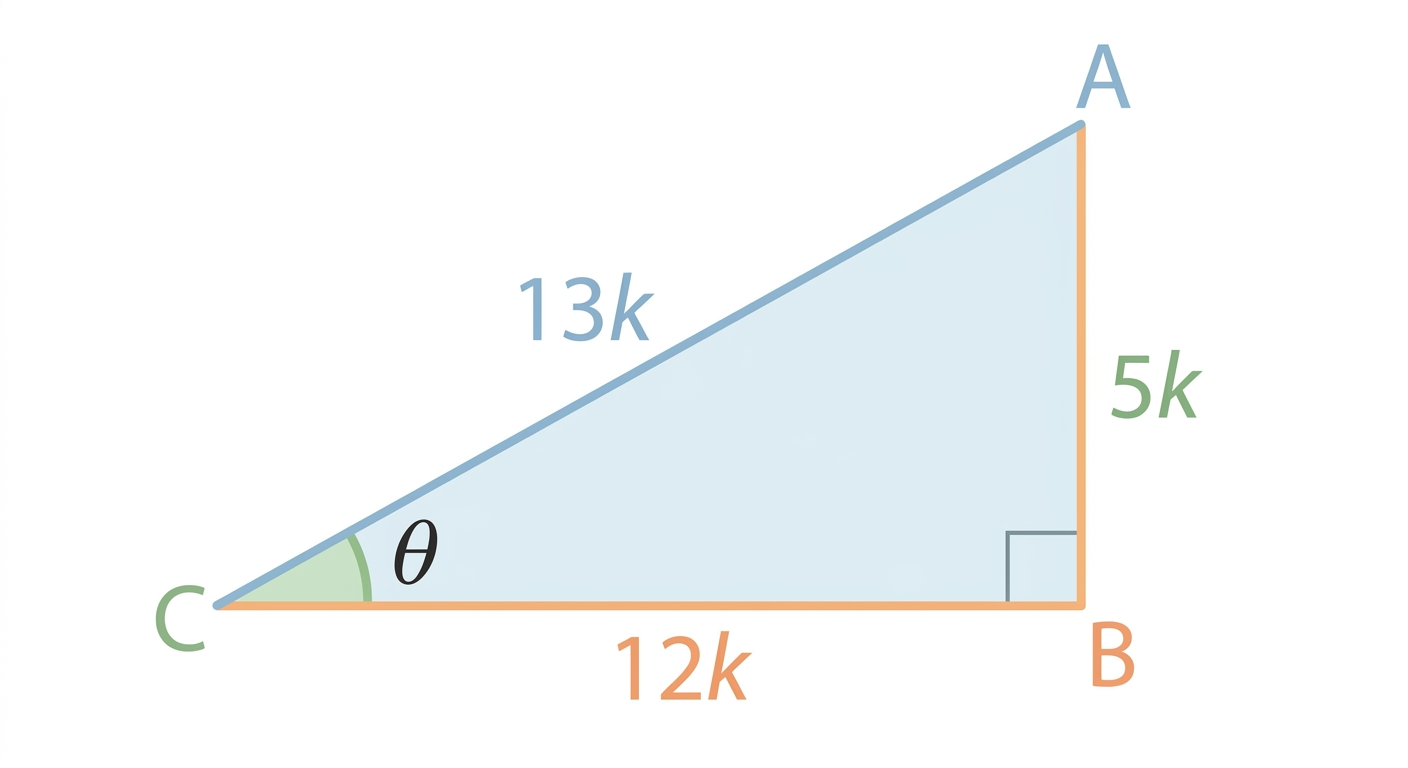
  • Given secθ=1312=HypotenuseAdjacent\sec \theta = \dfrac{13}{12} = \dfrac{\text{Hypotenuse}}{\text{Adjacent}}, let Hypotenuse=13k\text{Hypotenuse} = 13k and Adjacent=12k\text{Adjacent} = 12k, where kk is a positive constant.
  • Use the Pythagoras theorem to calculate the length of the opposite side.
  • Use the side lengths to determine the remaining five trigonometric ratios: sinθ\sin \theta, cosθ\cos \theta, tanθ\tan \theta, cscθ\csc \theta, and cotθ\cot \theta.

Step 1 · Find the Opposite Side

Consider right-angled triangle ABC\text{ABC} with B=90\angle \text{B} = 90^\circ and A=θ\angle \text{A} = \theta.Diagram 1

Given secθ=HypotenuseAdjacent side=ACAB=1312\sec \theta = \dfrac{\text{Hypotenuse}}{\text{Adjacent side}} = \dfrac{\text{AC}}{\text{AB}} = \dfrac{13}{12}

Let AC=13k\text{AC} = 13k and AB=12k\text{AB} = 12k for some positive number kk.

By Pythagoras theorem in ΔABC\Delta \text{ABC}

AC2=AB2+BC2(13k)2=(12k)2+BC2169k2=144k2+BC2BC2=169k2144k2BC2=25k2BC=25k2=5k\begin{aligned} \text{AC}^2 &= \text{AB}^2 + \text{BC}^2 \\ (13k)^2 &= (12k)^2 + \text{BC}^2 \\ 169k^2 &= 144k^2 + \text{BC}^2 \\ \text{BC}^2 &= 169k^2 - 144k^2 \\ \text{BC}^2 &= 25k^2 \\ \text{BC} &= \sqrt{25k^2} = 5k \end{aligned}

Step 2 · Calculate Other Trigonometric Ratios

Using the side lengths: Opposite=BC=5k\text{Opposite} = \text{BC} = 5k, Adjacent=AB=12k\text{Adjacent} = \text{AB} = 12k, and Hypotenuse=AC=13k\text{Hypotenuse} = \text{AC} = 13k

sinθ=OppositeHypotenuse=BCAC=5k13k=513\sin \theta = \dfrac{\text{Opposite}}{\text{Hypotenuse}} = \dfrac{\text{BC}}{\text{AC}} = \dfrac{5k}{13k} = \dfrac{5}{13}

cosθ=AdjacentHypotenuse=ABAC=12k13k=1213\cos \theta = \dfrac{\text{Adjacent}}{\text{Hypotenuse}} = \dfrac{\text{AB}}{\text{AC}} = \dfrac{12k}{13k} = \dfrac{12}{13}

tanθ=OppositeAdjacent=BCAB=5k12k=512\tan \theta = \dfrac{\text{Opposite}}{\text{Adjacent}} = \dfrac{\text{BC}}{\text{AB}} = \dfrac{5k}{12k} = \dfrac{5}{12}

cscθ=HypotenuseOpposite=ACBC=13k5k=135\csc \theta = \dfrac{\text{Hypotenuse}}{\text{Opposite}} = \dfrac{\text{AC}}{\text{BC}} = \dfrac{13k}{5k} = \dfrac{13}{5}

cotθ=AdjacentOpposite=ABBC=12k5k=125\cot \theta = \dfrac{\text{Adjacent}}{\text{Opposite}} = \dfrac{\text{AB}}{\text{BC}} = \dfrac{12k}{5k} = \dfrac{12}{5}

Answer

sinθ=513,cosθ=1213,tanθ=512,cscθ=135,cotθ=125\sin \theta = \dfrac{5}{13}, \quad \cos \theta = \dfrac{12}{13}, \quad \tan \theta = \dfrac{5}{12}, \quad \csc \theta = \dfrac{13}{5}, \quad \cot \theta = \dfrac{12}{5}

Common Mistakes
  • Swapping Opposite and Adjacent Sides: Ensure side AB\text{AB} is adjacent to angle θ\theta and BC\text{BC} is opposite to angle θ\theta.
  • Reciprocal Shortcut: Notice that cosθ=1secθ=1213\cos \theta = \dfrac{1}{\sec \theta} = \dfrac{12}{13} can be written directly without finding the third side first.

More questions in Exercise 8.1

Q1

In ΔABC\Delta \text{ABC}, right-angled at B, AB=24 cm\text{AB} = 24\text{ cm}, BC=7 cm\text{BC} = 7\text{ cm}. Determine :

(i) sinA\sin A, cosA\cos A

(ii) sinC\sin C, cosC\cos C

Q2

In Fig. 8.13, find tanPcotR\tan P - \cot R.

Q3

If sinA=34\sin A = \dfrac{3}{4}, calculate cosA\cos A and tanA\tan A.

Q4

Given 15cotA=815 \cot A = 8, find sinA\sin A and secA\sec A.

Q5

Given secθ=1312\sec \theta = \dfrac{13}{12}, calculate all other trigonometric ratios.

Q6

If A\angle A and B\angle B are acute angles such that cosA=cosB\cos A = \cos B, then show that A=B\angle A = \angle B.

Q7

If cotθ=78\cot \theta = \dfrac{7}{8}, evaluate :

(i) (1+sinθ)(1sinθ)(1+cosθ)(1cosθ)\dfrac{(1 + \sin \theta)(1 - \sin \theta)}{(1 + \cos \theta)(1 - \cos \theta)}

(ii) cot2θ\cot^2 \theta

Q8

If 3cotA=43 \cot A = 4, check whether 1tan2A1+tan2A=cos2Asin2A\dfrac{1 - \tan^2 A}{1 + \tan^2 A} = \cos^2 A - \sin^2 A or not.

Q9

In triangle ABC, right-angled at B, if tanA=13\tan A = \dfrac{1}{\sqrt{3}}, find the value of:

(i) sinAcosC+cosAsinC\sin A \cos C + \cos A \sin C

(ii) cosAcosCsinAsinC\cos A \cos C - \sin A \sin C

Q10

In ΔPQR\Delta \text{PQR}, right-angled at Q, PR+QR=25 cm\text{PR} + \text{QR} = 25\text{ cm} and PQ=5 cm\text{PQ} = 5\text{ cm}. Determine the values of sinP\sin P, cosP\cos P and tanP\tan P.

Q11

State whether the following are true or false. Justify your answer.

(i) The value of tanA\tan A is always less than 1.

(ii) secA=125\sec A = \dfrac{12}{5} for some value of angle A.

(iii) cosA\cos A is the abbreviation used for the cosecant of angle A.

(iv) cotA\cot A is the product of cot\cot and AA.

(v) sinθ=43\sin \theta = \dfrac{4}{3} for some angle θ\theta.

← Back to Introduction to Trigonometry