Question 3
If , calculate and .
Right-Angled Triangle: A triangle with one angle equal to 90°. For any angle A in a right-angled triangle:
- Opposite — the side facing angle A
- Adjacent — the side next to angle A (not the hypotenuse)
- Hypotenuse — the longest side, opposite the 90° angle
The trig ratios are defined as:
Pythagoras Theorem:
Since , we take opposite and hypotenuse , then find adjacent using Pythagoras.
We will use a right-angled triangle and the Pythagoras theorem.
Step 1 — Find the missing side
Let's draw a right-angled triangle. We know that . Given . So, the opposite side is . The hypotenuse is . Let's use the Pythagoras theorem. The square of the hypotenuse equals the sum of the squares of the other two sides. Let the triangle be ABC, right-angled at B. Then BC is the opposite side to angle A. AC is the hypotenuse. AB is the adjacent side.
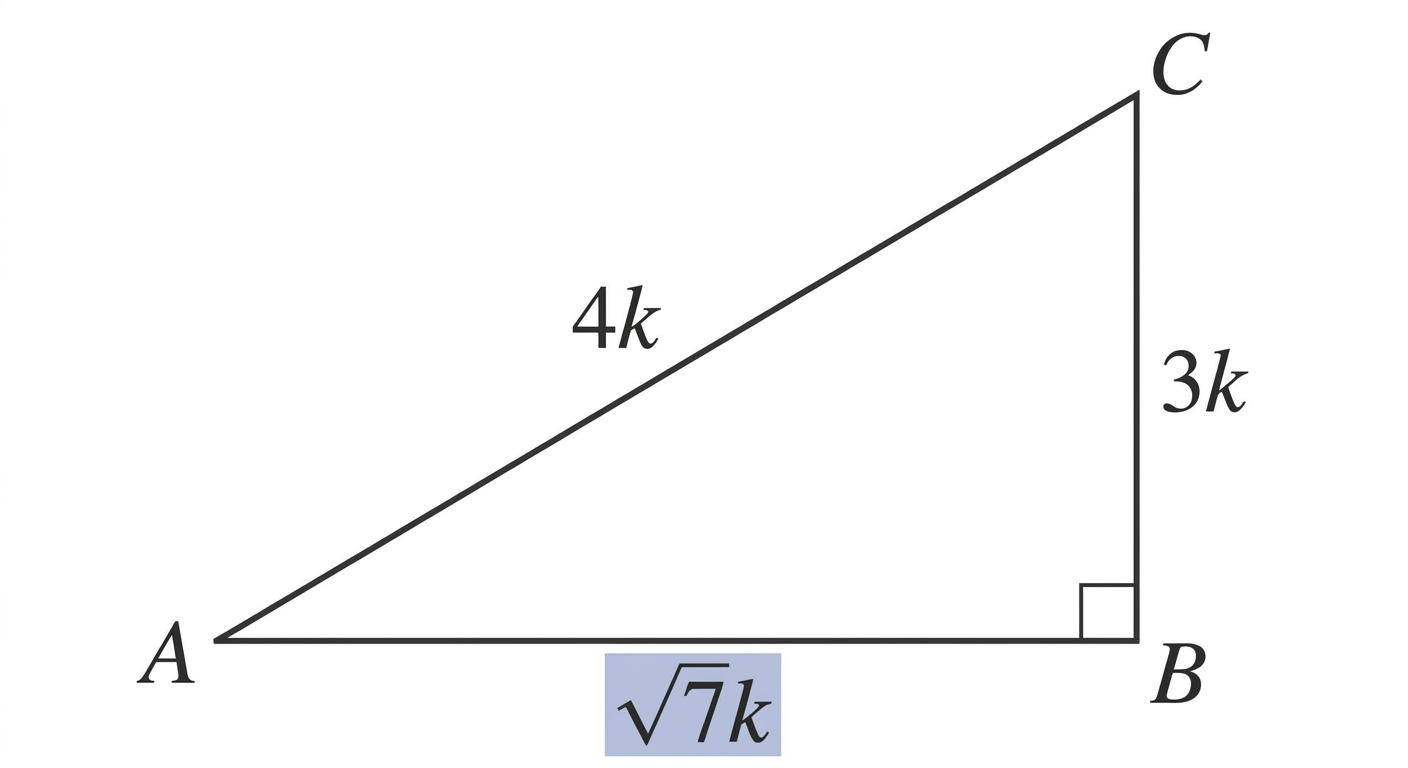
Step 2 — Calculate cos A
We know that . Let's substitute the side lengths we found.
Step 3 — Calculate tan A
We know that . Let's substitute the side lengths we found.
Answer
(i) (ii)
More questions in Exercise 8.1
In , right-angled at B, , . Determine :
(i) , (ii) ,
In Fig. 8.13, find .
If , calculate and .
Given , find and .
Given , calculate all other trigonometric ratios.
If and are acute angles such that , then show that .
If , evaluate :
(i) (ii)
If , check whether or not.
In triangle ABC, right-angled at B, if , find the value of:
(i)
(ii)
In , right-angled at Q, and . Determine the values of , and .
State whether the following are true or false. Justify your answer.
(i) The value of is always less than 1.
(ii) for some value of angle A.
(iii) is the abbreviation used for the cosecant of angle A.
(iv) is the product of and .
(v) for some angle .